.png)


The question of whether to move to a cloud-based SaaS ERP or maintain an on-premise system is no longer purely a technology decision for UK housing associations. It has become a strategic one, shaped by regulatory pressure, financial sustainability, workforce expectations, and the pace at which the sector is being asked to change.
Civica's 2026 digital transformation report for housing stated plainly that by 2026, no housing association system should remain outside the cloud or outside an active migration plan. The reality, as the same report acknowledged, is that many social housing organisations are still running core finance and operational systems on deeply embedded on-premise infrastructure. This article sets out the core differences between SaaS and on-premise ERP deployment models, examines the specific considerations for UK social housing, and helps decision-makers build a clear-eyed view of what each model actually costs and delivers.
Understanding the Two Models
On-Premise ERP
An on-premise ERP is installed and run on servers within the organisation's own physical infrastructure. The organisation owns the software licence outright and is responsible for all hardware, security, maintenance, upgrades, and disaster recovery. IT staff manage the environment directly, and changes to the system require internal resource or external consultancy. Major version upgrades are discrete projects, typically costly and disruptive, and occur every several years.
SaaS ERP
A SaaS ERP is hosted and managed by the vendor on cloud infrastructure and accessed through a web browser. The organisation pays a recurring subscription fee that covers the software, hosting, security patching, and continuous updates. The vendor handles infrastructure management, compliance with cloud security standards, and quarterly feature releases. There is no hardware to maintain and no upgrade project to plan.
At a surface level, on-premise looks cheaper because you are buying a perpetual licence rather than paying indefinitely. In practice, the total cost picture is significantly more complex, and for most housing organisations, materially more expensive.
The Real Cost Comparison
On-premise ERP annual maintenance fees alone typically run at 18 to 22 percent of the original licence value, every year. On top of that, organisations carry the cost of server infrastructure, internal IT staffing to manage the environment, hardware refresh cycles, disaster recovery provision, and the periodic major upgrade projects that are unavoidable on a perpetual licence platform.
Industry analysis consistently shows that cloud ERP delivers 30 to 50 percent lower total cost of ownership over a five-year period compared to on-premise alternatives, primarily by eliminating hardware costs, reducing IT staffing requirements, and removing expensive upgrade cycles. Over a ten-year horizon, the divergence is even wider.
The hidden costs that skew on-premise comparisons include customisation debt, where bespoke code built to meet operational needs must be re-tested and re-validated with every major upgrade; shadow IT costs, where teams build spreadsheet workarounds because the system cannot meet their needs; and the cost of delayed upgrades, where organisations defer major version changes because of the disruption involved and end up running unsupported software.
At-a-Glance Comparison
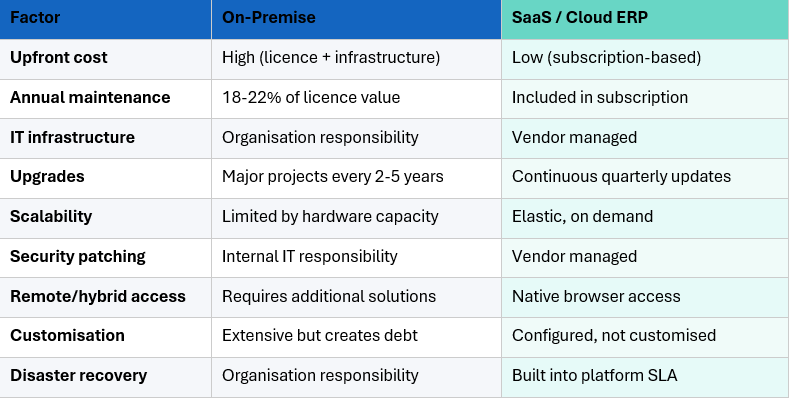
Why the Housing Sector Has Specific Considerations
Housing associations are not generic commercial enterprises. Several factors make the SaaS versus on-premise decision particularly consequential for this sector.
Regulatory Environment and Compliance Currency
The Regulator of Social Housing has strengthened its oversight framework significantly in recent years. Awaab's Law, which came into force in October 2025, introduced legally binding timescales for investigating and resolving hazards in social housing properties, with requirements expanding in 2026 to cover a broader range of hazards. The Social Housing (Regulation) Act 2023 has raised the bar for transparency and accountability across the sector. Meeting these obligations requires systems that are current, integrated, and capable of producing the audit trail that regulators increasingly expect.
On-premise ERP platforms that are running on delayed upgrade cycles or unsupported versions cannot guarantee the compliance currency that this regulatory environment demands. SaaS platforms deliver legislative and compliance updates as part of the standard quarterly release cycle, with no project overhead required from the organisation.
Multi-Entity Group Structures
Many housing associations operate as group structures, managing several legal entities with different operational profiles. The trend toward entity consolidation, reducing the number of subsidiary companies within a group over a defined timescale, creates a specific technology challenge: the finance system must be able to handle the current multi-entity structure while also being configured to adapt as consolidation progresses. SaaS platforms built on a configurable multi-entity architecture handle this far more gracefully than on-premise systems, where entity changes typically require bespoke development work.
IT Capacity and In-House Expertise
Housing associations are not technology companies. Their IT teams are typically sized to support operations, not to manage enterprise infrastructure or lead complex upgrade projects. Running an on-premise ERP places ongoing demands on internal IT capacity that many housing organisations are not resourced to meet comfortably. SaaS fundamentally shifts this burden to the vendor. Internal IT teams are freed from infrastructure management and can focus on supporting users, managing integrations, and delivering improvement projects.
Data Sovereignty and UK GDPR
A legitimate concern raised by housing organisations evaluating SaaS platforms is data sovereignty. All major enterprise SaaS ERP vendors, including Oracle, operate UK data centre regions that provide UK data residency. The Data (Use and Access) Act 2025 also introduced new requirements for cloud and SaaS providers, including obligations around data portability and contract termination, strengthening the position of organisations that wish to move between platforms. For housing associations processing sensitive tenant and employee data, selecting a SaaS vendor with UK data residency and a clear contractual commitment to data governance is a requirement, not a preference, and the leading enterprise platforms now meet this standard.
Workforce Accessibility
Housing associations employ operationally diverse workforces: office-based finance and HR staff, field-based maintenance and housing officers, and community-facing support teams. On-premise systems were built for desktop access in a fixed office environment. SaaS ERP platforms provide native browser-based access from any device, supporting the hybrid and mobile working patterns that housing organisations now rely on. Self-service access to payslips, leave requests, and HR records reduces the administrative burden on HR teams and improves the employee experience across a dispersed workforce.
The Case for Staying On-Premise: Is There One?
There are scenarios where maintaining an on-premise system can be justified in the short term. Organisations that have recently completed a major on-premise upgrade and are within the vendor's supported lifecycle may reasonably defer migration until the current investment matures. Organisations with highly customised legacy environments may need to invest in process standardisation and data cleansing before they are ready to migrate. And organisations facing severe capital constraints may need to phase their approach, beginning with SaaS for new functional areas while maintaining legacy systems for core transactional processing during a transition period.
What is not defensible is the position of maintaining on-premise ERP indefinitely because the status quo feels comfortable. The costs of inaction compound. Security vulnerabilities accumulate. Compliance gaps widen. And when the decision to migrate is eventually forced by end-of-support deadlines or a critical system failure, the options and the timeline become far less favourable.
What a Phased Migration Looks Like
Most housing associations do not migrate their entire ERP estate in a single programme. A phased approach is both pragmatic and sensible, particularly for organisations with complex multi-entity structures or heavily customised legacy environments. A typical sequencing for housing organisations migrating to Oracle Fusion Cloud includes:
- Phase 1: Finance and Procurement, establishing the cloud general ledger, accounts payable and receivable, and purchasing as the new system of record for financial data
- Phase 2: HCM and Payroll, migrating employee records, payroll processing, and pension scheme administration onto the unified cloud platform
- Phase 3: Reporting and Analytics, decommissioning legacy reporting tools and transitioning to Oracle Fusion's real-time analytics and regulatory reporting capability
- Phase 4: Integration optimisation, replacing point-to-point legacy integrations with structured API-based connections to housing management systems and other operational platforms
Budgets are a genuine constraint for many housing associations. A phased approach allows organisations to demonstrate early ROI from the first phase before committing to subsequent investments, and to spread capital and change management demands over a manageable timeline.
The Decision Framework
For UK housing associations evaluating their ERP deployment model, the question is not whether SaaS will eventually replace their on-premise systems. That outcome is close to certain. The question is whether to migrate proactively, on the organisation's own terms and timeline, or reactively, under pressure from a vendor end-of-support deadline or a system failure.
Proactive migration gives the organisation control over timing, implementation quality, and the ability to select an experienced implementation partner. It allows finance and IT leaders to manage the change programme properly, prepare data thoroughly, and design integrations that will serve the organisation well for the next decade. Reactive migration does none of those things.
The housing organisations that will be best positioned for the regulatory, financial, and operational demands of the coming years are those that move their core systems to modern cloud platforms now, while the window for a well-managed transition remains open.
VE3: Oracle Fusion Cloud ERP for Social Housing
VE3 is an enterprise AI, data, and digital transformation consultancy supporting UK housing associations through ERP assessment, migration planning, and Oracle Fusion Cloud implementation. We work with housing providers to build the business case, manage the migration, and deliver the outcomes that make the investment worthwhile. To discuss your ERP strategy, visit ve3.global.

.png)
.png)


