.png)
A secure, scalable, and fully governed operating model — combining our purpose-built platform, multidisciplinary people, proven best practices, and repeatable processes — that takes complex public-sector digital products from discovery to live operation with the rigour Government demands and the pace modern users expect.

Falcon is VE3’s purpose-built digital delivery operating model. It brings together the Falcon Platform (technology architecture), the right people in structured roles, engineering governance, release management, best practices, and live-service operations — everything needed to design, build, and run complex data-driven services under public-sector assurance requirements.
Falcon is not a product you install. It is a complete operating model that integrates product leadership, architecture, engineering, quality assurance, User-Centred Design, User Research, DevOps, business analysis, programme management, and live service support into one coherent, repeatable delivery engine.
Government digital services demand more than good code. They require traceable release management, separation of duties, environment-controlled promotion, incident readiness, and full alignment with frameworks such as the GDS Service Standard. Falcon was engineered from the ground up as an operating model that meets these requirements natively — not as afterthoughts — by combining people, platform, and proven ways of working.
Government delivery fails not because teams lack talent, but because they lack coherence. Separate workstreams, disconnected governance, and unclear decision rights mean that design, engineering, and operations pull in different directions at the worst possible moments.
Falcon removes that problem by design. Every specialist - frontend engineers, backend engineers, DevOps, QA, UX designers, user researchers, business analysts, and programme managers - operates inside a single, unified governance structure from day one. There is one delivery cadence, one set of escalation paths, and one set of decision rights. Everyone knows who owns what, who approves what, and who the client speaks to.
This is not a matrix of separate contracts or blended teams. It is an integrated operating model in which all disciplines are accountable to each other, to the programme, and to the client, not to separate reporting lines that diverge under pressure.

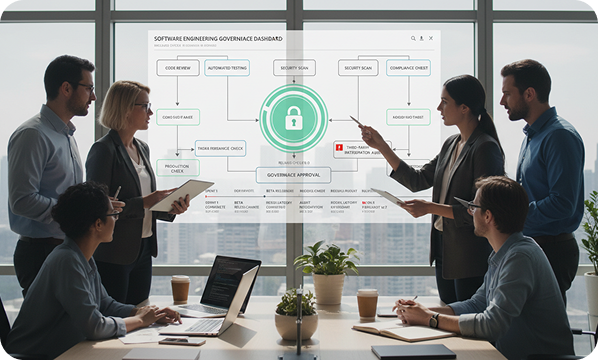
In government digital services, a bad release is not just a technical problem - it is a public trust problem. Code that reaches citizens must be correct, secure, and authorised. Every change must be traceable. Every deployment must be deliberate.
Falcon’s engineering governance model is built around this principle. Every line of code flows through a structured, multi-stage pipeline before it reaches a production system. Feature branches are created for individual changes, reviewed against pre-dev, promoted to main via peer-reviewed pull requests, and then progressed through controlled release branches into live environments.
This is not bureaucracy for its own sake. It is a system designed to ensure that no untested, unreviewed, or unauthorised change ever reaches the public. The controls are technical, not procedural - they are enforced by the platform, not by instruction.
Technology procurement decisions made today have consequences that last years. A platform that works only on one cloud provider, requires proprietary tooling, or cannot be transitioned without re-engineering is a risk that government programmes cannot afford.
Falcon’s architecture is intentionally cloud-agnostic. The Falcon Platform, the technology backbone of the Operating Model, is built on Kubernetes for container orchestration and Terraform for infrastructure-as-code. This means the entire platform can be deployed on AWS, Azure, GCP, or on-premises infrastructure without modification. The current UK Fuel Finder deployment runs on AWS. A future service could run on Azure or on HMG’s own infrastructure using exactly the same codebase and configuration.
The platform is composed of independently deployable microservices, each with its own repository, ownership, and responsibility. This means individual components can be updated, scaled, or replaced without affecting the rest of the system. It also means the platform can grow incrementally as the service matures, without requiring a full rebuild.


Security in government digital services is not a checkbox. It is a structural requirement that must be embedded into every layer of the delivery model, from how code is written and reviewed, to how infrastructure is configured, to how users authenticate, to how incidents are managed.
Falcon’s security approach is structural, not procedural. Controls are enforced by the platform and the codebase, not by policy documents and manual processes. When admin bypass is disabled on a branch, it cannot be circumvented. When production is locked outside a deployment window, no deployment is possible regardless of who requests it. These are platform-level guarantees, not guidelines.
The operating model aligns with HMG security frameworks, NCSC guidance, and the requirements of GDS Service Standard Point 9. It is designed for the environments in which government services operate - where public trust, data integrity, and regulatory compliance are non-negotiable.
The GDS Service Standard is not an assessment you prepare for at the end of a project. It is a framework that should shape every decision made during delivery, from how user research is conducted, to how the technology is chosen, to how the service is operated after go-live.
Most teams treat GDS alignment as a compliance exercise: they build the service, then map it against the 14 points, then scramble to address gaps. Falcon inverts this entirely. The operating model is designed so that a service delivered through Falcon inherently satisfies the majority of the 14 points as a consequence of how the model works — not as a result of a separate compliance effort.
User research is a standing activity embedded in every sprint, not a phase that ends after discovery. Accessibility is tested continuously, not reviewed at the end. Agile governance is structural, not ceremonial. Open technology choices are the default, not an afterthought. When you arrive at a GDS assessment with Falcon, most of the evidence is already in the delivery artefacts.


Going live is not the end of delivery. For government digital services, the live phase is where the real work begins. A service that launches successfully but degrades within weeks, fails under load, or accumulates unresolved user complaints has not delivered value. It has created ongoing liability.
Falcon is designed for operation from the outset. Live Service Operations is not a separate engagement or an optional add-on, it is a standing function within the operating model, present and active from the moment a service goes live. The same team that built the service operates it. They know the architecture, the codebase, the known issues, and the users.
The Falcon Live Service function covers the full spectrum of operational responsibility: proactive monitoring, reactive incident management, user communications, performance reporting, continuous improvement, and service review. It is the difference between a service that is launched and a service that works.
Falcon is built on a modern, production-proven architecture designed to deliver high reliability, scalability, and security in line with government standards. The platform adopts a modular, service-oriented approach, enabling independent scaling, rapid iteration, and long-term maintainability.

A responsive and accessible interface designed to meet government usability and accessibility standards.

A set of scalable backend services handling business logic, data processing, and integrations.

Workloads are packaged and orchestrated to ensure resilience, portability, and efficient resource utilisation.

Fully automated environment provisioning and configuration to ensure consistency, repeatability, and governance.

Optimised mechanisms for high-speed data access, event processing, and system communication.
The platform integrates seamlessly with government and third-party services, including Gov.UK OneLogin, Gov.UK Notify, OS API, Companies House, and many more. These integrations ensure compliance with public sector standards while enabling secure, real-time interactions across the ecosystem.
.png)
Main public-facing web application
Retailer-facing portal for data submission and API access
Internal support and administration frontend
Central entry point for all external API requests
Core data aggregation engine
Authentication service
OAuth 2.0 service managing API authentication
Transactional messaging service
KPI generation, monitoring, and reporting
Infrastructure-as-code definitions
Rapid prototyping and proof-of-concept environment
Dedicated User Research function and UX team embedded within the delivery structure. User research is a standing activity across all sprint cycles.
Product Lead and Business Analysts ensure end-to-end user journeys. Programme governance enforces whole-problem thinking.

Falcon ensures a consistent, seamless experience for end users across web, email, SMS, mobile (where applicable), and other channels, with uniform GOV.UK branding, messaging, tone, and integrated transactional communications via Gov.UK Notify.

Dedicated UX designers enforce simplicity; GOV.UK Design System patterns used throughout.

Accessibility built to WCAG 2.2, tested across devices and assistive technologies.
Inherently multidisciplinary: Product, Architecture, Engineering, DevOps, QA, UX, User Research, BA, Programme Management, and Live Service Support — all under one governance structure.
Two-week sprints, daily stand-ups, bi-weekly planning, and weekly governance reviews.
Controlled release model and CI/CD pipelines enable frequent, safe deployments.
Security enforced at every layer with separation of duties and auditable infrastructure.

Automated KPI Mapper with CSV exports for transparent reporting.

Open, cloud-agnostic stack with government-approved common components.

All code in GitHub with clear ownership and review processes.

Integrates Gov.UK One Login, Gov.UK Notify, and GOV.UK Design System; built on REST, OAuth 2.0, OpenID Connect.

Dedicated Live Service Operations with L1/L2 support, incident management, and 24/7 monitoring.
UK Fuel Finder has successfully passed its GDS Service Standard assessment, demonstrating that the Falcon Operating Model delivers services that meet government assurance requirements from the outset.
Stay current with the strategies, trends, and technologies defining the next era of digital excellence


.png)









.jpg)