.png)


Artificial Intelligence is evolving. Previously, AI systems answered questions, generated text, or made predictions. Now, the focus is on Agentic AI, which can reason, act, and complete multi-step tasks with minimal human input.
Agentic AI acts as a collaborator rather than just a tool. It investigates anomalies, gathers information, evaluates outcomes, and recommends next steps. This enables automated analysis and proactive decision support for organizations.
However, the success of Agentic AI does not depend only on better models. It depends largely on how well enterprise data is prepared, connected, and understood.
For many organizations, data remains the primary barrier to deploying Agentic AI in real business environments.
The Shift from Analytics to Agentic Intelligence
Traditional analytics systems rely on dashboards, reports, and queries. Humans explore the data, interpret the results, and decide what to do next.
Agentic AI changes this interaction.
Instead of manually exploring data, AI agents can:
- Investigate business changes
- identify patterns across datasets
- generate explanations
- recommend or trigger actions
For example, an AI agent could detect a drop in sales, analyze contributing factors, identify affected segments, and suggest corrective actions.
But to do this effectively, AI must work with data that is consistent, trustworthy, and connected across systems.
Why Data Becomes the Limiting Factor
Most enterprises collect large volumes of data. The challenge is not quantity, but the fragmentation of data environments.
Organizations often run many applications, each with its own data. Over time, this creates complex landscapes with information scattered across platforms.
Common issues include:
1. Data Silos
Business information is often isolated in systems that do not communicate. Customer data may be in a CRM, transaction data in financial systems, and operational data in supply chain tools.
When AI systems try to analyze these datasets independently, they miss the relationships that connect them.
2. Duplicate and Conflicting Records
The same entity may appear multiple times across systems. For example, a supplier might be recorded differently in procurement, logistics, and accounting platforms.
Without mechanisms to reconcile these records, AI systems may interpret them as different entities, leading to inaccurate conclusions.
3. Inconsistent Data Quality
Much enterprise knowledge exists in unstructured formats such as contracts, reports, service logs, and emails. Traditional data systems often cannot easily interpret these documents.
Agentic AI must combine structured and unstructured information to fully understand a problem’s context.
Also Read: Data Quality Tools 2026: The Complete Buyer’s Guide to Trusted Data
What Agentic AI Needs from Data
To operate effectively, Agentic AI requires three essential data capabilities.
1. Unified Data Context
AI agents need a complete view of the entities they analyze. This requires linking related records across systems so AI can understand how information connects.
2. Trusted and Governed Data
Organizations must ensure AI data is accurate, validated, and traceable. Trust is especially important when AI influences operational decisions.
3. Interpretable Relationships
Agentic AI must understand how entities relate. Customers, products, suppliers, transactions, and documents form complex networks that AI must navigate.
Without these foundations, even advanced AI models struggle to generate meaningful insights.
Read More: Agentic Architecture: Building the Foundation for Autonomous AI Systems
Moving from Data Preparation to Data Understanding
Historically, organizations prepared data for analytics by building pipelines to clean datasets and populate dashboards.
In the agentic era, the focus shifts from data preparation to data understanding.
AI systems need more than clean data; they need context.
They must understand:
- which records represent the same entity
- how entities are connected
- where the data originated
- how reliable the information is
This deeper understanding enables AI agents to reason about problems instead of simply computing outputs.
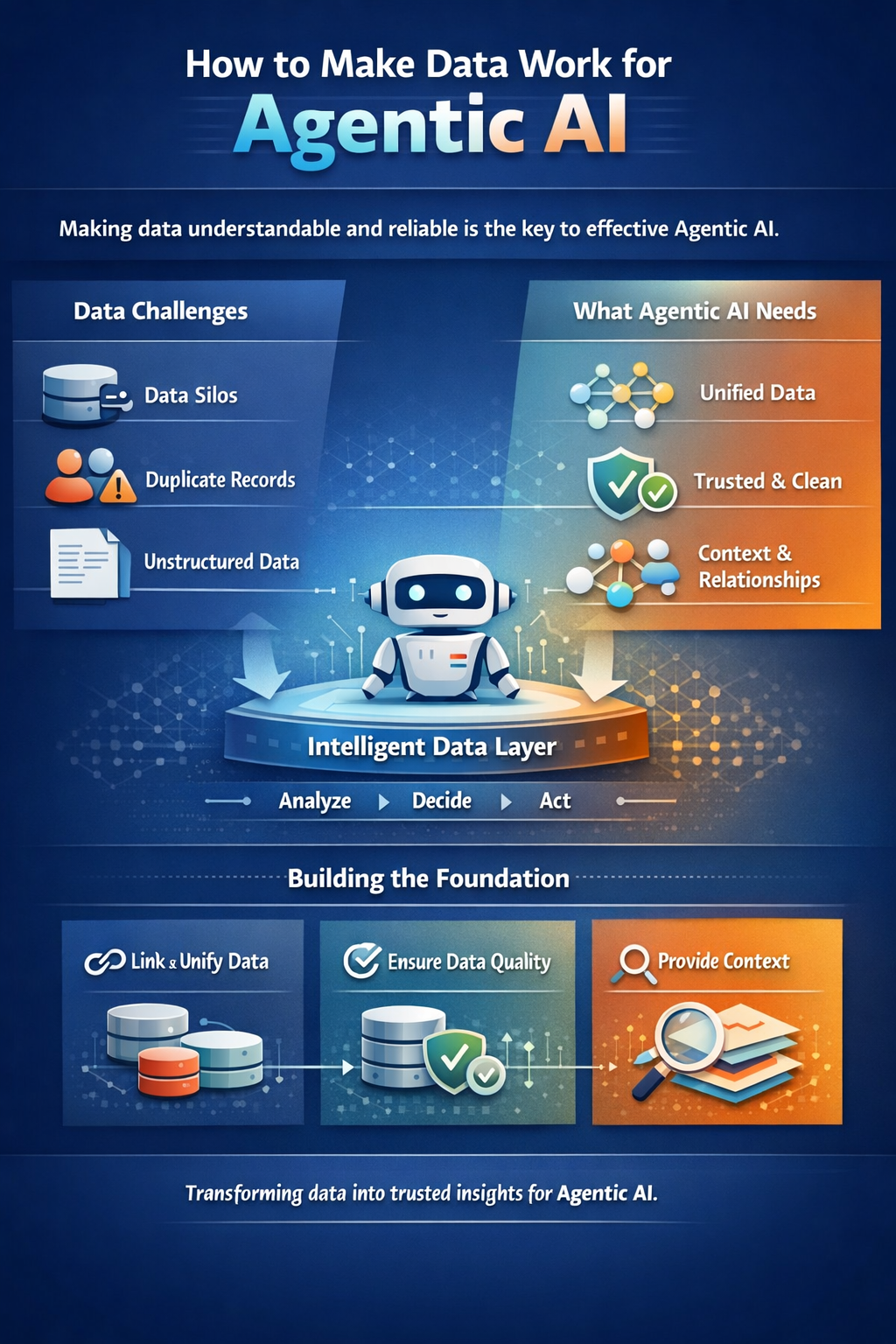
Building Data Foundations for Agentic AI
Organizations that successfully adopt Agentic AI often prioritize several data practices.
1. Linking Fragmented Information
Connecting related datasets across systems gives AI agents a broader perspective, enabling more accurate analysis and decision support.
2. Maintaining Data Trust
Reliable insights require reliable data. Data validation, governance processes, and traceability help ensure that AI outputs can be trusted.
3. Integrating Structured and Unstructured Data
Combining database records with insights extracted from documents and text sources expands the knowledge available to AI systems.
4. Preserving Context
Data must retain the business meaning behind numbers and records. Context helps AI systems interpret patterns correctly.
The Role of an Intelligence Layer
As organizations move toward agentic systems, many are recognizing the need for a layer that sits between enterprise data sources and AI agents.
This layer interprets and organizes data, allowing AI systems to work more effectively. Rather than forcing AI to navigate fragmented datasets, it provides a clearer, more structured foundation.
Such an intelligence layer can unify entities, maintain relationships, and provide trusted context before information reaches AI systems.
The Future of Data and Agentic AI
Agentic AI represents a significant evolution in how organizations interact with data. Instead of relying on manual analysis, businesses will increasingly depend on AI agents to monitor operations, identify risks, and surface opportunities.
However, the effectiveness of these agents depends on the quality and clarity of their data environment.
Organizations that invest in unified, trusted, and contextual data foundations will be best positioned to realize the full value of Agentic AI.
Ultimately, the question is not simply how to build smarter AI models. It is how to ensure that data itself becomes understandable and usable for intelligent systems.
When data is connected, trusted, and interpretable, AI can move beyond automation to deliver meaningful intelligence.

.png)
.png)


