.png)


Most maintenance programmes in UK industry are still built around time. Service an asset every six months. Replace a component every 2,000 operating hours. Inspect a system annually regardless of how it is performing. This approach is orderly and easy to plan, but it has a fundamental flaw: it ignores what the asset is actually telling you.
Condition-based maintenance (CBM) takes a different approach. Instead of scheduling work by the calendar, it uses real-time performance data from sensors and monitoring systems to determine when maintenance is actually needed. Work is done when the evidence says it is time, not when the schedule says it should be.
This distinction has significant financial and operational consequences. CBM eliminates unnecessary maintenance on assets that are performing well. It catches developing failures before they become unplanned breakdowns. And it gives maintenance teams the lead time they need to schedule interventions efficiently rather than responding to emergencies.
How Condition-Based Maintenance Works
CBM relies on three connected components working together: data collection, analysis, and maintenance response.
1. Data Collection
IoT sensors attached to assets continuously capture performance data: vibration, temperature, pressure, acoustic signatures, current draw, and other parameters relevant to the asset type and its known failure modes.
2. Analysis and Detection
AI and machine learning algorithms analyse the incoming data stream in real time. They compare current readings against historical baselines and failure pattern libraries to detect anomalies and model how conditions are developing.
3. Maintenance Response
When the analysis identifies a developing issue, an alert is generated and a maintenance work order is created. The team receives specific information about the asset, the detected condition, and the recommended intervention, with enough lead time to plan the work.
CBM vs Time-Based Preventive Maintenance: The Key Differences
Condition-based maintenance and time-based preventive maintenance are both proactive, in that neither waits for assets to fail before acting. But they operate on fundamentally different logic.
Time-Based: What It Assumes
Assets deteriorate at a predictable rate determined by age or usage cycles. Maintenance performed at regular intervals will prevent failures. Parts are replaced before they reach the end of their useful life.
CBM: What It Knows
Actual deterioration rates vary by operating environment, load, and maintenance history. The same component in two different machines may reach failure at very different points. CBM acts on evidence of what is actually happening, not on statistical averages.
Time-Based: The Hidden Cost
Maintenance is performed on assets that are performing well, consuming labour and parts unnecessarily. Assets deteriorating between inspection cycles may still fail unexpectedly. The inspection itself can introduce new failure risks through reassembly errors.
CBM: The Efficiency Gain
Work is done only when condition data indicates it is needed. Labour and parts are allocated to assets that actually require attention. The maintenance window is planned in advance, not dictated by an emergency.
What Condition-Based Maintenance Requires
Implementing CBM effectively requires more than installing sensors. The following components are all necessary for it to deliver its potential.
- IoT sensor coverage on the assets to be monitored, calibrated to capture the data relevant to each asset's known failure modes
- A data infrastructure capable of ingesting and processing continuous sensor streams without latency that undermines real-time detection
- AI analytics capable of building baseline performance profiles, detecting anomalies, and modelling failure trajectories for each asset type
- Integration between condition monitoring and work order management so that alerts automatically generate planned maintenance responses
- Asset history and failure mode libraries to contextualise sensor data and improve the accuracy of AI-generated condition assessments
- A maintenance team capable of acting on condition alerts, scheduling planned work effectively, and feeding outcomes back into the system
Condition-Based Maintenance in Regulated Industries
One important nuance for UK enterprises in regulated sectors is that CBM does not replace all time-based maintenance. Many regulatory frameworks in energy, water, transport, and facilities management require documented inspections at fixed intervals regardless of asset condition.
In these environments, CBM sits alongside compliance-driven preventive schedules rather than replacing them. The combination is more effective than either approach alone: fixed-interval inspections satisfy regulatory requirements and provide a structured checkpoint, while condition monitoring catches developing issues between those inspection windows.
How IBM Maximo Condition Insight Delivers CBM at Scale
IBM Maximo Application Suite supports condition-based maintenance through Maximo Monitor, which ingests real-time sensor data, and Maximo Health and Predict, which generate asset health scores and failure probability models.
Maximo Condition Insight, released in late 2025, adds an agentic AI layer to this capability. Powered by IBM watsonx, it evaluates work orders, sensor metrics, time-series data, meter readings, failure mode libraries, and alerts together and returns a clear, plain-language explanation of each asset's condition, the trends it is identifying, and the corrective actions it recommends.
Critically, Condition Insight maps its findings to specific failure modes and prescribes maintenance activities aligned to those modes. This moves beyond alerting that something is wrong to explaining what is wrong and what to do about it, removing much of the interpretive burden from maintenance teams and making CBM operationally practical across large, mixed asset portfolios.
Where CBM Delivers the Strongest Results
Condition-based maintenance delivers the strongest return on investment when applied to assets where the following are true:
- The failure consequence is high: unplanned failure causes significant operational disruption, safety risk, regulatory breach, or financial loss
- The failure mode is detectable from condition data: degradation produces measurable changes in vibration, temperature, pressure, or other monitorable parameters before catastrophic failure occurs
- The asset operates continuously or at high utilisation: the more an asset runs, the more condition data is generated and the more accurate the predictive modelling becomes
- The cost of monitoring is justified by the failure cost: for high-consequence assets, the investment in sensor infrastructure and analytics typically returns multiples of its cost in avoided emergency repair and downtime
The Bottom Line
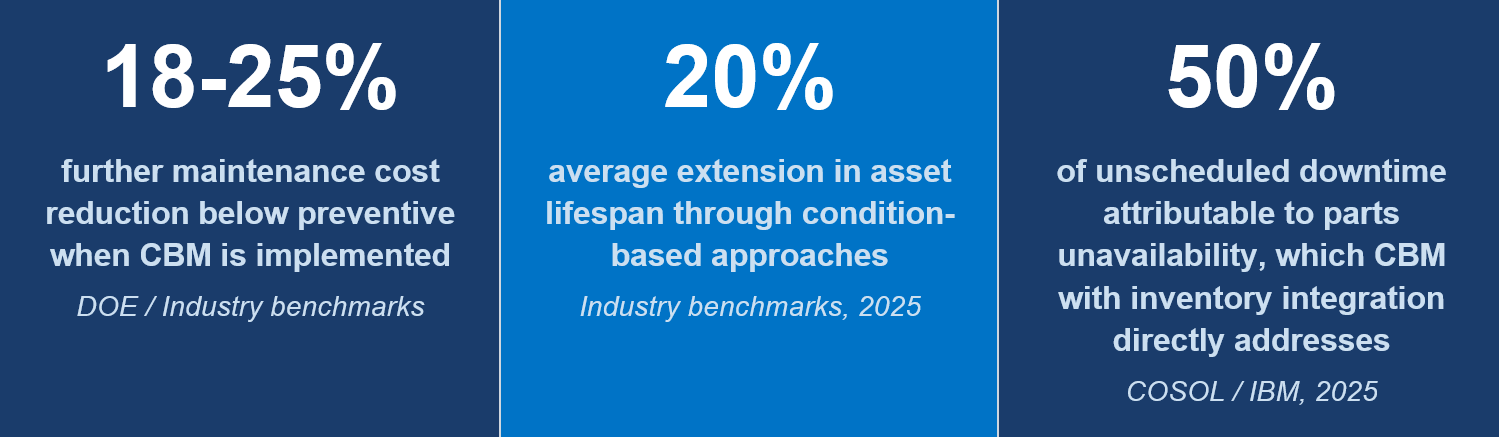
Condition-based maintenance is not a futuristic concept. It is a mature, well-evidenced approach that asset-intensive organisations across utilities, transport, manufacturing, and public sector are implementing today, with measurable reductions in unplanned downtime, maintenance costs, and capital expenditure.
The barrier to adoption has historically been the complexity of data integration and analytics. IBM Maximo Application Suite, and specifically Maximo Condition Insight, has significantly reduced that barrier. VE3 helps organisations design and implement CBM programmes that match the right technology to the right assets and deliver results that are visible on the balance sheet.
Ready to move from time-based to condition-based maintenance?
VE3 implements IBM Maximo Application Suite across energy, transport, manufacturing, public sector, and facilities management. We help organisations design maintenance strategies grounded in real asset condition rather than fixed schedules, delivering measurable improvements in reliability and cost.
Talk to our team about your maintenance strategy.

.png)
.png)


