.png)


When an asset fails unexpectedly, the first question is not what broke. It is whether the replacement part is available. For a significant proportion of unplanned downtime events in asset-intensive industries, the answer is no.
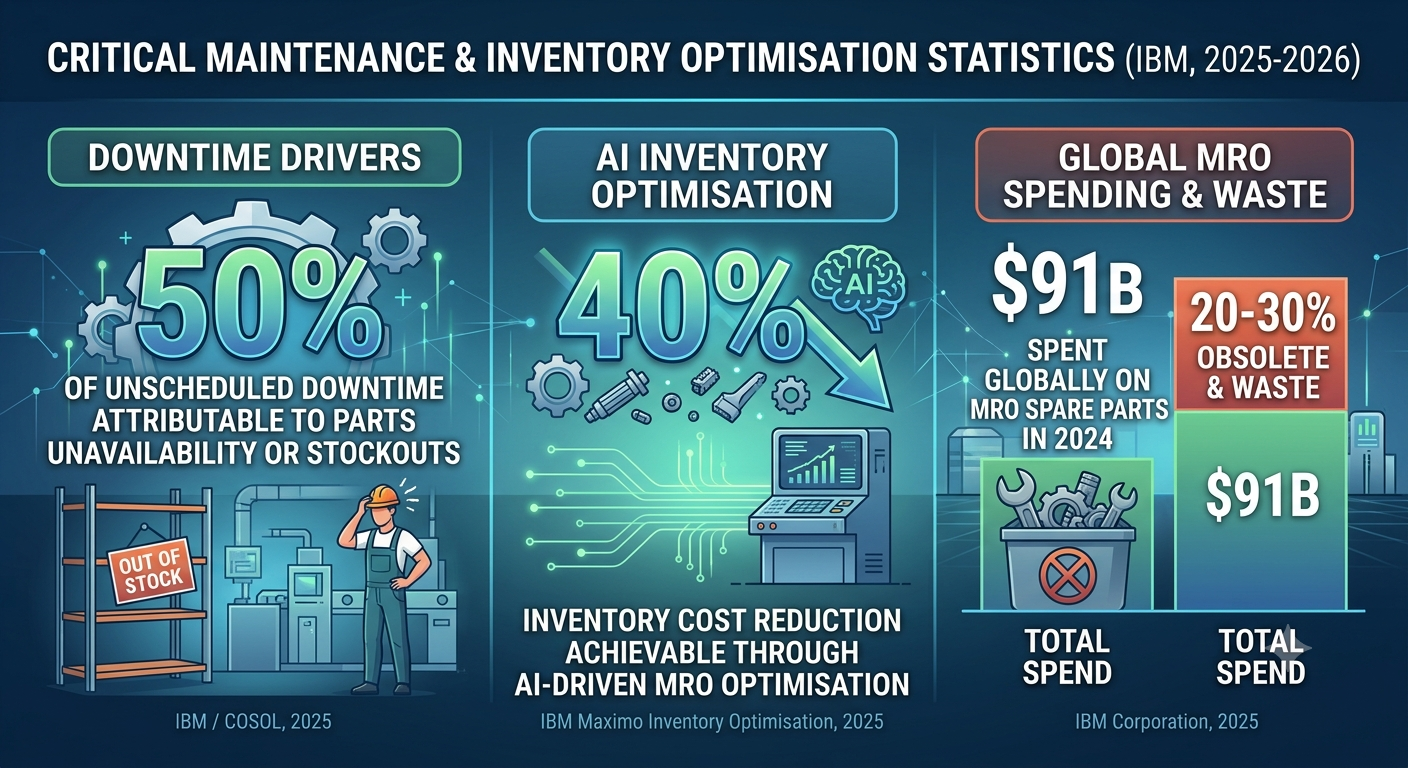
Up to 50% of unscheduled downtime has been attributed to spare parts unavailability or stockouts. An asset fails, the maintenance team is ready to respond, but the part is not in the storeroom. Production stops. Engineers wait. Emergency procurement begins. Downtime extends from hours into days.
MRO inventory, which stands for maintenance, repair, and operations inventory, is the stockpile of spare parts, consumables, and materials that keeps assets running. Managing it well is one of the least visible but most operationally consequential decisions an asset-intensive organisation makes. Get it right and maintenance teams can respond to any failure quickly. Get it wrong, in either direction, and the consequences are significant.
The Two Failure Modes of MRO Inventory Management
Poor MRO inventory management fails in one of two ways, and both are expensive.
Understocking: the Parts Are Not There
When a critical spare part is not in stock at the moment it is needed, downtime extends until emergency procurement can source it. Rush orders carry premium costs. Expedited shipping adds further expense. And throughout that process, production or service delivery is disrupted. For high-utilisation assets, a single stockout can generate losses that far exceed the cost of holding the part in reserve.
Overstocking: the Money Is Sitting on a Shelf
Carrying too much inventory ties up working capital, generates holding costs, and creates the risk of obsolescence as assets are retired or upgraded. Industry data suggests that between 20 and 30% of MRO inventory value is obsolete at any given time, and that 8 to 10% of MRO spare parts are actually consumed annually, meaning the majority of inventory holdings are rarely used. That is a significant amount of capital doing nothing productive.
Why MRO Inventory Is Difficult to Manage
MRO inventory is structurally harder to manage than direct materials. The challenges are well understood but consistently underestimated.
- Demand is intermittent and unpredictable: spare parts are not consumed at regular intervals. A component might be needed once in five years or five times in one month, making standard inventory management models inadequate.
- Criticality varies enormously across thousands of line items: a premium-cost critical spare for a unique piece of infrastructure and a low-cost consumable commodity require completely different stocking strategies, but most organisations manage them with the same rules.
- Data is fragmented: parts data often sits across separate ERP, CMMS, and procurement systems with limited integration, making it impossible to see real inventory levels, usage patterns, and reorder requirements in one place.
- Asset criticality is rarely connected to inventory policy: stocking decisions are frequently made without reference to the operational consequence of the asset failing without the relevant part available.
What AI-Driven MRO Optimisation Delivers
IBM Maximo Inventory Optimisation addresses these challenges through a cloud-based platform that applies AI and prescriptive analytics specifically designed for the characteristics of MRO environments.
Intermittent Demand Forecasting
Standard demand forecasting algorithms perform poorly on the sparse, irregular usage patterns that characterise MRO spare parts. Maximo Inventory Optimisation applies algorithms purpose-built for intermittent demand, improving forecast accuracy and enabling more confident stocking decisions.
Criticality-Based Inventory Segmentation
Every item in the MRO catalogue is scored by criticality and business impact. High-consequence spares for critical assets are stocked to a different standard than low-impact consumables. Stocking policy is aligned to operational risk rather than applied uniformly across thousands of dissimilar items.
Continuous Reorder Optimisation
Reorder points and safety stock levels are recalculated continuously as usage data, lead times, and asset operating conditions change. The system identifies where current stocking levels are misaligned with actual need and surfaces specific recommendations for adjustment.
Cross-Site Inventory Sharing
For organisations operating across multiple sites, Maximo Inventory Optimisation identifies opportunities to share critical spare holdings across locations rather than duplicating stock at every facility, reducing total inventory investment without increasing the risk of stockout at any individual site.
40% reduction in inventory costs achieved through AI-driven stocking optimisation
50% reduction in unplanned downtime related to parts availability
35% savings in maintenance budget through optimised procurement and reduced emergency orders
25% improvement in service levels, with the right parts available at the right time
The Connection Between MRO Strategy and Downtime Reduction
Condition-based and predictive maintenance programmes often underperform their potential because the maintenance execution side of the equation is not aligned with the monitoring and alerting side.
A predictive maintenance alert creates a maintenance window: a planned intervention that avoids an unplanned failure. But that window only produces the expected benefit if the required parts are available when the work is scheduled. If they are not, the team either delays the intervention and accepts the failure risk, or scrambles to source parts reactively, incurring the same cost and disruption the predictive alert was meant to avoid.
Integrating MRO inventory optimisation with predictive maintenance and work order management closes this gap. When a condition alert is generated in Maximo, the system can check parts availability, flag any stocking issues, and trigger replenishment ahead of the maintenance window. The planned intervention happens as planned, with parts available, at the scheduled time.
Also Read: Predictive vs Preventive Maintenance: What Actually Reduces Downtime
What MRO Optimisation Looks Like in Practice
1. Energy and utilities
Large, geographically dispersed networks with unique critical spares held at multiple depots. Cross-site sharing reduces total inventory investment while maintaining availability at each location.
2. Manufacturing
Production lines with high asset criticality and low tolerance for downtime. Criticality-based stocking ensures that parts for the most consequential assets are always available, while slow-moving items are right-sized to reduce holding costs.
3. Transport and rail
Rolling stock maintenance programmes where fleet-wide parts standardisation and demand forecasting across operating cycles significantly improve stocking accuracy.
4. Facilities management
Large property portfolios with diverse asset types and complex procurement patterns. Centralised inventory visibility across sites enables consolidation, reduces duplication, and improves response times.
The Bottom Line
MRO inventory optimisation is not a procurement efficiency project. It is a downtime reduction strategy. The organisations that achieve the strongest overall asset management performance are those that align their spare parts holdings with their maintenance strategy and asset criticality, rather than managing inventory as a separate back-office function.
IBM Maximo Inventory Optimisation provides the AI-powered platform to make that alignment possible. VE3 implements Maximo across asset-intensive organisations to ensure that the full maintenance chain, from condition monitoring through to parts availability and work execution, delivers on its downtime reduction potential.
Is spare parts availability limiting your maintenance performance?
VE3 partners with IBM to implement Maximo Inventory Optimisation alongside broader Maximo Application Suite deployments across utilities, transport, manufacturing, and facilities management. We help organisations right-size their MRO inventory and connect parts availability to their predictive maintenance and work order management programmes.
Talk to our team about your MRO challenges.

.png)
.png)


