.png)


The report that nobody reads twice
Most discovery engagements end the same way: a thick document, a final presentation, and a slow fade. Six months later a new programme starts, asks the same questions, and commissions the same work. The knowledge was real — but it was trapped in a static artefact, and it decayed the moment the project closed. Each new initiative pays the full discovery cost again, an avoidable tax on every transformation.
The alternative is to treat discovery not as a deliverable but as a capability: a permanent, sustainable 'Discovery Factory' that captures what it learns, makes it reusable, and gets cheaper and faster with every programme it serves.
The shift
The goal is not a one-time report. It is the creation and operation of a persistent, scalable Discovery Factory whose knowledge base grows with every project.
How the factory works
The factory runs as a continuous loop around a central, reusable knowledge base. Each programme feeds the base; each new programme draws from it before starting from scratch.
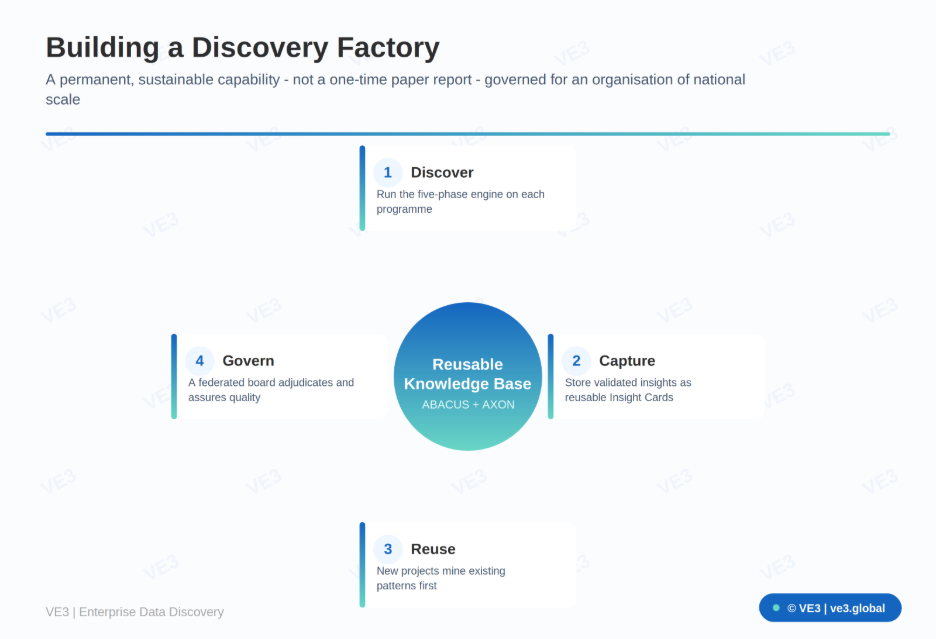
By capturing insights in a standardised, searchable repository, each new project can mine the existing knowledge base, review relevant patterns and 'Insight Cards', and avoid re-discovering known issues. Discovery effort shifts from rediscovering the estate to extending and validating what is already known.
Governance that fits a federated organisation
A factory at national scale needs governance — but a purely centralised model will fail in an organisation full of siloed systems and departments. A central data office cannot personally adjudicate every decision across dozens of programmes. The answer is a federated governance model that mirrors the federated organisation it serves.
The centrepiece is a cross-programme governance board with representation from the central data office and the programmes themselves. Its job is structured, formal decision-making, not newsletters. Specifically, it exists to:
- Set and enforce quality standards — for example, '100% of critical data elements have documented lineage' — before anything enters the enterprise knowledge base.
- Adjudicate and resolve cross-programme data conflicts and dependencies.
- Act as the primary escalation point for discovery issues that require cross-programme decisions, such as the need for a new master-data solution.
The same outputs also feed the wider control environment: a PII inventory becomes evidence for any privacy and ethics review, while data quality scorecards inform assurance and audit. The factory doesn't sit beside governance — it supplies it.
Why it compounds
A static report has a fixed value that only decreases. A Discovery Factory has a value that increases. Every programme adds validated patterns, every reuse saves discovery cost, and every governed decision raises the quality bar for the next. Over time the organisation stops paying the discovery tax and starts earning a discovery dividend.
The bottom line
Discovery should leave behind a capability, not a document. Build the factory once, govern it well, and every future programme starts further down the track.
VE3 helps organisations stand up and govern Discovery Factories that compound in value across programmes — combining a reusable knowledge base with a federated governance model fit for complex, national-scale estates. To learn how VE3 can turn discovery into a permanent capability, visit ve3.global.

.png)
.png)


