.png)


Oracle E-Business Suite (EBS) has been the foundation of enterprise operations all over the world. It gave stability and reliability, whether it was finance, HR, procurement or manufacturing. However, the changing technologies and business models seem to overburden on-premises systems such as EBS, which must usually adjust to current demands with speed.
The cloud age has introduced new requirements: constant innovation, flexibility of remote working, reduced infrastructure expenses and modern technology like AI and analytics are embedded into daily operating processes.
It is to this that the Oracle Fusion Cloud Applications were developed. They do not merely recreate EBS functions in the cloud: they redefine them with automation, agility, and smarter decision-making built into them.
However, the Oracle Fusion Cloud transition is not a plug-and-play transition between EBS and Oracle Fusion Cloud. It’s a transformation. Cloud deployments deliver 3.2× more ROI than on-premise solutions, with 2.3× lower total cost of ownership and 2.2× faster payback periods, according to a Nucleus Research report cited by Oracle. This guide will also take you through the migration journey step-by-step and offer some useful information on how to plan, execute and succeed long term..
Understanding the Key Differences- EBS vs. Fusion Cloud
It is essential to know the difference between Fusion Cloud and EBS before migrating. To many companies, it seems to mean simply an EBS on the cloud, but the fact is more nuanced.
- EBS is a software on-premise suite in which infrastructure, upgrades and customisations are under your control. It is predictable but expensive to stabilise.
- Fusion Cloud Applications are applications that are managed by orchestration, updates, infrastructure and security are controlled by Oracle as a SaaS. They introduce new capabilities every three months, have sophisticated analytics and are enriched with new technologies such as AI, machine learning, and digital assistants.
This transformation not only reshapes technology but also the way organisations are run. The transfer to Fusion Cloud can frequently involve rethinking business processes, simplifying customisations, and engaging with a new layer of best practices that are built into the applications. Accenture finds a 30–40% reduction in Total Cost of Ownership for organisations modernising by moving workloads to the cloud.
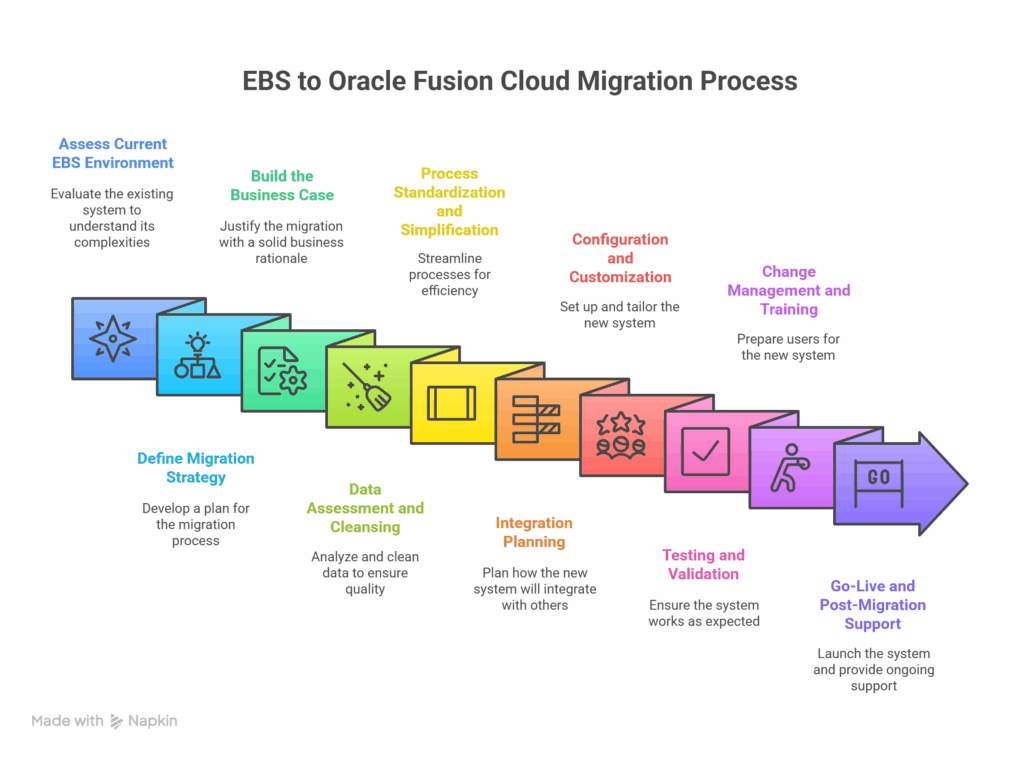
Step 1: Assess Your Current EBS Environment
The first step towards change is starting with a straightforward review of your current system. Over the years, and maybe decades, most businesses have customised EBS. That implies that there are no two comparable environments.
Key assessment questions include:
- Which modules are actively used, and which are obsolete?
- What customisations exist, and are they still adding value?
- How complex is your data footprint? How many ledgers, legal entities, suppliers, or customers are stored?
- Are there integrations with other third-party or in-house systems that need to be preserved?
This evaluation step sets the tone for the entire project. To the surprise of many organisations, a significant percentage of their customisations are available in Fusion Cloud out of the box.
Step 2: Define Your Migration Strategy
We do not have a one-size-fits-all route between EBS and Fusion Cloud. Generally, there are three strategies:
1. Reimplementation (Clean Slate)
In Fusion Cloud, begin anew with best practices and zero technical debt. Best when the organisation has an aged and highly-customised EBS.
2. Coexistence (Hybrid Approach)
Use Cloud Run + EBS to perform some operations (e.g. HCM on cloud, financials on-prem). This step-by-step approach minimises disruption and diffuses change.
3. Cloud Transformation (Full Migration)
In a single project shift, the whole EBS footprint is moved to Fusion Cloud. Maximises benefits within a short period but requires a significant initial effort. The choice of strategy is influenced by the extent to which your business is willing to change, your risk management approach, and the timeframes involved.
Step 3: Build the Business Case
Migration is not merely a decision in IT; it is an enterprise plan. Leaders should come to an agreement on the reasons why the move is important.
Such benefit types (typically featured in a business case) are:
- Reduced infrastructure and maintenance costs
- Faster adoption of innovation (quarterly updates)
- Improved employee productivity with modern user experiences
- Enhanced compliance, security, and audit capabilities
- Future-readiness with AI-powered insights
A strong business case earns executive sponsorship and prepares the organisation to effectively embrace the impending change.
Step 4: Data Assessment and Cleansing
It is the ideal time to move forward with tidying the house by relocating to Fusion Cloud. There is redundant information, old data or both forms of data in an outdated state in the EBS environments over the years. Introducing dirty data into the cloud defeats the purpose of what you are trying to achieve.
Steps include:
- Identifying inactive suppliers, customers, or employees
- Merging duplicate records
- Standardising addresses, codes, and formats
- Archiving or retiring historical data is no longer required for compliance
Oracle offers data migration tools as well as third-party accelerators that are used to extract, transform, and load data into Fusion Cloud.
Step 5: Process Standardisation and Simplification
EBS had nearly unlimited customisation. Fusion Cloud, on the other hand, motivates organisations to conform to standard best practices. This does not imply a loss of flexibility; it only implies the implementation of processes that have been tested in various industries.
To illustrate, where EBS may have required custom workflows to support procurement, Fusion Cloud provides configurable approval rules that encompass most requirements without the need for coding. Such standardisation helps eliminate future upgrade headaches, allowing businesses to enjoy new features sooner.
Step 6: Integration Planning
Very few businesses operate Oracle independently. You can use payroll, CRM, banking integration systems, or a bespoke reporting engine connected to EBS. All the integrations would have to be revisited and redesigned for Fusion Cloud.
Fusion Cloud enables modern APIs and middleware (such as Oracle Integration Cloud) to integrate with external systems. The change usually makes integrations very simple, yet it needs lots of planning to ensure it does not interfere with processes that are important to the missions of the organisation.
Step 7: Configuration and Customisation
The Fusion Cloud focuses on configuration, as opposed to EBS, which places a higher emphasis on customisations. The overwhelming majority of the needs are attainable through configuring application rules/workflows/preferences.
But, to achieve real customisation, tools such as Visual Builder Studio or Platform as a Service (PaaS) can be leveraged to expand functionality. The motto must be to configure as much as possible, only customise when there is no other option.
Step 8: Testing and Validation
Testing is the heartbeat of migration success. Agencies must validate not only that the system functions properly, but also that it supports new business processes and meets user expectations.
Key testing phases include:
- Unit Testing: Ensuring each module works as intended.
- Integration Testing: Validating cross-system workflows.
- User Acceptance Testing (UAT): Involving real users to confirm processes meet day-to-day needs.
- Performance Testing: Checking the system’s response under heavy loads.
Iterative testing ensures issues are caught early, before full deployment.
Step 9: Change Management and Training
Another aspect of migration that often receives little attention is the people involved. Switching to Fusion Cloud transforms the relationship between the staff and the system, frequently in an impressively significant way. Even the finest technical project will not work without appropriate change management.
A successful change program includes:
- Communicating the vision and benefits clearly
- Involving users early through pilots and testing
- Offering role-based training, not just generic overviews
- Providing ongoing support post-go-live
When employees see Fusion Cloud as a tool that simplifies their work rather than disrupts it, adoption rates soar.
Step 10: Go-Live and Post-Migration Support
Go-live comes with the moment of truth. A cutover is planned and down time and confusion are minimised. A lot of organisations are phased, meaning that finance and even HR are initiated and only then expanded to other departments.
Once it goes online, special teams will need to manage the performance, resolve any existing issues promptly, and assist end users in adapting. This hypercare phase takes about 30-90 days. Agencies can then redirect their efforts as soon as stability is achieved to focus on optimisation and continuous improvement.
Common Challenges and How to Overcome Them
Every migration faces hurdles. Some of the most common include:
- Resistance to Change: Employees used to EBS may be skeptical. Solution: invest heavily in change management.
- Complex Customisations: Long-standing EBS modifications may not translate directly. Solution: challenge the need for each customisation and replace it with configuration where possible.
- Data Quality Issues: Dirty data complicates migration. Solution: prioritise cleansing early, not as an afterthought.
- Underestimating Effort: Migration is not a simple upgrade; it’s a transformation. Solution: set realistic timelines and budgets.
With the right planning and mindset, these challenges can be turned into opportunities for improvement.
Conclusion
Leaving EBS and going to Oracle Fusion Cloud is not a simple technical upgrade; it is a structural spring forward. It requires proper planning, as well as readiness to re-engineer processes, and, above all, solid organisational alignment.
The benefits are substantial, though: less money spent, uninterrupted innovation, greater security, and a platform that can expand with your business.
Starting with a full implementation, gradual coexistence, or fully transforming to the cloud, no matter which route you will follow toward Fusion Cloud, the journey puts your company in a good position to succeed in the digital age. The cloud is never the future anymore, but the present. For businesses operating on Oracle EBS, the time to map the road to Fusion Cloud is now. To know more, explore our innovative Oracle solutions or contact us directly.

.png)
.png)


