.png)


Microsoft Purview is now the recommended system of record for data governance and security across the Microsoft data estate. Since March 2026, Microsoft's own Cloud Adoption Framework has formalised this position, placing Purview at the centre of every Fabric, Azure, and Microsoft 365 deployment. For organisations already committed to Microsoft Fabric and a Medallion lakehouse architecture, Purview is not optional; it is foundational.
Yet implementations regularly fall short. Demonstrations get cancelled. Programmes stall. Organisations end up with partially catalogued data assets, inconsistent labelling, and a governance layer that nobody actually uses. The technology itself is not the problem. The problem is almost always how it gets introduced.
This article sets out the most common reasons Purview implementations fail, and what the right approach actually looks like.
The Scale of the Problem
Data governance failure is not a Purview-specific issue. Gartner research indicates that 80% of data and analytics governance initiatives will fail by 2027, and industry analysis suggests that organisations waste approximately 40% of their analytical potential because of poor data quality and inconsistent stewardship. Among those that do attempt Purview specifically, the most commonly cited issues on platforms such as Gartner Peer Insights include a steep learning curve, documentation that lags behind product releases, and the difficulty of implementing Purview in environments where no prior governance foundation exists.
The key issue
Purview is a sophisticated governance platform. It is not designed to be the first step in a governance journey. Organisations that deploy it without an existing classification strategy, data ownership model, or data quality baseline almost always struggle.
Six Reasons Purview Implementations Fail
1. Treating It as a Technology Project
The most common mistake is handing a Purview implementation entirely to an IT team. Purview requires decisions about data ownership, classification policy, retention rules, and business glossaries. These are not technical decisions. Without active involvement from Finance, Operations, Legal, and data stewards, implementations default to whatever the IT team finds easiest to configure, which is rarely what the business actually needs.
2. No Baseline Governance Before Deployment
Purview amplifies existing governance. It does not create governance from scratch. Organisations that arrive at implementation without a defined data classification framework, a business glossary, or any assigned data stewards find that Purview surfaces the scale of their problem without providing the structure to fix it. The platform can scan and catalogue everything. But if nobody has decided what good data looks like, the catalogue simply becomes a large inventory of uncertainty.
3. Choosing a Partner Who Sells Rather Than Delivers
Many Purview engagements are led by partners whose primary relationship with Microsoft is commercial. They know how to license the product and demonstrate it in controlled environments. They are less equipped to advise on classification taxonomy, sensitivity label design, data lineage configuration, or the operating model needed to sustain governance after go-live. When a demonstration fails to answer real-world questions from a technically informed audience, it is often because the presenting partner does not have genuine delivery depth.
4. Underestimating the Integration Complexity
Purview is designed to govern data across a mixed estate. In practice, connecting it to source systems, configuring scanning credentials, managing integration runtimes for on-premises or multi-cloud sources, and maintaining scan schedules across a large legacy application estate requires sustained technical effort. Organisations that treat Purview as a one-time deployment, rather than an ongoing operational capability, find that the catalogue degrades quickly as data sources change and scan configurations fall out of date.
5. Skipping the Data Quality Foundation
Purview can identify data quality issues. It cannot fix them. When data quality scores are low across the estate, cataloguing that data and making it visible to business users actually increases distrust rather than confidence. Purview works best when it operates on a data layer that has already been through quality remediation: standardised, deduplicated, validated. In a Medallion architecture, this means Purview should be connected at the silver and gold layers, not the raw bronze layer, for business-facing governance.
6. No User Adoption Plan
Purview investments frequently fail to deliver value because the people who are supposed to use the data catalogue, apply sensitivity labels, or query data lineage have received no training and have no reason to change their existing habits. Adoption across large organisations does not happen organically. It requires structured onboarding, clear ownership of catalogue entries, and visible endorsement from senior data leaders.
What a Good Purview Implementation Looks Like
A well-structured Purview programme is sequenced, not rushed. The following represents a realistic implementation approach for a large multi-entity organisation moving to Microsoft Fabric.
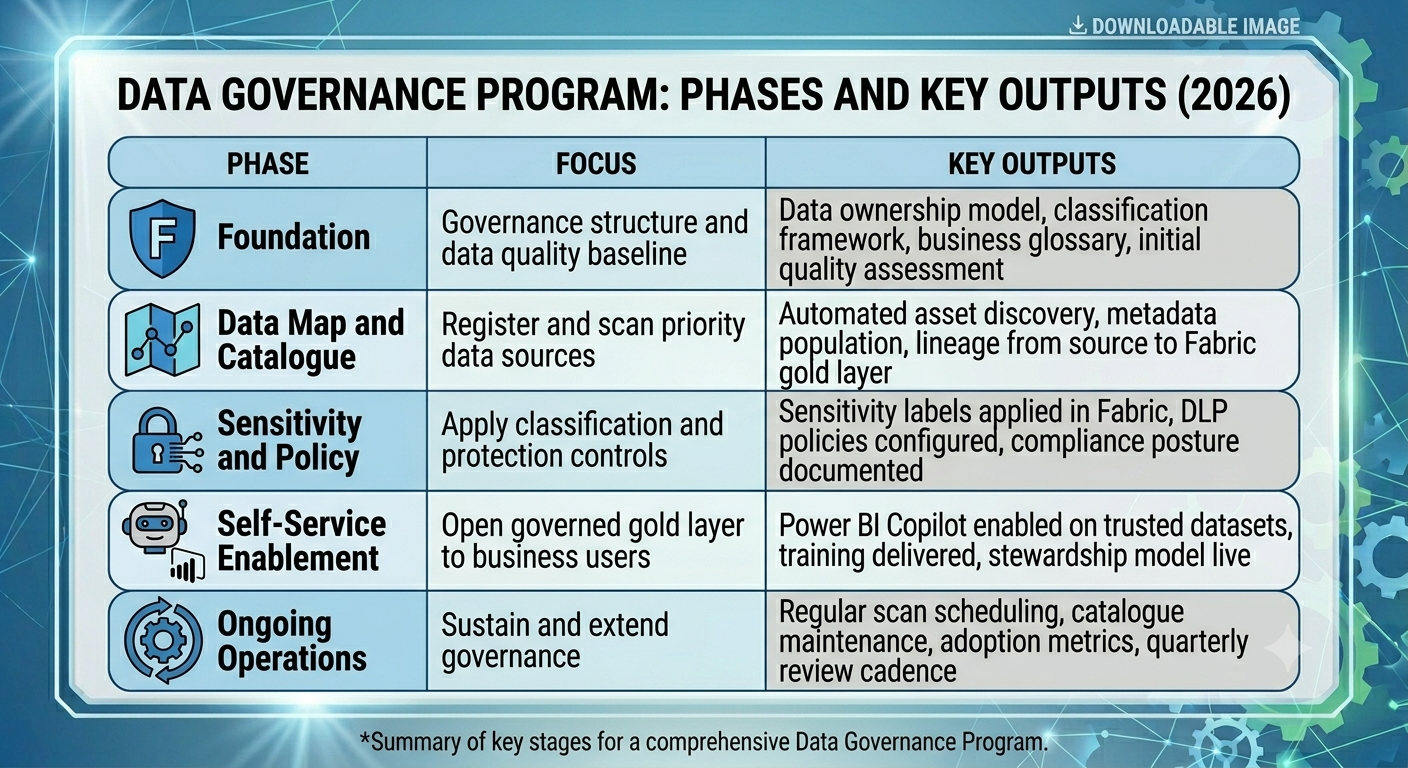
Purview Within a Fabric and Medallion Architecture
For organisations building on Microsoft Fabric, Purview operates across the full OneLake estate. The integration covers data lineage from ingestion through bronze, silver, and gold layers; sensitivity label inheritance so that classifications applied upstream persist through transformation; and data quality monitoring native to Purview's unified data map.
The practical recommendation from Microsoft's Cloud Adoption Framework is to scan the Fabric layer directly rather than every upstream source, unless full audit lineage to source systems is a compliance requirement. This reduces integration complexity significantly and concentrates governance effort where business users actually consume data.
For organisations using Power BI with Copilot, Purview-governed datasets provide the trust layer that makes AI-assisted analysis reliable. Without that governance, Copilot queries run against poorly classified, potentially inconsistent data, and the results are difficult to trust or audit.
Choosing the Right Partner
The difference between a Purview implementation that delivers and one that stalls almost always comes down to partner capability. The right partner brings three things that a software reseller cannot.
- Deep domain knowledge. Governance expertise, not just product knowledge. They can advise on classification taxonomy, stewardship operating models, and how governance needs to be structured before technology is deployed.
- Fabric and Purview delivery depth. Hands-on delivery experience with Fabric and Purview together. They understand how scanning, lineage, and sensitivity labels behave in a real Medallion environment, not just in a controlled demo tenant.
- User enablement and training. A capability transfer mindset. A good partner leaves an organisation more capable than they found it. This means structured training programmes for data stewards, analysts, and business users, not just a configured platform handed over at project close.
The right test for any Purview partner
Ask them to walk through how they would configure scanning for a specific data source in your environment, how they would design sensitivity labels for your data classification needs, and how they would structure data stewardship roles across your business units. A partner with genuine delivery capability will answer these concisely and specifically. A partner without it will defer to a follow-up conversation.
The Right Conditions for Success
Microsoft Purview is the right platform for enterprise data governance at scale. The organisations that succeed with it treat it as a programme, not a project. They build governance foundations before they deploy technology. They engage partners who can advise on operating models and deliver technically, not just demonstrate. And they invest in training and adoption so that the catalogue, the lineage, and the policies are actually used.
Done well, Purview creates the trusted data layer that makes AI-assisted analytics credible, supports regulatory compliance, and gives senior data leaders genuine visibility over their estate. Done poorly, it becomes another underused platform in an already crowded technology landscape.
The difference between the two outcomes is almost never the technology itself.
Working with VE3 on Microsoft Purview
VE3 is a Microsoft-aligned data and AI transformation partner with hands-on delivery capability across Microsoft Fabric, Purview, and Power BI. We help organisations design governance frameworks, implement Purview correctly from the ground up, and build the internal capability to sustain it.
To speak with our data governance team, visit ve3.global or contact us directly.

.png)
.png)


