.png)


Where the institutional memory really lives
In many large organisations, the most important business logic is not written in a policy document. It is encoded in software — calculations, eligibility checks and validation rules embedded in systems written decades ago, in languages like COBOL, by people who have long since retired. The documentation, if it ever existed, is gone. The behaviour is the spec.
This is the central obstacle to modernising a legacy estate. You cannot safely replace a system whose rules you do not understand, and you cannot understand them by reading a manual that does not exist. Business Rule Extraction is the discovery technique that addresses this head-on.
Why this matters
You cannot retire what you cannot explain. Every undocumented rule in a legacy system is a hidden constraint on modernisation — and a hidden risk if it is broken by accident.
From legacy code to validated logic
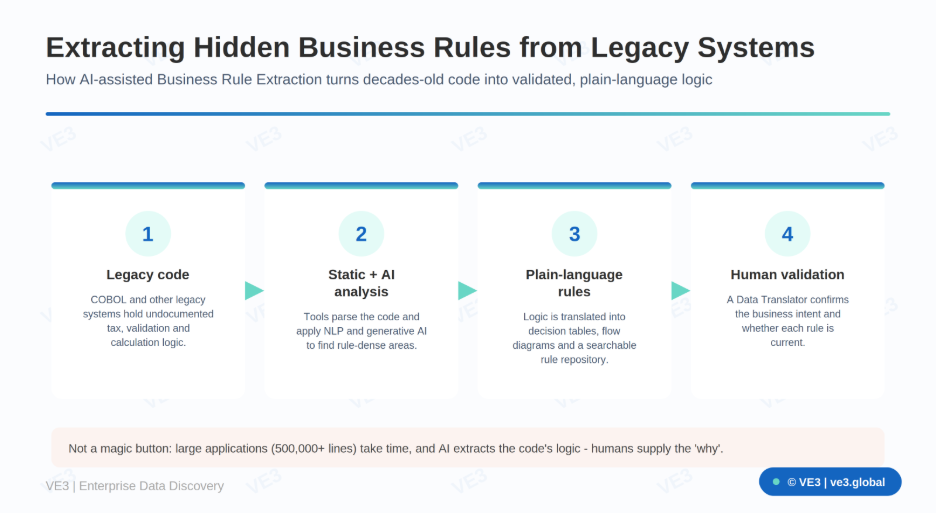
Business Rule Extraction combines static code analysis with modern AI. Tools ingest legacy code and apply natural-language processing and generative AI to identify rule-dense areas and translate the logic into plain-language rules, decision tables and flow diagrams — building a centralised, searchable repository of rules. The pipeline runs in four stages.
The limits worth being honest about
It would be easy to oversell this. Business Rule Extraction is not a magic button, and treating it as one is how modernisation programmes get into trouble. Two limitations matter in particular:
- Scale is hard. For very large, complex applications — think 500,000+ lines of code — extraction can be extremely challenging and time-consuming. Effort has to be prioritised toward the rule-dense, high-value areas first.
- Code logic is not business intent. AI can extract what the code does, but not always why. A calculation might be correct, obsolete or a workaround for a problem that no longer exists. Recovering the intent requires a human who understands the business.
The human in the loop
This is why the final stage is validation by a Data Translator working with subject-matter experts. The rules extracted by the tools are presented to the people who understand the policy — to confirm their accuracy, establish the business intent behind them, and decide whether each rule is still current or can be safely retired. The machine surfaces the candidate; the human makes the call.
Done this way, Business Rule Extraction turns one of modernisation's biggest risks into a managed, evidence-based activity. The hidden rules become a documented, validated repository — an asset the transformation can build on with confidence rather than a minefield it has to tiptoe around.
The bottom line
AI makes legacy rule extraction possible at a scale humans never could. But it is the human validation step that makes the output trustworthy enough to modernise on.
VE3 combines AI-assisted Business Rule Extraction with expert human validation to turn opaque legacy systems into documented, validated and modernisation-ready logic. To explore how VE3 can de-risk your legacy modernisation, visit ve3.global or talk to our Data & AI team.

.png)
.png)


