.png)



There is a particular kind of exhaustion that comes not from doing difficult work, but from doing the wrong work. Across the UK public sector, heritage institutions, and government-funded bodies, operations leads arrive early, leave late, and spend most of their day in a cycle of reports, emails, meeting follow-ups, and administrative tasks that feel urgent but are rarely strategic. The problem is not effort. The problem is structure.
Research from Appian and Coforge in 2025 found that manual process inefficiency is costing UK public sector workers an average of five hours per week in extra work or delays. Across the 6.12 million public sector workforce, that adds up to 30.6 million hours of additional work every single week. For small operations teams carrying broad remits, this is not a statistic. It is a description of every Tuesday.
AI does not solve this by working harder. It solves it by removing the category of work that should never have required a person in the first place.
The Structural Problem: Lean Teams, Expanding Remits
Small public sector and heritage operations teams are typically responsible for a scope of work that would, in a larger organisation, be distributed across multiple departments. Facilities management, health and safety compliance, contractor oversight, reporting to leadership and trustees, budget tracking, help desk management, sustainability reporting, and project delivery often land on a team of three to five people with little headcount flexibility and no meaningful administrative support.
When demand spikes, the default response is to bring in external consultants. This pattern is expensive, structurally repetitive, and does not build internal capability. Organisations pay premium rates to backfill work that is not genuinely complex, it is simply time-consuming. AI changes that equation by absorbing the time-consuming work directly, rather than outsourcing it.
Deloitte's State of the Enterprise AI report (2026) found that in the public sector, AI agents are already being used to cover workforce shortages, partnering with human workers to complete key processes. PwC and Microsoft's joint analysis of agentic AI in public institutions identifies the same dynamic: the organisations gaining the most ground are not those hiring more people. They are those deploying AI to close the gap between what their existing teams can handle and what the organisation needs done.
The Consultant Dependency Trap
Organisations that rely on external consultants to backfill operational capacity are, in most cases, paying for time rather than expertise. The tasks being outsourced are often structured, repetitive, and data-driven. That is precisely the profile of work AI handles most effectively. Redirecting even a portion of that consultant spend toward AI tooling produces both a financial return and a structural shift: the organisation builds internal capability rather than permanent external dependency.
What Enterprise-Scale Capacity Actually Means for a Small Team
Enterprise-scale capacity is not about headcount. It is about the ability to process information, route requests, track compliance, generate reports, and manage workflows at a volume and consistency that a small team cannot sustain manually. AI provides this not by replacing the team but by handling the repeatable, structured layer of operations so that the team can focus on the work that genuinely requires their judgement.
The contrast between a manual operations model and an AI-augmented one is most visible in how time is distributed across a working week.
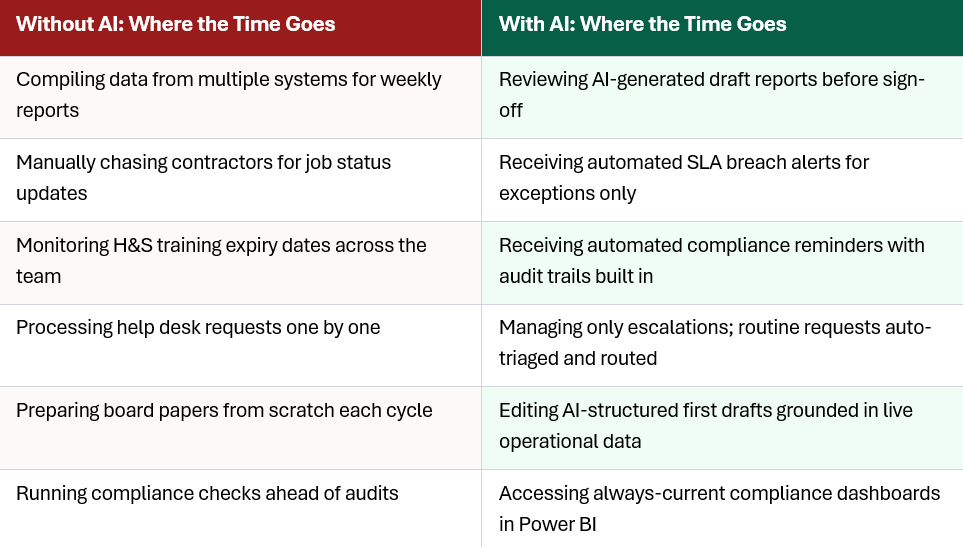
Where AI Delivers Capacity for Small Teams: Six High-Impact Areas
1. Automated Reporting and Board Paper Production
For most operations leads, report writing is the single largest non-strategic time drain. Board papers, management updates, and trustee briefings require pulling data from multiple systems, structuring it coherently, and presenting it in a format appropriate for governance audiences. AI tools embedded in Microsoft 365 can generate first-draft reports from operational data in SharePoint, Power BI, and Outlook, cutting the time from data to finished draft by a significant margin.
The person reviewing and approving the output still matters. But the hours spent on assembly, formatting, and first-draft writing are recovered.
2. Compliance Tracking Without Manual Monitoring
Health and safety training records, risk assessment schedules, contractor certification renewals, and regulatory audit trails are the kind of work that must be done accurately, consistently, and on time, but that does not require senior judgement to manage. Automated workflows handle reminder cadences, flag overdue items, update compliance logs, and produce audit-ready documentation without anyone managing the queue. Small teams operating in regulated environments get coverage they could not previously afford to staff.
3. Facilities and Contractor Workflow Automation
Power Automate within Microsoft 365 enables fault reports submitted via email, Teams, or a SharePoint form to automatically create tracked work orders, notify the relevant contractor, and update a central log. SLA breach alerts fire before deadlines are missed, not after. Buckinghamshire Council's integration of AI into departmental systems reduced call wrap time and administrative burden within months of deployment. Singapore's embedding of AI into government processes cut administrative time nearly in half. These are not edge cases. They are the expected outcome of applying automation to structured, high-frequency operational tasks.
4. Help Desk Triage and Request Routing
A single administrator managing an internal help desk, facilities requests, and departmental liaison simultaneously is one of the most common capacity pinch points in public sector operations. AI-assisted triage classifies incoming requests, routes them to the right function, sends automated acknowledgements, and flags high-priority items for human attention. The administrator stops managing the inbox and starts managing the exceptions. Response times improve, nothing gets dropped, and the person at the centre of it recovers meaningful cognitive space.
5. Data Aggregation and Operational Dashboards
Many public sector organisations hold significant volumes of operational data they cannot currently interrogate effectively. Fault histories, contractor performance logs, energy consumption data, visitor records, and training completion rates exist across multiple systems and formats. AI-powered tools, particularly Power BI with its natural language query capabilities, connect these sources and surface usable insight without requiring manual aggregation. A head of operations can ask what has driven the increase in reactive maintenance calls this quarter and receive an answer in seconds, rather than commissioning a report that takes days to produce.
6. Agentic AI: The Next Step for Genuinely Overstretched Teams
Most AI deployments to date have been assistive: tools that help a person work faster. The shift currently underway is toward agentic AI, where systems act autonomously on defined goals rather than waiting to be prompted. Research from Elsewhen and techUK published in May 2026 argues that this shift is where the real productivity dividend for the UK public sector lies. Faster briefings save time. Agentic systems reduce backlogs, resolve requests end-to-end, and coordinate across workflows without human intervention at every step.
The Office for Budget Responsibility has estimated that effective AI adoption across the public sector could unlock up to £41 billion a year in productivity value. For individual organisations, the implication is that the capacity constraints currently treated as a structural reality are, in part, a technology problem with a technology solution.
Addressing the Barriers: Why Small Teams Hesitate
The operational case for AI is clear. The barriers are also real, and dismissing them does not help the organisations that need to navigate them.
'We Do Not Have the Technical Capacity to Implement This'
This is the most common objection and the most frequently misplaced. The tools that deliver the most immediate value for small operations teams, particularly within Microsoft 365, are designed for non-technical users. Power Automate flows can be built in plain English using Copilot assistance. Power BI dashboards can be configured without data engineering. The barrier is not technical sophistication. It is the time and support to get started, which is where a knowledgeable implementation partner closes the gap.
'Our Data Is Too Fragmented to Support AI'
Fragmented data is a real constraint, but it is not a binary blocker. Most organisations can identify one or two operational datasets that are reasonably structured and accessible. Starting there, rather than waiting for a comprehensive data strategy to be completed, produces early wins that build the internal case for further investment. Data quality improves as a consequence of AI adoption, not only as a precondition of it.
'Security and Governance Will Block It'
Regulated environments require careful governance of AI deployment, particularly around data access and permissions. This is a solvable problem, not a permanent obstacle. The key is deploying AI within existing, trusted infrastructure rather than introducing new third-party platforms, and treating deployment as a governance project from the outset rather than as an IT project that governance reviews at the end.
The Harder Truth About Inaction
The 2026 UK Public Sector AI Adoption Outlook found that 45% of AI initiatives are operating as bolt-on experiments rather than embedded workflows. The risk of waiting is not just operational. Civil servants are already using personal AI accounts at work because their organisations have not provided approved alternatives. Inaction does not eliminate AI use. It removes the governance around it.
What Good Looks Like: A Practical Starting Point
Organisations that successfully use AI to extend their operational capacity share a common starting approach: they do not begin with a transformation programme. They begin with a problem.
- Identify the task consuming the most unstrategic time in a typical week. Reporting, compliance tracking, help desk management, and contractor oversight are the most common answers. null
- Assess whether the data underpinning that task is accessible and reasonably structured. If it is, that is the starting point. If it is not, a short data readiness exercise is required before automation. null
- Deploy within existing infrastructure wherever possible. For M365 organisations, this means Power Automate, Copilot, and Power BI. Extending a trusted platform is faster to approve, faster to adopt, and lower risk than onboarding a new vendor. null
- Measure the outcome in terms that matter to leadership and trustees: hours recovered per week, reduction in consultant days, compliance incidents avoided, reduction in report turnaround time. null
- Use that evidence to justify the next step. AI adoption in small teams works best as a sequence of specific improvements with measurable outcomes, not as a single large-scale transformation. null
The Real Measure of Success
Success is not the number of AI tools deployed. It is the number of hours recovered each week for work that requires genuine human judgement. An operations lead who spends the first two hours of their day on report assembly, compliance chasing, and inbox management should not still be doing that eighteen months after AI tooling becomes available. The technology exists. The question is whether the organisation is using it.
The Capacity Gap Is a Choice
UK public sector productivity fell by 0.7% in Q2 2025 according to the ONS, even as demand for services continued to grow and headcount in many bodies increased. The gap between what public sector teams are asked to deliver and what their current structure allows them to deliver is widening, not narrowing. For small operations teams in particular, the options are clear: continue absorbing the administrative burden manually, continue paying for consultants to cover capacity gaps, or deploy AI to close them structurally.
The organisations that move first are not necessarily the ones with the largest budgets or the most sophisticated IT departments. They are the ones with an operations lead willing to pick a specific problem, make a credible internal case, and take a structured first step. That is a much lower bar than most organisations assume.
VE3 partners with heritage institutions, public sector bodies, and regulated organisations to close the gap between operational demand and team capacity. We deploy practical AI within existing infrastructure, with governance and change management built in from day one.
Talk to VE3 about your capacity challenges at ve3.global

.png)
.png)


