.png)


We are in an ever-evolving data-driven ecosystem where no enterprise can survive by running its digital infrastructure on a single architecture. Enterprises today operate in a hybrid, multi-modal data landscape where structured, semi-structured, and unstructured data coexist. As businesses scale AI, real-time analytics, and data-driven decision-making, the choice between a Data Warehouse and a Data Lakehouse has become a strategic decision rather than a purely technical one.
Context-sensitive and accurate data has become the core driver of innovation, competitiveness, and intelligence. Organisations across industries are dealing with unprecedented volumes of data generated from cloud applications, IoT devices, customer interactions, social platforms, and AI systems. The traditional systems (with reporting systems & dashboards) we used to work upon no longer serve the dynamic data-driven business framework. This shift has sparked a crucial architectural debate: Should enterprises continue relying on Data Warehouses or adopt the modern Data Lakehouse approach?
The answer is not straightforward since both have their own benefits. This article explores the differences between Lakehouse and Data Warehouse architectures in depth to help enterprises make informed decisions based on their current capabilities, future ambitions, and data strategies. We will understand the benefits of both & their core components. Then the following section will differentiate between them, along with the data maturity model, where your enterprise may fit. Lastly, we will comprehend them from an AI standpoint.
Understanding the Data Warehouse
We can define a data warehouse as a centralised system for storing & managing structured data, ready for analysis after cleaning and transformation. It follows a schema-on-write approach, meaning data must be defined and structured before it is stored. It ensures consistency, accuracy, and reliability, making it ideal for business intelligence (BI), reporting, and compliance-driven use cases.
Over the years, enterprises have been leveraging data warehouses as highly optimised systems capable of handling complex SQL queries & delivering fast performance for analytical workloads. We can largely use them in industries such as finance, healthcare, and retail, where data integrity and governance are key. However, as the nature of enterprise data is changing, the rigid structure of data warehouses has become less suitable for handling rapidly changing data types (in unstructured and semi-structured data) & large volumes of unstructured data.
Understanding the Data Lakehouse
We can consider the data lakehouse as a modern data architecture that combines the best features of Data Lakes and Data Warehouses. It allows enterprises to store all forms of data (structured, semi-structured, and unstructured) in a single platform while maintaining transactional reliability and performance. Traditional data lakes suffer from poor governance and data quality issues.
That's where Lakehouse offers ACID transactions, schema enforcement, and metadata management. At the same time, it retains the flexibility and cost-efficiency of object storage systems. It makes it particularly well-suited for advanced analytics, machine learning, and real-time data processing. In our AI-centric modern era, the Lakehouse is increasingly becoming the foundation for AI-driven enterprises. It enables seamless integration between data engineering, data science, and analytics workflows.
Benefits of Data Warehouse
Data warehousing has matured from just data analytics-based hype to actual implementation, from data maturity, agility, and AI integration. Enterprises that want a data warehouse must understand the advantages of leveraging it. In this section, we will dive into its benefits.
- Centralised Data Management: We can use a data warehouse because it consolidates data from multiple sources into a single, centralised repository. The centralised nature eliminates data silos, ensuring consistency across all departments for better decision-making within the enterprise.
- High-Performance Querying: Data warehouses offer optimisation for fast query execution. It uses indexing, partitioning, and columnar data storage. It helps us retrieve data quickly for insights, even from large datasets. Thus, it is perfect for business intelligence (BI).
- Improved Data Quality and Consistency: Through ETL/ELT processes, we can retrieve clean, validated, and standardised data before use. It ensures quality, accuracy, and consistency for reliable analytics and informed business decisions.
- Strong Data Governance and Security: With data warehouses, enterprises can enjoy robust governance features such as role-based access control, auditing, and compliance mechanisms. All these features help enterprises meet regulatory requirements and maintain data security across sensitive datasets.
- Separation of Analytical Workloads: By isolating analytical processing from transactional systems, data warehouses prevent performance degradation in operational databases. It ensures that day-to-day business operations run smoothly while independently handling analytics workloads.
Also Read: Data Warehousing in CRM: A Technological Backbone for Customer-Centric Strategy
Challenges of Data Warehouses
Enterprises that want to choose data warehousing should know its drawbacks as well. These are:
- Data warehouses can become expensive for enterprises due to tightly coupled storage and compute resources. It also adds to licensing costs, increasing total ownership expenses.
- They rely on a rigid schema-on-write model, which makes them less flexible. Enterprises that work on diverse data structures may face issues as working becomes challenging with changing data structures.
- Data warehouses are excellent for structured data. Handling unstructured data, such as images, videos, and logs, is inefficient or often unsupported.
- Warehousing data goes through a complex ETL pipeline. It increases development time and operational overhead.
- Most data warehouses rely on batch processing, leading to delays in data availability. It makes real-time analytics difficult to achieve.
- Data warehouse solutions remain tied to specific vendors and ecosystems. It limits flexibility and makes migration or integration challenging.
Benefits of Data Lakehouse
Enterprises can use a data lakehouse because it offers modern data architecture. It combines low-cost & scalable storage of a data lake with the data management, reliability, and high-performance analytics of a data warehouse. Let us explore some other benefits of data lakehouses.
- Unified Data Platform: We can use data lakehouses because they combine the capabilities of data lakes and data warehouses into a single architecture. This enables enterprises to manage structured, semi-structured, and unstructured data within a scalable & unified platform.
- Cost-Effective Storage: Lakehouses are low-cost cloud object storage that enables us to handle massive datasets efficiently. By separating storage and compute resources, organisations can scale economically without significantly increasing infrastructure expenses.
- Support for Multiple Data Types: Unlike traditional warehouses, lakehouses can store and process diverse data formats, including text, images, videos, logs, and IoT streams. This flexibility supports modern analytics and AI-driven applications.
- Real-Time Data Processing: With lakehouses, we can gain both batch and streaming data processing. It enables enterprises to perform real-time analytics and make decisions faster. We can use this facility for fraud detection, monitoring systems, and personalised customer experiences.
Challenges of Data Lakehouses
Enterprises that want to choose data lakehouses should also know their drawbacks. These are:
- Since data lakehouses involve multiple layers, such as storage, metadata, and processing engines, managing and integrating them can increase architectural complexity.
- Enterprises need to ensure that consistent security, compliance, and data quality are provided as an additional effort.
- Achieving high query performance often depends on proper partitioning, indexing, and file optimisation. Poor configuration can lead to slower analytics and increased compute costs.
- Enterprises often require experienced data engineers (with cloud expertise) to implement and maintain a lakehouse. Enterprises may face skill gaps during this adoption.
- Because raw data can be ingested rapidly, poor-quality or duplicate data may accumulate. Without strong validation processes, we may suffer from poor analytics accuracy.
- Handling metadata across massive datasets can become complicated. Inconsistent metadata management may reduce data discoverability & reliability.
Data Warehouses vs Data Lakehouses
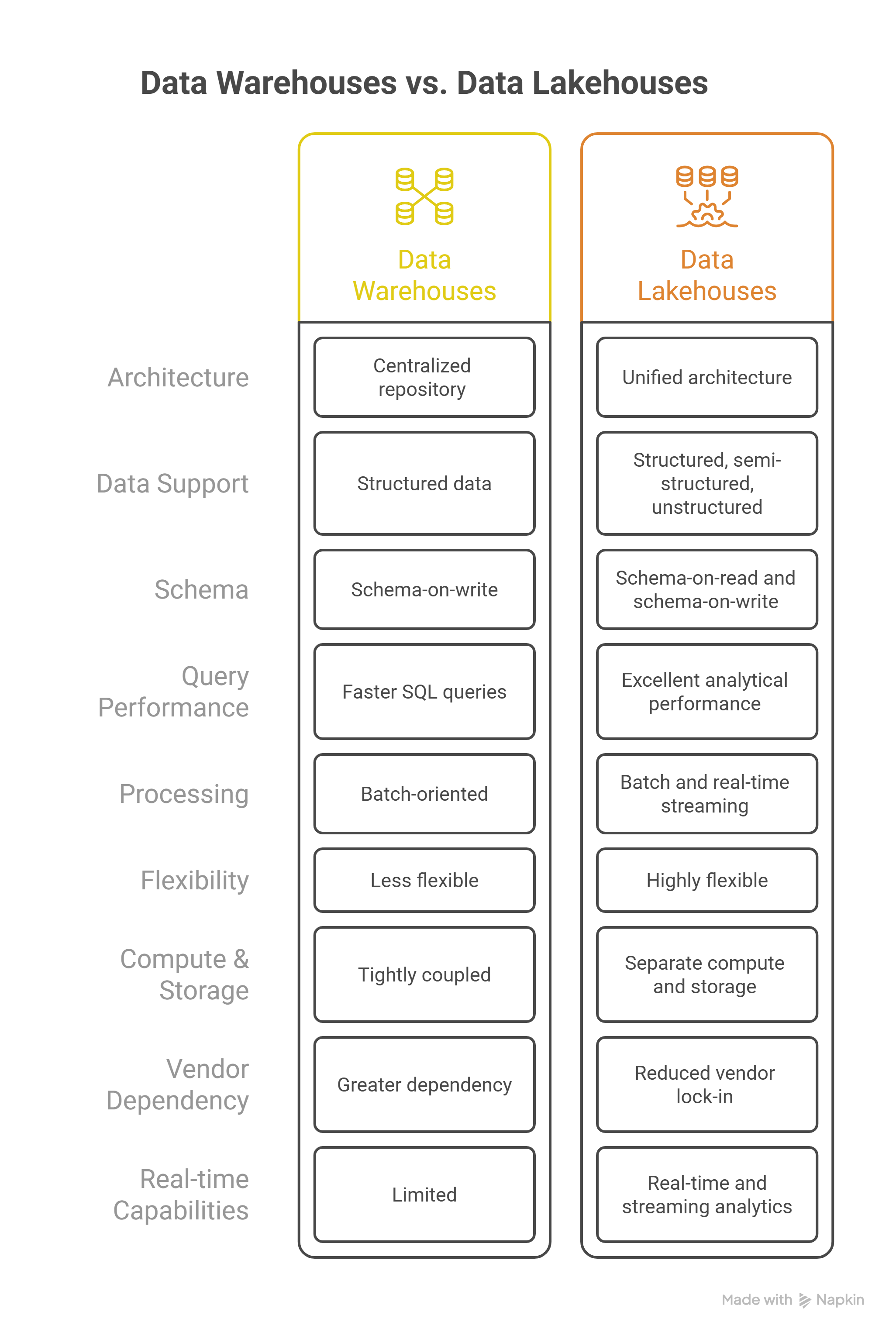
Data Maturity Model: Where Do You Fit?
As we know, enterprises generate and consume increasing amounts of data; their ability to manage, analyze, and extract value from that data evolves. The progression is known as the Data Maturity Model. It helps businesses assess how effectively we can use data for operations, analytics, and decision-making. Understanding the data maturity stage is essential for selecting the right architecture, tools, and governance strategies.
Whether a company or a business relies on traditional reporting or advanced AI-driven analytics, each stage of the data maturity model reflects a different level of technological capability. If we understand the stages where to use data warehouse and data lakehouses, we can comprehend where we fit! Let's explore the stages one by one.
1. Initial Stage – Basic Data Awareness (Data warehouse)
At this stage, enterprises collect limited amounts of data mainly for operational purposes. They store the data in isolated systems with minimal governance, making analytics inconsistent and decision-making reactive rather than strategic.
2. Developing Stage – Structured Reporting (Data Warehouses)
Now, enterprises begin to centralize all structured data into databases or data warehouses for reporting & business intelligence. With dashboards and KPIs, they can improve visibility into operations while enabling more consistent & data-driven business decisions.
3. Defined Stage – Integrated Analytics (Hybrid Usage)
Under proper data governance, businesses integrate multiple data sources across departments to create a unified analytical environment. It helps generate deeper insights & optimize operational efficiency.
4. Advanced Stage – Real-Time and Predictive Intelligence (Data Lakehouses)
At this level, enterprises implement real-time analytics, automation, and predictive modeling. Data platforms and information search tools support streaming data, context-driven searches, and advanced visualization, enabling businesses to anticipate trends, mitigate risks, and proactively improve customer experiences.
5. AI-Driven Stage – Intelligent Enterprise (Data Lakehouse)
Finally, with all refined data, enterprises can leverage AI, machine learning, and real-time predictive analytics (for decision-making) extensively. A Data Lakehouse is essential for managing massive amounts of structured and unstructured data while supporting advanced AI pipelines.
Role of Data Warehouses & Lakehouses in AI-First Enterprises
Both data warehouses and lakehouses play a significant role in AI-first enterprises. Data warehouses provide clean, structured, and highly governed data for business intelligence, reporting, and historical analysis. They ensure data consistency, accuracy, and compliance, which are essential for training reliable AI models and supporting enterprise-wide decision-making processes.
Again, data Lakehouses enable AI-first enterprises to process structured, semi-structured, and unstructured data within a unified platform for enhanced automation & model training. They support large-scale machine learning, real-time analytics, and AI workflows by offering scalable storage, faster data ingestion, and seamless integration between data engineering, analytics, and AI development environments.
Conclusion
We hope this article provided a clear distinction between data warehouses and data lakehouses. We have gathered insights into their benefits and drawbacks. Then we saw a stark difference between them. The debate between Lakehouse vs. Data Warehouse is not about replacement; it is about alignment with your data maturity and business goals. While lakehouses are the future of unified data intelligence, warehouses remain a critical foundation for reliable business analytics.
VE3 is a leading cloud, data and AI solution provider with years of experience in working on projects. Visit our expertise or contact us directly

.png)
.png)


