.png)


The most expensive CRM decision your organization will make in 2026 is not the one on the contract. It is the one made three months after go-live, when adoption stalls, integrations break down, and the business case quietly disappears.
Most mid-market organizations approach the Dynamics 365 vs. Salesforce decision backwards. They start with product demos, sit through vendor roadshows, and build business cases around feature lists. Then, somewhere between implementation and year two, reality arrives. Research by Johnny Grow in 2025 found that 55% of CRM implementations fail to deliver their intended objectives, a figure that has barely shifted in a decade despite platforms becoming exponentially more sophisticated.
This is not a technology problem. It is a strategy problem. CIOs, CROs, RevOps heads, and transformation leaders across North America and the UK are re-evaluating not just which CRM to choose, but how they are making that choice in the first place. Dynamics 365 and Salesforce remain the dominant forces in this market, but they solve fundamentally different organizational challenges. Understanding which problem your business actually has is the only reliable starting point. And this is where VE3 can help organizations assess their CRM needs.
Why Mid-Market CRM Re-Evaluation Is at a Tipping Point in 2026
CRM is no longer a sales management tool. That framing expired years ago. In 2026, a CRM platform sits at the intersection of customer data strategy, AI-enabled operations, marketing intelligence, and ERP convergence. The pressure on mid-market organizations is real and compounded: boards expect connected customer data ecosystems, commercial teams demand AI-powered workflows, and operations leaders want unified reporting without the administrative overhead of fragmented systems.
The global CRM market reflects this shift. Mordor Intelligence reports growth driven not by new license volume but by demand for deeper integration between CRM, ERP, and data platforms. Nearly half of new CRM investment in 2026 is going toward data architecture and AI infrastructure, rather than additional seat licenses, a signal that the evaluation conversation has fundamentally changed.
Mid-market organizations, typically between 100 and 2,000 employees, sit in a particularly exposed position. Large enough to need enterprise-grade capability. Not always large enough to absorb the implementation complexity that comes with it. What leadership teams are evaluating today is long-term scalability, integration architecture, data readiness, and the realistic total cost of transformation. That shift in evaluation framing is precisely where Dynamics 365 and Salesforce diverge most sharply.
Dynamics 365 vs Salesforce: Two Fundamentally Different CRM Philosophies
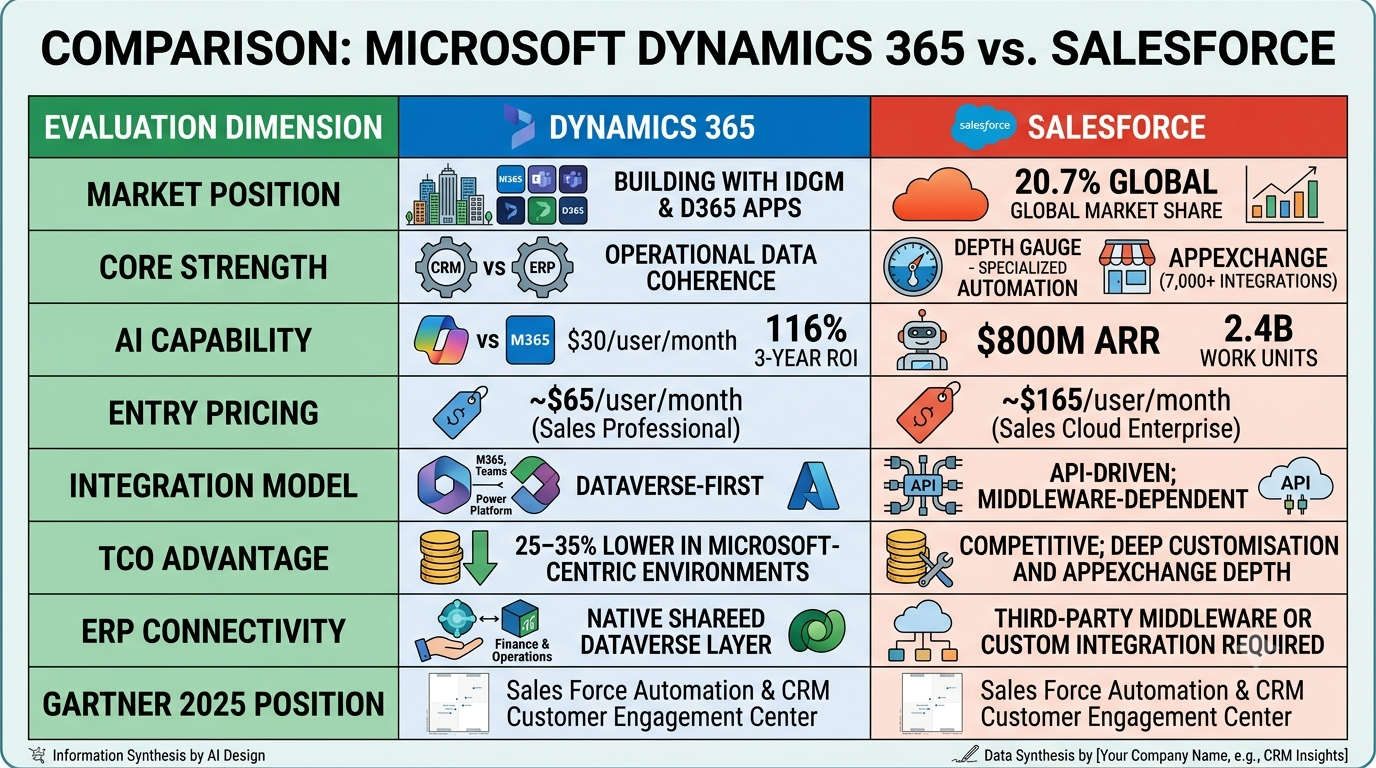
Salesforce built its dominance on being the best standalone CRM in the world. It remains that. The platform holds 20.7% of the global CRM market share, according to IDC’s 2025 Worldwide Semiannual Software Tracker, its twelfth consecutive year at number one across North America, Western Europe, and Asia-Pacific. The AppExchange ecosystem spans over 7,000 integrations. Its customization depth, sales automation maturity, and Marketing Cloud capabilities remain unmatched for organizations whose primary strategic driver is customer engagement and revenue growth.
Dynamics 365 occupies an entirely different position. Microsoft does not build a CRM; it builds a connected business applications platform in which CRM is one layer of a broader Microsoft ecosystem. Sales, Customer Service, Field Service, and Business Central all run on a shared Dataverse layer, natively integrated with Microsoft 365, Teams, Power Platform, and Azure. For organizations already standardized on Microsoft technology, a significant proportion of mid-market businesses in the UK and North America do not have coherence as a feature. It is the central argument.
The architectural difference matters more than any individual feature comparison. Salesforce is a best-of-breed ecosystem assembled through integration. Dynamics 365 is a unified platform in which integration is the default. Neither approach is inherently superior. But the operational implications of each, especially at mid-market scale, are substantial. Both vendors are recognized as leaders in Gartner’s 2025 Magic Quadrant for Sales Force Automation Platforms and CRM Customer Engagement Center, so analyst parity at the platform level is genuine.
Microsoft Copilot vs Salesforce Agentforce: What the AI Claims Actually Mean
The AI narrative around both platforms has intensified to the point where every capability claim requires scrutiny. Salesforce Agentforce closed 29,000 deals by Q4 FY26, reached $800 million in ARR, and processed over 2.4 billion agentic work units. These are not trivial numbers. But Salesforce has approximately 150,000 customers globally, meaning the vast majority are not yet running Agentforce in production at scale. Forrester’s assessment of Dreamforce 2025 was direct: meaningful AI agent ROI remains a long way off for most organizations.
Microsoft took a deliberately different commercial approach. From October 2025, Copilot for Sales, Service, and Finance was consolidated into the standard Microsoft 365 Copilot license at $30 per user per month, eliminating the premium barrier that had slowed adoption in Dynamics 365 environments. Forrester’s Total Economic Impact study on Microsoft 365 Copilot found a three-year ROI of 116%, with users saving an average of nine hours per month. For sales teams specifically, qualified opportunity volumes improved by 2.7% and win rates by 2.5%.
The harder truth is that both platforms’ AI promises depend entirely on data quality. Salesforce Data Cloud ingested 112 trillion (53 trillion via Zero Copy) records in FY26, a scale claim no rival can match. But Gartner’s 2025 Magic Quadrant for Customer Data Platforms found that 67% of organizations use only 47% of their CDP capabilities. Fragmented customer data environments remain the primary reason AI value fails to materialize. Dynamics 365 Customer Insights ships natively integrated with Dataverse and Microsoft Fabric, which reduces data architecture overhead for Microsoft-centric organizations considerably.
CRM Implementation Costs and Total Cost of Ownership: The Full Picture
The license is never the cost; it is the start of the conversation. Mid-market organizations consistently underestimate the full cost of CRM transformation, and both Dynamics 365 and Salesforce carry different hidden cost profiles that only become visible after contracts are signed.
Dynamics 365 Sales Professional starts at approximately $65 per user per month versus Salesforce Sales Cloud Enterprise at $165, a 60% headline difference that narrows considerably once implementation, customization, and ongoing optimization are factored in. A mid-market Dynamics 365 deployment typically costs between $40,000 and $170,000 in implementation services, depending on scope and ERP integration requirements. The Dataverse storage charge of $40 per gigabyte per month compounds quickly for data-intensive organizations.
For organizations running Microsoft 365 already, the total cost argument shifts decisively toward Dynamics 365. Integrating Salesforce with Microsoft 365, Teams, and SharePoint typically requires custom API development costing $50,000 to $150,000, plus ongoing middleware maintenance. Multiple integrator analyses converge on a 25 to 35% lower three-year total cost of ownership for Dynamics 365 in Microsoft-centric environments. Salesforce adds a high incremental cost when Marketing Cloud (from $1,250 per month), Einstein Analytics, CPQ, or Pardot are required as separate license lines.
1.5-2x Typical final implementation cost vs. initial budget across both platforms, once integrations, data migration, and change management are included
User adoption is the cost center that almost no implementation budget adequately accounts for. Vantage Point’s diagnostic data attributes 38% of CRM failures directly to low adoption, with a further 22% traced to inadequate change management. Training and enablement routinely average 10% of total project cost and are routinely the first budget line cut. Mid-market RevOps and Customer Success Operations leaders who have been through a failed CRM program will recognize this pattern immediately. The technology works. The transformation does not.
Dynamics 365 vs Salesforce: Side-by-Side Platform Comparison
The following comparison maps the dimensions that matter most to mid-market evaluation teams: not a feature checklist, but the strategic, commercial, and architectural factors that determine long-term CRM ROI.
Which CRM Platform Is Right for Your Mid-Market Organization?
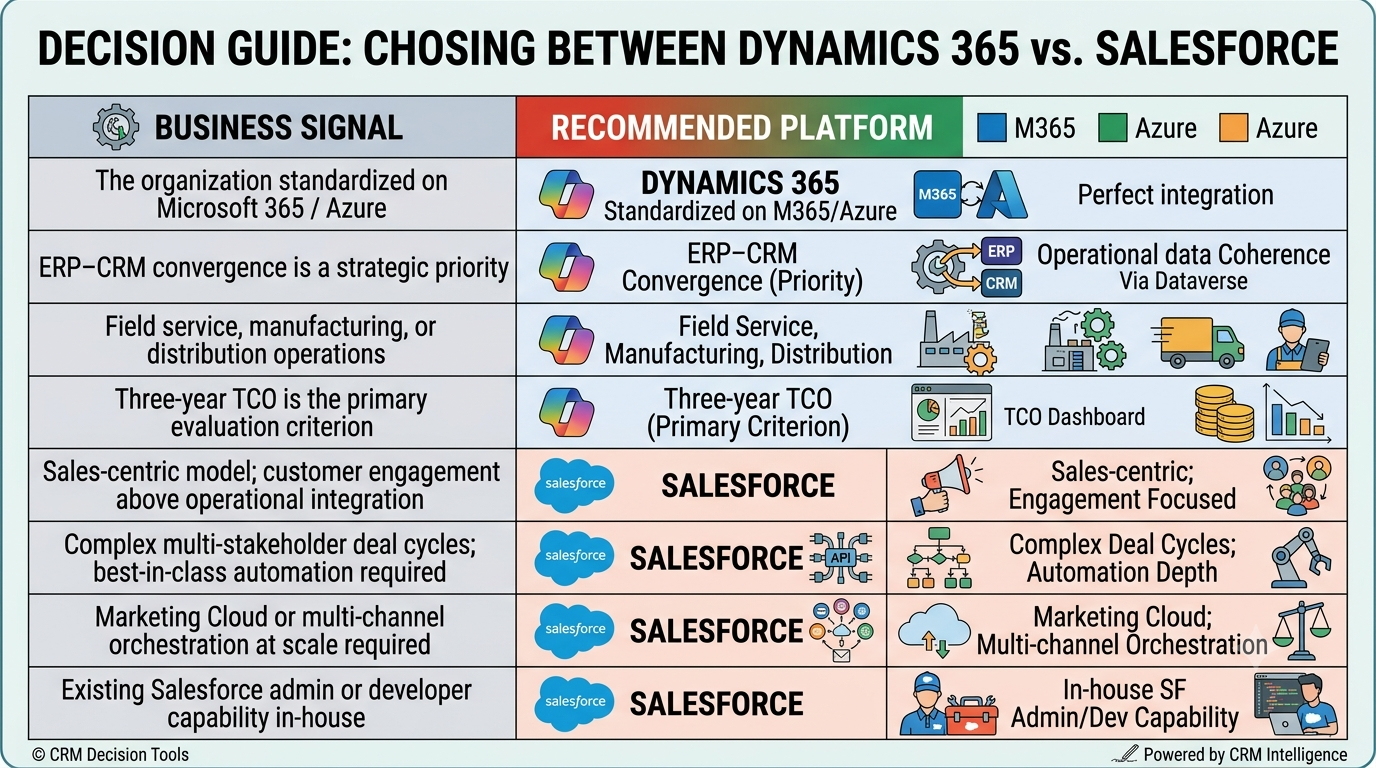
Platform fit depends almost entirely on ecosystem alignment and operational maturity, not on individual features. The following decision framework maps common mid-market business signals to the platform most likely to deliver sustained ROI.
When Dynamics 365 Is the Stronger Choice
Organizations already standardized on Microsoft 365, Azure, and Teams will extract significantly more value from Dynamics 365. The native integration removes friction at every layer: Outlook, Teams chat, SharePoint documents, and Power BI reporting are all native, not middleware-dependent. For manufacturing, distribution, professional services, and field service sectors where real-time reconciliation of pipeline data and operational data is non-negotiable, Dynamics 365 holds a structural advantage through its shared Dataverse layer across Sales, Field Service, Business Central, and Finance & Operations.
When Salesforce Is the Stronger Choice
Organizations that require best-in-class sales automation depth, advanced marketing orchestration via Marketing Cloud, or have complex multi-stakeholder deal cycles will typically see stronger Salesforce ROI. Organizations with existing Salesforce admin and developer capability in-house, or those whose commercial model places customer engagement decisively above operational integration, belong in the Salesforce column.
Where Each Platform Creates Unexpected Complexity
Salesforce becomes operationally expensive when it requires extensive Microsoft 365 integration, when Marketing Cloud and CPQ must be licensed separately at scale, or when internal teams lack the developer resources to maintain a heavily customized org. Dynamics 365 introduces unnecessary complexity when an organization has no existing Microsoft infrastructure, when its commercial model is exclusively sales-led rather than operations-led, or when the required Copilot AI licensing adds cost beyond what the use case justifies.
Conclusion
There is no definitive answer to whether Dynamics 365 or Salesforce is the better CRM for mid-market organizations. The right answer depends on ecosystem alignment, customer data strategy, operational complexity, ERP integration requirements, and the internal capability to sustain a transformation over time. What is definitive is that organizations evaluating CRM platforms through the lens of software features rather than business outcomes consistently underperform, and the 55% failure rate is the evidence.
The CRM market in 2026 rewards strategic clarity over technical sophistication. Both platforms are powerful. Both are growing rapidly. Both carry genuine AI momentum: Salesforce through Agentforce’s commercial scale and Dynamics 365 through Copilot’s embedded breadth. But neither platform delivers value on its own. The business strategy, the data architecture, and the adoption model deliver the value. The platform is the enabler.
Mid-market organizations that treat CRM modernization as a long-term transformation initiative rather than a software purchase will consistently outperform those that do not. That shift in thinking is, ultimately, the most honest comparison this conversation can offer.
Connect with us for a CRM assessment or implementation strategy consultation.

.png)
.png)


