.png)


In a lot of finance functions, planning and reporting are two separate worlds. Actuals live in the ERP. The budget lives in a spreadsheet model — or a planning tool that was set up by different people, on different assumptions, at a different level of detail. Then someone spends the back half of every month trying to compare them.
A leading energy group we worked with set out deliberately to close that gap. Their planning principle is one any finance leader can borrow.
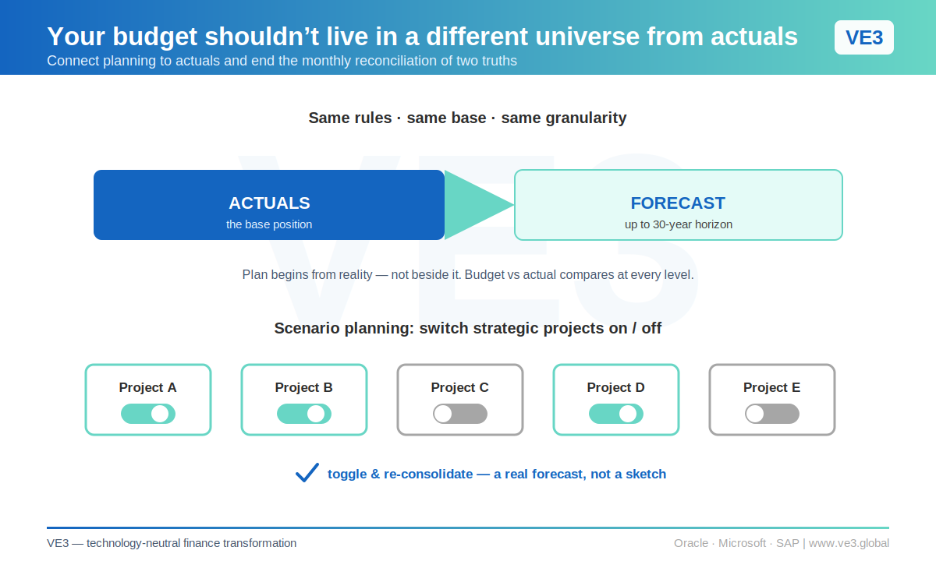
Three things that connect plan to actual
Same consolidation rules. Their budget consolidates using exactly the same rules, reporting groups and intercompany logic as their actuals. A consolidated budget and consolidated actuals are therefore directly comparable, because they were assembled the same way. No reconciliation of methodologies, just a variance.
Actuals as the base. Each company's budget starts from its actuals position rather than a blank sheet, then models forward — in this group's case, over long horizons of up to several decades for some entities. Planning begins from reality instead of beside it.
Same level of detail. They plan at general-ledger and dimension level — profit centre, cost centre, department — the same granularity their actuals carry. So a budget-versus-actual comparison works at every level, not just at the top.
The scenario-planning payoff
Because the plan shares the actuals' structure, this group can do something genuinely useful: switch entire strategic-project companies on and off to model different futures. Want to see the group's shape if three projects go ahead and two are deferred? Toggle them and re-consolidate. The projects are modelled at the same depth as operational entities, so the scenario is a real forecast, not a sketch.
This is only possible because planning isn't a separate island. If your budget lived in a disconnected model, switching a project on would mean rebuilding the model by hand.
What to ask for in a demo
Two questions cut to the heart of it. First: "Show me a consolidated budget and consolidated actuals side by side — were they built with the same consolidation logic?" Second: "Let me override a few forecast periods with actuals as they come in, without breaking the model." If both work cleanly, your plan and your actuals genuinely share a home. If the vendor has to export, re-map and re-import, they don't.
The goal is not fancier forecasting. It is ending the monthly ritual of reconciling two versions of the truth that were never built to agree.
About VE3
VE3 is a technology-neutral finance transformation consultancy partnering with Oracle, Microsoft and SAP. Connecting planning to actuals is an operating-model and data question before it is a tooling one, which is why our vendor-independent approach starts with how you want to forecast and reconcile — then selects the platform to match. If your budget and your actuals still live in separate worlds, the VE3 team can help you bring them together.

.png)
.png)


