.png)


In short: TM Forum compliance across Open APIs, the Open Digital Architecture, and related certifications has shifted from a nice-to-have to a hard procurement gate for telecom vendors and integrators. With 60 per cent of CSP RFPs mandating Open API conformance, certified companies are winning deals faster, integrating more cheaply, and positioning themselves where the transformation spend is heading through 2030.
The telecom industry doesn't change quietly. Legacy OSS/BSS stacks that took decades to build are being pulled apart and rebuilt as cloud-native, API-first platforms, and TM Forum is writing the rulebook for how that happens.
What started in 1988 as a small interoperability group has grown into a global alliance of 800-plus companies, including AT&T, Vodafone, Deutsche Telekom, Jio, all three hyper scalers, and every major vendor from Ericsson to Amdocs. Together, these members serve five billion customers and generate over $2 trillion in revenue. When an industry body of that scale agrees on standards, those standards stop being suggestions and start becoming procurement requirements.
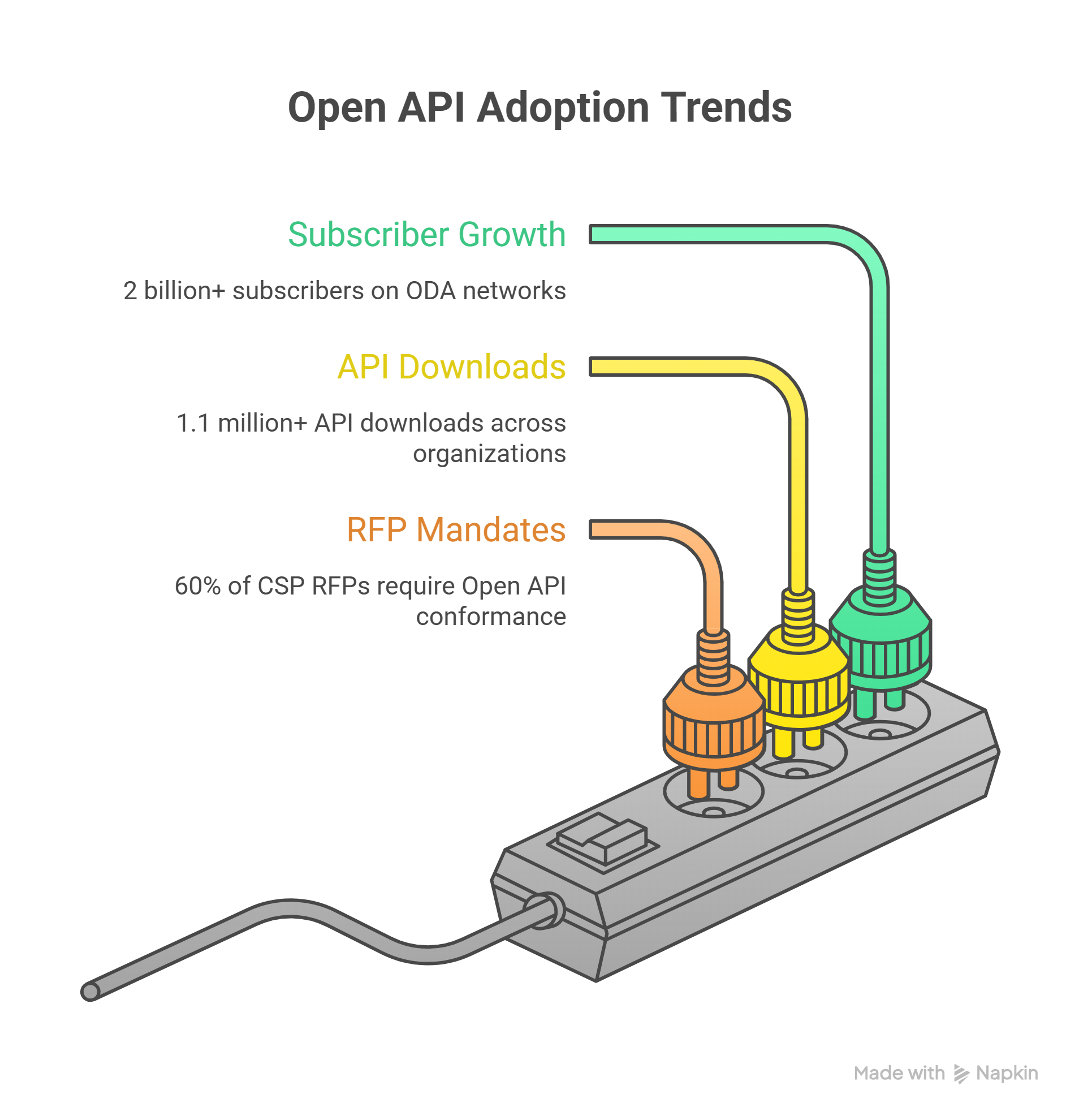
And that's exactly what's happening. Roughly 60 per cent of CSP RFPs now mandate TM Forum Open API conformance. If your product isn't certified, you may not even make the shortlist.
What are the TM Forum standards that matter?
TM Forum's output is organised into two layers. The first is Frameworx, the Business Process Framework (eTOM), the Information Framework (SID), and the Application Framework (TAM). Around 90 per cent of major operators already use these as the foundation of their operations. They're the shared language of telecom IT.
The second layer is the Open Digital Architecture (ODA), which repackages those Frameworx assets for the cloud-native era. ODA breaks telecom IT into modular, pluggable components that communicate through standardised APIs and run on a Kubernetes-based environment called the ODA Canvas. It's organised into four architectural layers: business, information systems, implementation, and deployment, with components grouped across six functional blocks covering everything from commerce and billing to engagement and intelligence management.
In TM Forum's 2025 survey of executives at 117 operators, one in three said ODA is the core guiding principle of their transformation. Another 55 per cent have embedded elements of it. AWS, Microsoft, and Google Cloud have each built managed ODA Canvas environments. This is one of the rare standards where operators, vendors, and hyperscalers are all genuinely invested.
Why are TM Forum Open APIs the integration layer everyone is building on?
At the centre of TM Forum's commercial influence is its Open API programme, with over 100 REST-based specifications covering product catalogues, ordering, customer management, billing, trouble ticketing, service activation, and newer intent-based capabilities for autonomous networks.
The numbers speak for themselves: 1.1 million-plus downloads, 60,000 developers, 2,900 organisations. Over 200 CSPs and partners have signed the Open API Manifesto, and around 100 companies have achieved formal conformance certification across 1,500-plus APIs in live products.
Why does this matter commercially? Three reasons. First, it's a procurement gate vendor without certification that is filtered out before conversations begin. Second, it eliminates the bespoke integration work that historically consumed 30 to 40 per cent of OSS/BSS project budgets. Third, through the joint conformance programme launched by TM Forum and the GSMA in 2025, compliance now extends to the broader network-API economy, including Open Gateway and CAMARA service APIs. One certification effort, multiple market doors.
Do TM Forum certifications actually move the needle?
TM Forum runs product-level and individual-level certification programmes, both of which carry real commercial weight.
On the product side, the Open API Conformance programme uses tiered levels Bronze through Diamond (50-plus APIs) validated against test kits with results published on a public leaderboard. The newer ODA Component Certification, launched at DTW Ignite in June 2025, validates that components meet ODA specifications inside a compliant Canvas. Around 100 companies have certified over 1,500 APIs, and 18 CSPs have earned the "Running on ODA" accreditation, collectively serving more than two billion subscribers.
On the people side, more than 33,000 individuals hold TM Forum certifications across skill paths, including eTOM, SID, Open APIs, ODA, and autonomous networks. For systems integrators, the depth of their certified talent pool is now a standard differentiator in competitive evaluations. It shows up in RFP responses, and it matters to procurement teams.
The measurable impact of TM Forum compliance
What operators are actually seeing
The impact isn't theoretical. A major European operator realised the scale of the impact.
Speed: Product launches cut from 12 months to 4. Service extensions from 9 months to 2 weeks. API provisioning from weeks to seconds.
Cost: Up to 30% lower integration costs and 40% faster deployments with ODA-based architectures (McKinsey).
Scale: 1.5 million daily customer onboardings, 65% NOC headcount reduction, code reused unchanged across 11 national markets.
Autonomy: 80% fewer critical network faults, 5,500 person-years of labour saved, 800 MWh energy reduction at Level 4.
These are production-scale results at operators serving hundreds of millions of subscribers.

What should technology companies do about TM Forum compliance?
For organisations serving the telecom sector, TM Forum compliance has become the primary mechanism for demonstrating credibility with CSP buyers. The playbook is practical: certify your consultants across the frameworks that show up in RFPs, pursue product-level conformance for any platforms or accelerators you bring to market, engage in TM Forum's Catalyst programme to co-deliver proofs-of-concept alongside named CSP champions, and start building competency in the emerging AI and autonomy standards before they become mandatory.
The companies that treat compliance as a strategic investment, not an afterthought, will capture a disproportionate share of the telecom transformation spend that defines this decade.
Who We Are
VE3 helps telecom operators and technology companies navigate digital transformation with deep expertise in cloud, data, AI and industry-standard frameworks. To learn how we can support your TM Forum compliance journey, get in touch.

.png)
.png)


