.png)


Why group consolidation is still the hardest thing your ERP has to do
If you lead finance for a group of any real size, you already know that consolidation is where the month-end clock runs out. Everything upstream can be on time and the close still slips, because consolidation is where the unreconciled, the multi-currency and the intercompany all arrive at once.
We recently worked with a leading energy group consolidating more than 70 entities across four jurisdictions, in multiple base currencies, rolling up to a single group currency under IFRS. Their experience is a useful lens on why this problem is so stubborn — and what actually fixes it, regardless of which ERP platform you run.
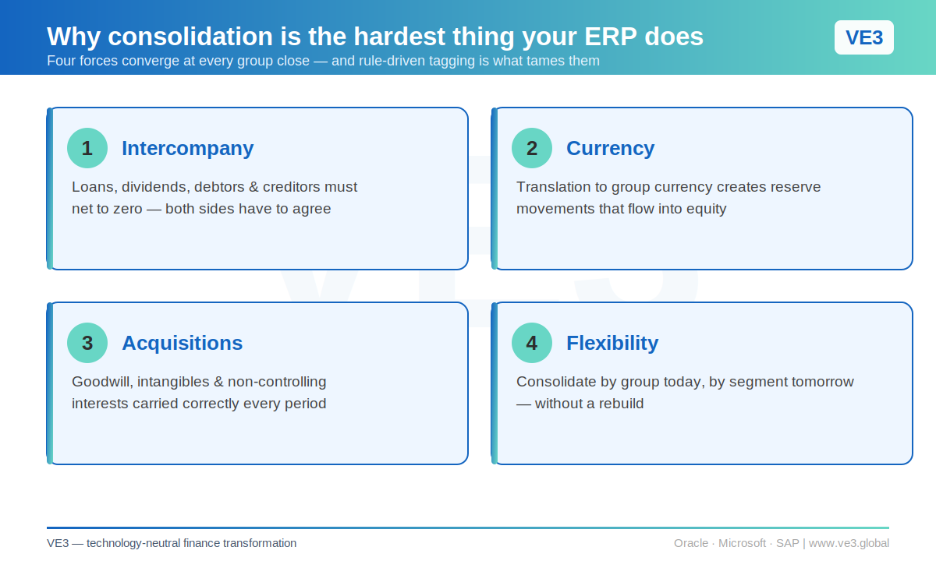
Figure 1: The four forces that converge at every group consolidation.
The four things that make consolidation hard
Intercompany. Every loan, dividend, debtor and creditor between group companies has to be eliminated, and the two sides have to agree. When they don't, someone hunts for the mismatch. Multiply that across dozens of entities and the hunting becomes the job.
Currency. Companies reporting in different base currencies have to be translated to the group currency, and the translation itself creates entries — foreign-currency translation reserve movements that flow into equity. Get the mechanics wrong and the balance sheet doesn't balance.
Acquisition accounting. Goodwill, acquired intangibles and non-controlling interests all have to be calculated and carried correctly through consolidation, period after period.
Flexibility. Today you consolidate at group level. Next year leadership wants it by segment, or by a new sub-group. If that means rebuilding your consolidation, you don't really have a consolidation engine — you have a one-off model.
What good looks like
The change that mattered most for this group was not a feature, it was a principle: eliminations and translations are driven by rules and tags, not by manual journals.
Intercompany transactions are tagged at the point they are posted, then matched automatically against reconciliation rules. Mismatches surface as exceptions to investigate, rather than as discrepancies discovered at the worst possible moment. Currency translation runs automatically, and — this is the part finance leaders should ask to see live — a rate change can be simulated and the whole consolidation re-run to show the impact on reserves.
And because consolidation is built on consistently tagged data, the same engine consolidates at group, segment or sub-group level without rework. The flexibility is a property of the data model, not an extra build.
The question to ask your vendor
When you sit through an ERP demonstration, don't accept "yes, it consolidates." Ask the vendor to post an intercompany transaction in front of you, then show it eliminating automatically, then change an exchange rate and re-run. If they can do that smoothly, the architecture underneath is probably sound. If they reach for a manual journal, you've learned something important.
About VE3
VE3 is a technology-neutral finance transformation consultancy and a partner to Oracle, Microsoft and SAP. Our advice on consolidation starts with your group structure and reporting needs, not a product roadmap and the rule-driven, tag-at-source approach described here can be built on any of the leading platforms. If consolidation is where your close runs out of time, the VE3 team can help you fix the architecture underneath it.

.png)
.png)


