.png)


The Architecture Decision That Defines Digital Success
Enterprise architecture decisions have become significantly more complex in 2025 and 2026 than they were even a few years ago. Organizations are no longer making technology choices solely based on infrastructure upgrades or software replacements. Instead, architecture decisions are now directly connected to AI readiness, digital resilience, operational scalability, cybersecurity maturity, cloud economics, and long-term competitive advantage.
Technical debt is estimated to consume 20–40% of enterprise technology value across many organizations. This shift is happening because the technology landscape itself has fundamentally changed. According to Gartner, global IT spending is projected to reach nearly $5.43 trillion in 2025, reflecting the rapid acceleration of enterprise investments in AI, cloud ecosystems, automation, and intelligent platforms. At the same time, enterprises are under pressure to modernize aging systems while simultaneously integrating generative AI into business operations. Nearly 40% of enterprise applications are expected to include AI-agent capabilities by 2026.
However, despite massive investment, many organizations are struggling to convert transformation initiatives into measurable business outcomes.
More than 75% of large enterprises are expected to establish platform engineering teams by 2027.
Many enterprises rushed into cloud migration, SaaS expansion, or AI adoption without first evaluating whether their underlying systems were actually capable of supporting future operational complexity. Enterprise AI adoption has crossed 90% in several industries, yet governance maturity remains significantly lower.
This is precisely why one question has become central to every architecture review board:
Should we buy, build, or modernize?
The answer determines not only implementation success, but also how adaptable an organization will remain over the next decade.
Why Traditional Architecture Reviews Are No Longer Sufficient
From Technology Selection to Business Strategy
Today, architecture leaders must evaluate whether systems can integrate with AI ecosystems, support composable business models, enable real-time interoperability, and scale across increasingly distributed digital environments. In many organizations, technology stacks now consist of legacy applications, cloud-native services, SaaS platforms, AI copilots, microservices, APIs, and third-party integrations operating simultaneously across hybrid environments.
As complexity increases, poor architecture decisions create compounding risks. These risks do not always appear immediately. Instead, they emerge over time through integration bottlenecks, rising cloud costs, fragmented data governance, the accumulation of technical debt, vendor lock-in, and operational inefficiencies.
The Rise of Platform Engineering
This growing complexity explains why platform engineering has become one of the most important enterprise architecture trends globally. Organizations are increasingly recognizing that without strong architectural governance, transformation programs become unsustainable. Consequently, architecture reviews can no longer function as isolated technical assessments.
Understanding the Buy Strategy
Buying refers to adopting commercial software products, SaaS platforms, managed ecosystems, or vendor-driven enterprise solutions instead of building capabilities internally.
For many operational functions, buying remains the most efficient strategy because mature vendors already provide highly optimized solutions. For example, payroll management, collaboration platforms, CRM systems, HR software, and IT service management are less likely to require extensive customization to produce competitive differentiation.
The biggest advantage of buying is speed. Organizations can get to enterprise-grade capabilities much faster than they could build them themselves. Vendors also are constantly updating their products, dealing with security patches, and increasingly adding AI-enhanced features to their platforms.
The Hidden Cost of Convenience
However, the buy approach is far from risk-free.
In recent years, SaaS has exploded in the enterprise, often leading to fragmented ecosystems and uncontrolled software sprawl. There are organizations that are adopting SaaS platforms due to the reason of their cheaper implementation and ease of the process. But licensing fees, integration complexity, and the overhead of customization ultimately resulted in significant operational inefficiencies.
Too much reliance on external platforms can lead to issues for organizations such as:
- vendor lock-in,
- limited customization,
- escalating subscription costs,
- integration bottlenecks,
- and restricted architectural flexibility.
As a result, architecture review boards must evaluate buying decisions not only from an implementation perspective, but also from a long-term sustainability standpoint.
Understanding the Build Strategy
Building means crafting solutions that are tailored to an organization’s workflows, operational requirements, customer experiences, or proprietary business models.
This strategy is even more valuable when technology itself is a competitive advantage.
Fintech, healthcare, logistics, manufacturing, and AI-native businesses are increasingly turning to custom-built ecosystems as standardized platforms cannot fully accommodate their operational complexity or strategic differentiation.
Generative AI’s Impact on Software Development
Generative AI and AI-assisted software development have fundamentally changed the economics of building.
Engineers are now becoming more productive with AI coding assistants that support developers in code generation, automation, documentation, and rapid prototyping.
This enables organizations to now create complex digital platforms much quicker than ever before. But faster development also brings new architectural risks.
Why Modernization Has Become the Dominant Strategy
Replacing current systems is impractical and perhaps dangerous for most businesses. Therefore, corporate architecture has adopted modernization as the most popular approach in the world. Modernization allows enterprises to leverage existing ecosystems rather than starting from scratch.
This will require a transformation of operational procedures, data platforms, customer experiences, and integration layers. The modernization efforts are not just about moving to the cloud anymore.
Cloud Migration Alone Is Not Modernization
The real modernization is about creating adaptable AI-enabled ecosystems that are ready to use. This covers API enablement, workflow redesign, improvements of data accessibility, automation, reduction of technical debt and support for composable architecture models. Legacy systems are increasingly becoming a roadblock to AI adoption, cybersecurity resilience, real-time analytics, automation and digital customer experiences. Hence, modernization is not just an IT initiative anymore.
Quick Decision Checklist for Architecture Review Boards
Before approving any architecture decision, leadership teams should evaluate the following questions:
Strategic Alignment Checklist
- Does this capability create competitive differentiation?
- Will this system remain relevant for the next 5–7 years?
- Can the architecture support future AI integration?
- Does the solution reduce or increase technical debt?
- Can the platform integrate easily with existing ecosystems?
- Is vendor dependency acceptable for this capability?
- Does the organization possess the engineering maturity required?
- Can governance and compliance requirements scale effectively?
- Will long-term operational costs remain sustainable?
- Does the solution improve business agility?
If multiple answers remain unclear, the organization likely needs deeper architectural assessment before proceeding.
Step-wise Practical Buy-Build-Modernize Framework for Enterprise Architecture Reviews
This framework helps architecture review boards move beyond emotional or trend-driven decision-making and focus instead on long-term enterprise sustainability.
Step 1: Identify whether the capability is strategic or operational?
If the system is standardized and doesn’t differentiate the organization such as payroll, HRMS, communication tools or IT ticketing systems, purchasing is typically the best bet because there are already mature platforms out there. But construct or modernize adds greater value if the capability directly influences customer experience, proprietary intelligence, AI enablement or revenue growth.
A simple rule many enterprise architects now follow is:
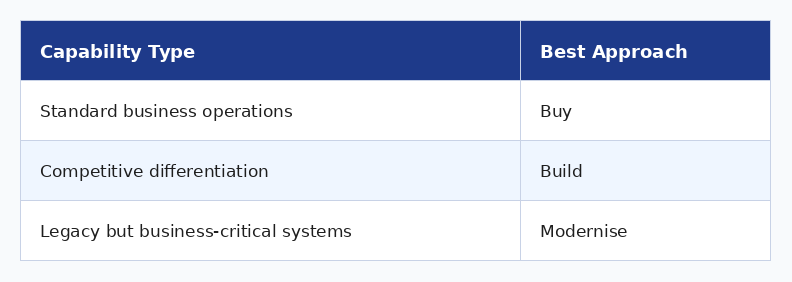
This prevents organizations from wasting resources building systems that provide little strategic value.
Step 2: Assess current architecture readiness
Before deciding anything, organizations should evaluate whether their current ecosystem is actually ready for transformation.
Some points should necessarily be examined by the architectural leaders:
- integration maturity,
- data accessibility,
- infrastructure scalability,
- engineering capability,
- and governance readiness.
There are AI initiatives that fail not because the AI models are weak, but because the organization lacks clean APIs, accessible data, or scalable infrastructure.
Similarly, organizations with low engineering maturity often struggle when attempting large-scale custom development programs.
This assessment helps determine whether the organization is capable of building effectively or whether modernization should happen first.
Step 3: Evaluate long-term sustainability, not just cost
One of the biggest mistakes architecture review boards make is focusing only on implementation cost.
The real evaluation should include:
- operational maintenance,
- integration overhead,
- cloud consumption,
- vendor dependency,
- technical debt,
- and scalability over the next 5–7 years.
Many SaaS platforms initially appear inexpensive but become operationally expensive after customization and AI licensing costs increase.
Likewise, building internally may seem strategically attractive, but without strong governance, it can quickly create technical debt and operational complexity.
The goal is not to find the cheapest solution.
The goal is to identify the most sustainable architecture.
Step 4: Introduce an AI readiness check
AI transformation leads to AI readiness for every architectural decision in 2026 and beyond.
Organizations should assess whether the system can expose APIs, support automation, integrate with AI platforms, enable real-time analytics, and scale dynamically.
If a platform cannot support future AI integration, modernization may become necessary even if the current system still functions operationally.
This is especially important because many organizations are now discovering that legacy environments are limiting AI adoption far more than expected.
Step 5: Use a Hybrid Decision Model
In practice, most enterprises should not fully buy, fully build, or fully modernize.
The most successful organizations combine all three approaches strategically.
For example, they may:
- buy operational platforms,
- build proprietary AI-driven capabilities,
- and modernize legacy integration layers simultaneously.
This hybrid approach reduces risk while improving flexibility and long-term adaptability.
It also aligns better with modern enterprise architecture, where systems evolve instead of being replaced through replacement programs.
Common Architecture Mistakes Organizations Continue to Make
Mistake 1: Selection based on cost
Many organizations focus on short-term savings from implementation while ignoring the long-term consequences for operations. Architectural decisions made cheaply often turn into transformation problems that are expensive.
Mistake 2: Neglecting governance in the excitement of innovation
Due to hurry or time constraints, organizations speed up development with AI-generated code and overlook governance requirements leading to fragmented architectures and risks of technical debt too.
Mistake 3: Customizing everything
Some capabilities don’t need to be built internally. Too much detail and complexity in the design of operational systems leads to unnecessary complexity with no business value.
The Future Belongs to Hybrid Enterprise Models
In practice, most organizations will not rely exclusively on buying, building, or modernizing.
Rather, the future is hybrid operating models that strategically combine all three approaches.
Enterprises might buy standard operational platforms, build in-house AI customer capabilities, and upgrade legacy integration architecture simultaneously.
This hybrid approach balances innovation and operational control. It enables organizations to evolve over time and not be caught up in large transformation programs risks.
Final Thoughts
The buy-build-modernize decision is no longer simply a technology procurement discussion.
It is now a strategic business decision that shapes organizational resilience, innovation capacity, and future competitiveness.
In today’s architectural environment, decisions directly determine how effectively organizations can adapt to change.
The enterprises that succeed over the next decade will not necessarily be those with the largest technology budgets or the most aggressive transformation programs.
Instead, the winners will be organizations that make disciplined, future-focused architecture decisions by buying strategically, building selectively, modernizing intelligently, and governing continuously. VE3 helps technology companies navigate digital transformation with deep expertise in cloud, data, AI

.png)
.png)


