.png)


Oracle Fusion Cloud licensing is one of the most frequently misunderstood aspects of an ERP transformation project. Finance directors and project sponsors often enter procurement conversations with a broad sense of what Oracle Fusion does, but limited visibility into how the licensing actually works, what the subscription covers, and where costs beyond the headline fee sit.
This guide is written specifically for housing finance and IT leaders who are evaluating Oracle Fusion or preparing for a licensing conversation with Oracle or an implementation partner. It explains the licensing model in plain terms, covers what is and is not included in the subscription, and highlights the commercial decisions that have the greatest impact on total cost.
The Basics: SaaS Subscription, Not a Perpetual Licence
Oracle Fusion Cloud is available exclusively as a Software as a Service (SaaS) subscription. There is no option to purchase a perpetual licence for Oracle Fusion and run it on your own infrastructure. Organisations that need an on-premise Oracle ERP would need to consider Oracle E-Business Suite or JD Edwards, which are entirely separate product lines with different licensing structures.
A SaaS subscription means the organisation pays an annual fee in exchange for access to the software, which Oracle hosts and manages on its own cloud infrastructure (Oracle Cloud Infrastructure, or OCI). The subscription is typically structured as a multi-year commitment, with three and five years being the most common contract terms. Oracle's standard term is three years, but five-year commitments attract meaningful additional discounts.
This is a fundamentally different commercial model from legacy on-premise ERP. There is no large upfront licence purchase, no server infrastructure to procure, and no major upgrade project to fund every few years. The subscription is a recurring operating expenditure rather than a capital investment, which has implications for how the cost appears in the housing association's financial statements and how it is approved through governance.
What the Subscription Covers
The core Oracle Fusion Cloud subscription covers:
- Access to the licensed software modules on Oracle's cloud infrastructure
- Hosting and infrastructure management by Oracle on OCI
- Quarterly product updates, delivered automatically without a customer-managed upgrade project
- Standard Oracle Support access via My Oracle Support (MOS)
- Basic security patching and vulnerability management
- A non-production environment (typically one test environment) for configuration and testing
It is equally important to understand what the subscription does not cover, as this is where organisations frequently underestimate their total investment.
What is NOT included in the base subscription
Implementation and deployment services. Oracle Integration Cloud (OIC), required for connecting Fusion to third-party systems such as NEC housing management platforms. Oracle Analytics Cloud, if advanced analytics beyond standard Fusion reporting is required. Oracle Guided Learning (OGL), the in-application walkthrough and training tool. Additional production or testing environments beyond the standard allocation. Oracle University training courses and certifications. These are all licensed and billed separately, and should be included in the full business case for any Oracle Fusion deployment.
How Oracle Fusion Licensing is Measured
Oracle Fusion uses two primary licensing metrics, and understanding the difference is essential before entering any commercial negotiation.
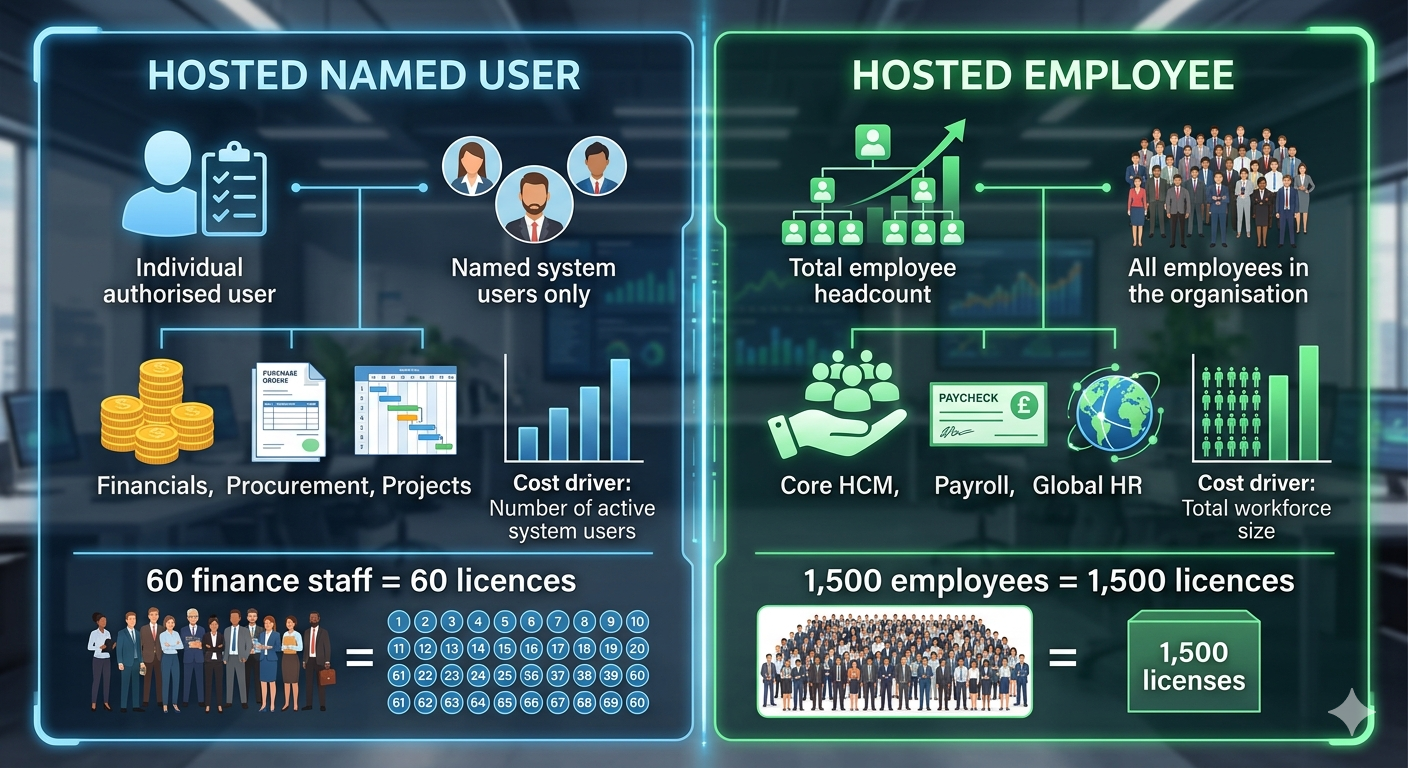
Hosted Named User
A Hosted Named User licence is assigned to a specific individual who is authorised to access the system. It does not matter whether that person uses the system every day or once a month. If they are authorised, they consume a named user licence. This metric is common for modules used by a defined set of operational users, such as the finance team using Oracle Fusion Financials or the procurement team using Oracle Fusion Procurement.
For a housing association with 60 finance staff using Oracle Fusion Finance and Procurement, the organisation would typically need 60 named user licences for those modules, regardless of how many of those users log in on any given day.
Hosted Employee
A Hosted Employee licence is an enterprise-wide metric. It is counted based on the total number of employees recorded in the system, not the number of people who actively log in. This metric applies primarily to Oracle Fusion HCM and Payroll modules, because these systems hold data for every employee in the organisation, not just those who interact with the system directly.
For a housing association with 1,500 employees, the Hosted Employee licence count for HCM and Payroll would be based on that total headcount, including staff who never personally access Oracle Fusion. This reflects the reality that the system is processing payroll, managing pension records, and holding employment data for all 1,500 people, even if only the HR and payroll team interact with it directly.
Understanding this distinction matters because it shapes the total licence count and therefore the subscription cost for organisations with large workforces relative to the number of active system users. A housing association with 1,500 employees but only 60 finance and HR system users will pay on a Hosted Employee basis for HCM and Payroll, and on a Named User basis for Finance and Procurement.
Named User vs Hosted Employee: At a Glance
Module Structure: What You License and What You Do Not
Oracle Fusion Cloud is structured as a suite of modules across several pillars. Housing organisations typically license from the Finance and HCM pillars, though the specific modules within each pillar vary by organisation.
Within Oracle Fusion Financials, common modules for housing include General Ledger, Accounts Payable, Accounts Receivable, Fixed Assets, Cash Management, and Expenses. Procurement is a separate pillar covering Purchasing, Sourcing, Supplier Management, and Contracts. HCM covers Core HR, Payroll, Absence Management, and Time and Labor.
Critically, each module is licensed separately. An organisation that licenses Oracle Fusion Financials does not automatically receive access to Procurement or HCM. The initial scoping exercise with an implementation partner should identify which modules are required and confirm the licensing metric that applies to each, because this is what drives the subscription cost calculation.
Each module also comes in different editions, typically Standard, Professional, and Enterprise, with materially different price points between them. Oracle's default proposal will often lead with Enterprise edition pricing. A proper needs assessment before contract negotiation can identify where Standard or Professional editions meet the organisation's requirements at a lower cost.
Contract Terms and What to Watch For
Oracle Fusion Cloud contracts contain several commercial provisions that housing finance teams should understand before signing.
You cannot reduce licence counts mid-term
Once a subscription term is agreed, the organisation is committed to the licence volumes purchased for the full contract period. If headcount falls during the term, the licence cost does not reduce until the next renewal. This means the initial licence count should be sized carefully, avoiding over-purchasing relative to the actual planned rollout scope.
Annual price escalation
Oracle typically builds annual price escalation into multi-year contracts. Finance teams should negotiate an explicit cap on this escalation, typically linked to CPI or a fixed percentage, and ensure it applies to both the current term and the first renewal period.
True-up at renewal
If the organisation's employee headcount or named user count grows beyond the licensed quantity during the term, Oracle will identify the excess at renewal and require a true-up payment. Regular internal reviews of licence utilisation against contracted quantities help avoid surprises at renewal. Negotiating a growth buffer of around ten percent into the initial contract provides some headroom before a true-up is triggered.
Contractors and temporary workers
The definition of who counts as a Hosted Employee can include contractors, agency workers, and temporary staff whose records are held in the HCM system. Housing associations with significant numbers of agency maintenance staff or seasonal workers should clarify this definition explicitly during negotiation, as it can materially affect the licence count.
What happens at renewal
Oracle SaaS subscriptions do not automatically revert to a lower cost at renewal. The negotiating leverage that exists at initial contract stage, where Oracle is motivated to win a new deployment, is reduced at renewal where the organisation is already live and migration costs are high. The most effective approach is to negotiate favourable renewal terms, including capped escalation rates, as part of the initial contract rather than leaving them open.
Integration Licensing: A Frequently Missed Cost
For housing associations, the integration between Oracle Fusion and the housing management system is not optional. It is a core requirement. Oracle Integration Cloud (OIC) is the Oracle platform for building and managing these integrations, and it is licensed separately from the core Fusion subscription.
OIC is priced on a combination of message volume and the number of connections, rather than per user. The cost depends on how many integrations are running and the transaction volumes passing through them. For a housing organisation connecting Oracle Fusion to a NEC housing management system, a payroll bureau, a banking platform, and a pension fund portal, the OIC licensing cost is a meaningful budget line that must be included in the full financial model for the project.
Some organisations consider third-party integration platforms as an alternative to OIC. These can be cost-effective for organisations with a small number of well-defined integrations, but for Oracle-to-Oracle integrations and high-volume transactional flows, OIC's native compatibility with Fusion typically provides the most reliable and lowest-overhead solution.
Building an Accurate Total Cost Model
A realistic total cost model for an Oracle Fusion deployment in a housing organisation should include the following components:
1. Core Fusion module subscriptions, sized by licence metric and edition for each module in scope
2. Oracle Integration Cloud, sized for the number of integrations and expected transaction volumes
3. Additional environments beyond the standard allocation, if required for testing and training
4. Oracle Guided Learning, if in-application training support for end users is planned
5. Implementation services from an Oracle partner, covering design, configuration, testing, data migration, training, and go-live support
6. Internal project resource costs, including the finance and HR team time committed to the implementation
7. Annual support and managed services post go-live, if the organisation does not intend to manage the platform entirely in-house
The subscription itself is typically the largest single line item but not always the majority of total first-year cost. Implementation costs for Oracle Fusion projects in housing organisations of typical scale can match or exceed the annual subscription value in year one. Planning for this properly avoids the most common cause of budget overruns in ERP transformation programmes.
Working with an Implementation Partner on Licensing
Most housing associations approach Oracle Fusion licensing through an implementation partner rather than negotiating directly with Oracle alone. A good implementation partner will conduct a proper scoping exercise to identify the correct modules, licence metrics, and edition levels before any commercial discussion with Oracle begins. They will also have visibility of Oracle's typical discount levels for organisations of a similar size and complexity, which is valuable context when evaluating whether a proposed subscription figure is competitive.
The key questions to ask any implementation partner before the licensing conversation starts are: which specific modules are in scope and why; what licence metric applies to each; what edition is being proposed and whether a lower edition would meet the requirement; and whether the integration approach is included in the scoping or priced separately.
Getting clarity on these points before a contract is presented, rather than after, is the single most effective way for housing finance teams to manage Oracle Fusion licensing costs. The subscription is a long-term commitment. Understanding exactly what is being committed to, and at what cost, from the outset is foundational to getting the project approved and keeping it on budget.
VE3: Oracle Fusion Licensing and Implementation Advice for Housing
VE3 is an enterprise AI, data, and digital transformation consultancy and Oracle partner with implementation experience across complex, multi-entity organisations in UK social housing and the public sector. We help housing finance and IT leaders scope their Oracle Fusion requirements accurately, build a credible business case, and navigate the licensing and commercial process. To discuss your Oracle Fusion requirements, visit ve3.global.

.png)
.png)


