.png)


A complete cost guide for UK housing finance and IT leaders
Cost is the question that dominates every Oracle Fusion evaluation conversation, and it is almost always the question that gets the least satisfactory answer. Oracle's list pricing is publicly available at the module level, but the total cost of a multi-entity deployment in a housing association context involves a great deal more than the subscription fee. Implementation services, data migration, integration, internal team time, and ongoing support all add materially to the total investment.
This article sets out every cost component that should appear in a credible business case for a multi-entity Oracle Fusion Finance and HCM deployment for a UK housing organisation, provides indicative ranges where these can be reasonably estimated, and identifies the factors that determine where on those ranges a specific organisation will sit.
An important note on pricing
Oracle does not publish fixed prices for its Fusion Cloud modules. All figures in this article are drawn from publicly available independent market research and benchmarking sources and represent indicative planning ranges, not guaranteed quotes. Sterling equivalents are based on prevailing exchange rates. Actual subscription costs depend on the specific modules, user counts, contract term, edition tier, and negotiation outcome. Always request a formal proposal and seek independent benchmarking before accepting any Oracle pricing proposal.
The Five Cost Components You Need to Budget For
A complete Oracle Fusion deployment budget has five distinct cost categories. Most organisations that experience significant budget overruns do so because they planned for the first one and underestimated the remaining four.
- Subscription licences: the annual SaaS fee for the modules and user counts agreed with Oracle
- Implementation services: fees paid to the implementation partner for design, configuration, testing, data migration, and go-live support
- Complementary platform licences: Oracle Integration Cloud, Oracle Analytics Cloud, Oracle Guided Learning, and additional environments
- Internal resource cost: the finance, HR, IT, and project management time your own organisation must commit to the programme
- Ongoing support and managed services: the cost of supporting and optimising the platform after go-live
Each of these is examined in detail below.
1. Subscription Licences
Oracle Fusion Cloud ERP is priced on a per-user, per-month subscription basis, billed annually. UK list pricing for core Fusion Finance modules typically runs in the range of £250 to £400 per named user per month at standard edition. HCM and Payroll modules that use the Hosted Employee metric are priced on total headcount rather than active users, with rates varying by edition and module.
For a mid-sized housing association with 60 named users across Finance and Procurement and 1,500 employees covered under HCM and Payroll licences, the indicative annual subscription before negotiation would typically fall in the range of £400,000 to £700,000. This range reflects variation in module scope, edition tier, and whether specialist modules such as Oracle Financials Reporting and Oracle Expenses are included.
15-25%
Typical discount achievable on Oracle list pricing through multi-year commitment, competitive positioning, and end-of-quarter negotiation
Oracle's list prices are a starting point, not the expected outcome. Multi-year commitments of three to five years attract meaningful additional discounts, with five-year contracts typically delivering 10 to 15 percentage points more discount than three-year agreements. Organisations that present credible competing proposals from SAP or Workday have significantly more negotiating leverage than those that signal Oracle preference early in the process.
Annual price escalation caps should be negotiated as part of the initial contract. Oracle's standard contract may include escalation provisions that, uncapped, could add 3 to 5 percent to subscription costs annually over a five-year term. Negotiating a cap tied to CPI or a defined maximum percentage protects the multi-year budget from unexpected subscription inflation.
2. Implementation Services
Implementation partner fees are typically the largest single cost line in year one of an Oracle Fusion programme, often exceeding the annual subscription value during the delivery period. Independent benchmarking indicates that a core Finance and Procurement deployment for a mid-market organisation runs in the range of £300,000 to £650,000 in partner services. Adding HCM and Payroll to the scope brings the total implementation fee to £500,000 to £1,000,000 for a housing organisation of typical complexity.
For multi-entity deployments with complex intercompany structures, NEC or other housing management system integrations, multiple pension scheme configurations, and a legacy data migration, the upper end of these ranges is the more realistic planning assumption.
What implementation services cover
A well-scoped statement of work from an implementation partner should cover enterprise structure design and configuration, chart of accounts design, module configuration across all in-scope modules, integration design and build, data migration design, extraction, transformation, validation and loading, test cycle management (unit, system integration, and user acceptance testing), training development and delivery, cutover planning and go-live support, and a defined hypercare period post go-live.
Services that are sometimes excluded from initial proposals and added later as change orders include additional test environments, extended parallel run support if payroll thresholds are not met on the first cycle, post-go-live report development, and integration remediation when data quality issues in source systems are discovered during testing rather than design.
20-40%
Additional cost added through change orders on Oracle implementations with poorly defined initial scope (ERP Research, 2026)
Scope definition is cost control
The single most effective way to control implementation costs is to define scope precisely before signing the statement of work. Ambiguous requirements become change orders. A housing organisation that takes the time to map its processes, document its data structures, and specify its integration requirements before partner selection will consistently achieve better cost outcomes than one that defers these decisions to the implementation phase.
Partner selection matters as much as scope definition. Oracle's own consulting arm tends to price at the higher end of the market. Specialist Oracle boutique partners frequently provide better value for mid-market housing deployments than the large system integrators, who carry higher overhead rates and may assign less experienced resource to engagements of this scale.
3. Complementary Platform Licences
The core Oracle Fusion subscription does not cover everything a housing organisation needs for a fully operational deployment. The following additional licence costs should be included in any complete budget.
Oracle Integration Cloud (OIC)
OIC is the Oracle platform for building and managing integrations between Oracle Fusion and third-party systems, including housing management platforms such as NEC. It is priced on a combination of message volume and the number of connections rather than per user. For a housing organisation running integrations with a housing management system, a banking platform, a pension portal, and payroll bureau interfaces, the annual OIC cost typically falls in the range of £30,000 to £80,000 depending on transaction volumes and the number of active integration flows.
Oracle Guided Learning (OGL)
OGL is Oracle's in-application guidance tool that provides contextual help and step-by-step walkthroughs for end users. It is licensed separately from the core subscription. For housing organisations with high staff turnover or a large self-service user population, OGL materially reduces the ongoing training burden and associated cost. Pricing typically runs in the range of £25 to £50 per user per month for the named user population.
Additional Environments
The standard Oracle Fusion subscription includes one non-production environment. Most implementation projects require at least two additional environments: a development and configuration environment, and a dedicated testing environment separate from the configuration instance. Additional environments are licensed separately and should be budgeted for explicitly. Each additional environment typically costs 15 to 25 percent of the annual production subscription.
Oracle Analytics Cloud (OAC)
Oracle Fusion includes built-in reporting and analytics capability through Oracle Transactional Business Intelligence (OTBI). For housing organisations with more sophisticated reporting requirements, Oracle Analytics Cloud provides enhanced visualisation, predictive analytics, and integration with external data sources. OAC is licensed separately and is an optional addition to the core deployment. It is not required for standard financial and management reporting.
4. Internal Resource Cost: The Budget Line Nobody Includes
The internal resource cost of an Oracle Fusion implementation is almost always the most significantly underestimated element of the total programme budget. It rarely appears as a line item in the business case presented to the board, because it does not generate an invoice. But it is a real cost, either as opportunity cost if existing staff are diverted from their day jobs, or as direct cost if backfill or additional interim resource is required to cover their operational responsibilities.
Industry guidance indicates that finance and operations subject matter experts (SMEs) should expect to commit 50 to 100 percent of their time during the peak phases of the implementation, which typically run from enterprise design through user acceptance testing. For a housing organisation deploying Oracle Fusion Finance, Procurement, and HCM in a single programme, this means meaningful time from the finance director, financial controller, payroll manager, procurement manager, and IT lead across a project period of nine to fifteen months.
50-100%
Time commitment expected from internal finance and operations SMEs during peak implementation phases (Oracle ERP Cloud Implementation Guide, 2026)
The consequences of under-resourcing the internal team are consistent and well documented. Implementation partners can configure the system, but they cannot make business decisions about chart of accounts structure, approval hierarchies, cost centre design, or exception handling rules. When these decisions are delayed because internal SMEs are not available, the project timeline extends and the implementation partner costs increase through extended engagement or change orders.
A realistic internal resource budget for a housing organisation of typical scale should account for: a part-time or full-time internal project manager throughout the programme; finance SME time at 60 to 80 percent during design and testing phases; payroll and HR SME time at similar levels during HCM configuration and parallel run; IT SME time for integration design and testing support; and a contingency for backfill costs in operational finance and HR roles during peak project periods.
5. Ongoing Support and Managed Services
The investment in Oracle Fusion does not end at go-live. The platform requires ongoing support, configuration management, and periodic optimisation to maintain its effectiveness as the organisation and its requirements evolve.
Application Managed Services (AMS)
Most housing organisations that lack deep Oracle Fusion expertise in-house engage an Oracle partner for ongoing Application Managed Services post go-live. AMS contracts cover break-fix support, configuration changes, quarterly update testing and validation, and user support escalations. For a housing organisation running Finance, Procurement, and HCM, an AMS contract with a specialist Oracle partner typically runs in the range of £5,000 to £20,000 per month, depending on the scope of support and the SLA required.
Internal Oracle Administration
Even with an AMS partner in place, most organisations require at least one internally resourced Oracle system administrator who understands the platform and can manage day-to-day user access, security configuration, and liaison with the AMS partner and Oracle Support. For housing associations, this is typically a role that sits within the IT or finance function and is shared with other responsibilities.
Oracle Support
Standard Oracle Support is included within the subscription fee and provides access to Oracle's My Oracle Support portal, patches, and a support request system for platform issues. Premier Support is the standard tier. Organisations with more complex support requirements can access additional support tiers, but for most housing deployments, the included standard support is sufficient when combined with a capable AMS partner.
Indicative Cost Summary: A Typical Housing Organisation
The following table provides indicative cost ranges for a UK housing association with 1,000 to 2,000 employees, 50 to 80 named Finance and Procurement users, deploying Oracle Fusion Finance, Procurement, HCM, and Payroll across a multi-entity group structure. All figures are annual except where stated.
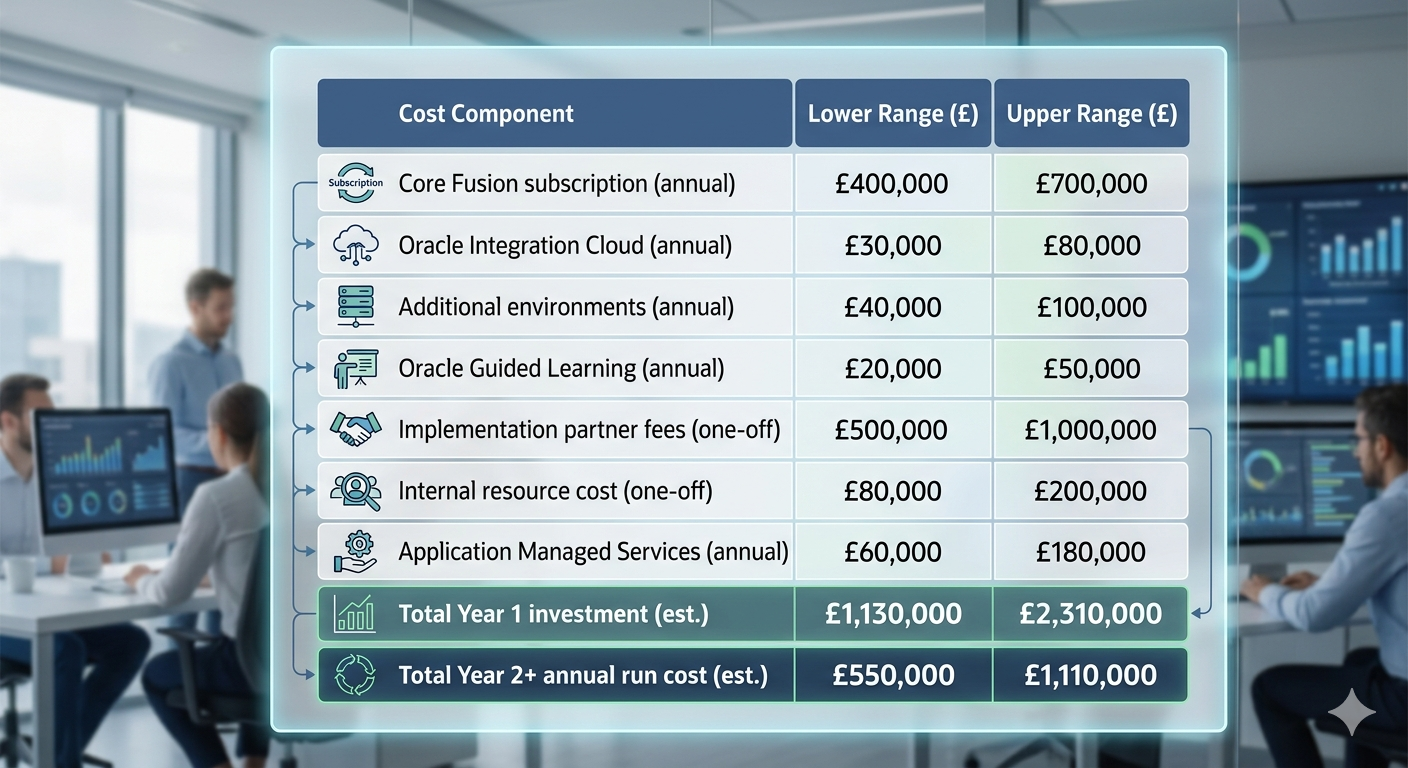
All figures are indicative planning ranges based on publicly available market benchmarks. Actual costs depend on scope, negotiated subscription terms, data complexity, number of integrations, and partner selection.
The total year one investment range of approximately £1.1 million to £2.3 million reflects the genuine spread of outcomes for a housing organisation of this profile. Organisations at the lower end of this range will have negotiated well on subscription pricing, defined scope tightly before signing the implementation statement of work, had clean legacy data, required fewer integrations, and had sufficient internal resource available to support the programme. Organisations at the upper end will have encountered one or more of the cost escalation factors described below.
What Drives Costs Above Budget?
The factors that push Oracle Fusion implementations above their initial budget are consistent and well documented across the sector. Understanding them before the programme begins is the most effective way to prevent them.
Scope creep through change orders
Poorly scoped initial statements of work lead to change orders that add 20 to 40 percent to implementation fees. The mechanism is straightforward: requirements that were not defined or were defined ambiguously at contract stage are treated as new scope when they emerge during delivery. Every change order adds cost and typically extends the timeline.
Data quality issues discovered late
Data issues identified during user acceptance testing rather than during the design phase are significantly more expensive to resolve. They require rework of data migration scripts, additional test cycles, and may delay go-live, extending the implementation partner engagement. Public sector Oracle Fusion implementations have documented go-live delays of several months caused by payroll parallel run failures attributable to data quality issues in legacy HR systems.
Extended parallel run
Payroll parallel runs are a critical control before cutting over from a legacy payroll system to Oracle Fusion. If the thresholds for acceptable variance between the two systems are not met in the first or second cycle, the parallel run extends. Each additional parallel run cycle adds implementation partner cost, maintains the burden of running two payroll systems simultaneously, and delays the go-live date. Organisations that underinvest in payroll data quality and parallel run planning are the most likely to encounter this cost.
Integration complexity underestimated
Integrations with housing management systems, banking platforms, pension portals, and payroll bureaux are frequently scoped optimistically in initial proposals. When the actual data structures in the source systems differ from what was assumed during design, integration build costs increase. Organisations that invest in integration discovery work, including technical connection testing with the housing management system vendor, before the implementation partner's statement of work is finalised will have significantly more accurate integration cost estimates.
Internal resource shortfall
When the internal team cannot commit the time the programme requires, the implementation partner fills the gap. This is one of the most expensive ways to run an Oracle Fusion project. Implementation consultants cannot substitute for the business knowledge that finance and HR SMEs bring, and when they try, configuration decisions take longer, testing takes longer, and training is less effective.
Is the Investment Justified?
The question housing boards and finance directors rightly ask is whether the total cost of an Oracle Fusion deployment is justified by the returns. The answer, for organisations of the scale and complexity described in this article, is consistently yes, provided the programme is well executed.
Oracle's own customer data indicates that organisations migrating to Fusion Cloud ERP typically achieve 15 to 25 percent reduction in finance process cycle times and 20 to 30 percent reduction in period-end close duration within 18 months of go-live. For a housing finance team spending significant time on manual consolidation, intercompany reconciliation, and spreadsheet-based reporting, these reductions translate to meaningful capacity release that can be redirected to analysis, business partnering, and compliance activity.
The elimination of on-premise infrastructure maintenance, the reduction in IT support overhead, and the removal of periodic major upgrade costs all reduce the ongoing cost base compared to maintaining a legacy environment. Over a five-year period, independent analysis consistently places cloud ERP at 30 to 50 percent lower total cost of ownership than an equivalent on-premise deployment.
For housing organisations specifically, the regulatory compliance currency that Oracle Fusion's quarterly update cycle provides, the audit trail quality that regulators increasingly expect, and the multi-entity reporting capability that eliminates manual consolidation work are not easily quantified but represent real and material operational value.
VE3: Oracle Fusion Deployment for UK Social Housing
VE3 is an enterprise AI, data, and digital transformation consultancy and Oracle partner with Oracle Fusion Finance and HCM implementation experience across complex, multi-entity UK social housing organisations. We help housing finance and IT leaders build accurate business cases, scope programmes correctly, and deliver Oracle Fusion deployments that stay on budget. To discuss your Oracle Fusion cost modelling requirements, visit ve3.global.

.png)
.png)


