.png)


The Enterprise Semantic Layer: Why Your BI Is Broken and How to Fix It
We are in a data-driven business dominance era, where Business Intelligence (BI) systems come with the power to solve one of the biggest challenges in modern enterprises – transforming raw data into actionable insights. Enterprises invested heavily in data warehouses, dashboards, analytics tools, cloud platforms, and data engineering teams, expecting that decision-making would become faster, more accurate, and more strategic. Yet many enterprises still struggle with conflicting reports, inconsistent metrics, duplicate dashboards, poor trust in analytics, and slow decision cycles.
One dashboard says quarterly revenue increased by 15%, while another claims it increased by 8%. Marketing and finance teams define "active customer" differently. Some enterprise data analysts spend more time validating numbers than generating insights. Many stakeholders & business executives lose confidence in reporting systems because every meeting turns into a debate about whose data is correct without gathering the appropriate context for the information.
This disconnect is not simply an analytical or tooling issue. It is a semantic problem. Such challenges occur in broken BI processing & at the center lies the absence of a robust enterprise semantic layer. Without a unified semantic foundation, enterprises will end up with fragmented definitions, duplicated logic, inconsistent metrics, and disconnected analytical systems. BI becomes unreliable because every department interprets data differently. This article will deliver a complete walkthrough of the enterprise semantic layer and how to fix the disconnected business intelligence analytics with semantic layering. We will also understand how it solves long-standing analytics challenges, its architecture, & benefits.
What is Enterprise Semantic Layer?
An Enterprise Semantic Layer is a centralized business abstraction layer that sits between an enterprise's raw data systems and its analytics or Business Intelligence (BI) tools. It translates complex technical data into standardized business-friendly definitions so that everyone across the organization uses the same meaning for metrics, dimensions, and KPIs.
The enterprise semantic layer ensures that terms such as revenue, active customer, profit margin, churn rate, monthly active users (MAU), etc., are defined consistently across all dashboards, reports, AI systems, and analytics tools. Without a semantic layer, different departments may calculate these metrics differently, leading to conflicting reports and poor decision-making.
Understanding Fragmented Data Ecosystem
One of the biggest reasons enterprise Business Intelligence (BI) systems fail is the existence of fragmented data ecosystems. Modern organizations generate enormous volumes of data across multiple platforms, departments, cloud environments, and applications. Instead of operating as a unified system, enterprise data often exists in disconnected silos with inconsistent structures, definitions, and ownership models. A fragmented data ecosystem occurs when enterprise data is spread across multiple disconnected systems, each operating independently with different formats, standards, and business logic.
Typical enterprise data sources include CRM systems, ERP platforms, HR applications, Marketing automation tools, e-commerce platforms, supply chain systems, cloud applications, IoT devices, financial databases, customer support tools, etc. Data fragmentation also occurs due to factors such as corporate mergers and acquisitions, departmental silos, multi-cloud and hybrid environments, rapid SaaS adoption, and a lack of governance. Let us now understand how the data engineering bottleneck also participates in data fragmentation.
Data Engineering Bottleneck
We can pinpoint that data engineering bottlenecks occur when enterprise analytics and Business Intelligence (BI) systems become overly dependent on centralized data engineering teams for every data-related request. In traditional BI environments, we have observed that engineers are responsible for building ETL/ELT pipelines, integrating multiple data sources, cleaning and transforming datasets, maintaining warehouse schemas, optimizing queries, and implementing new dashboard metrics.
As enterprises generate increasing volumes of structured and unstructured data from cloud platforms, SaaS applications, IoT systems, and operational databases, we can see that an unnecessary workload on data engineering teams. Business users frequently request new KPIs, custom reports, real-time dashboards, data corrections, and schema updates, creating long backlogs and delayed analytics delivery. It also leads to a fragmented data environment.
Instead of enabling agility, the BI ecosystem becomes slow, rigid, and operationally constrained. Common causes of data engineering bottlenecks include:
- Complex ETL/ELT pipeline maintenance
- Continuous schema evolution across systems
- Integration of fragmented enterprise data sources
- High dependency on manual SQL transformations
- Lack of standardized metric definitions
- Growing dashboard and reporting demands
- Poor metadata management and governance
- Limited automation in data workflows
- Real-time processing challenges
- Legacy infrastructure constraints
The solution to data fragmentation, data engineering bottleneck, and broken business intelligence is semantic layering. In the next section, we will have a closer look at how semantic layer can fix broken BI.
How the Semantic Layer Fixes Broken BI?
We can use the enterprise semantic layer to resolve many core problems that make traditional Business Intelligence (BI) systems unreliable and inefficient. By standardizing metrics, creating a central cloud + on-premise repository, and simplifying access to enterprise data (with robust security, of course), the semantic layer creates a unified analytical environment that improves consistency, trust, scalability, and decision-making across the enterprise.
Creating a Single Source of Truth
The semantic layer standardizes KPI definitions, business metrics, and dimensions across departments. It ensures every dashboard, report, and analytics tool uses the same governed data logic, eliminating conflicting reports and improving enterprise-wide consistency.
Eliminating Duplicate Logic
Instead of recreating calculations in multiple dashboards and SQL queries, we can use the semantic layer to define business logic once and reuse it everywhere. It reduces redundancy, maintenance complexity, and calculation inconsistencies across analytics systems.
Improving Self-Service Analytics
The semantic layer can help to expose business-friendly datasets and terminology, enabling non-technical users to explore data independently. With this, enterprise users can generate reports and insights without deep SQL expertise or constant support from engineering teams.
Enhancing Data Trust
Trust is essential for successful analytics adoption. Centralized metric governance and transparent business definitions improve confidence in enterprise analytics. We can use the semantic layer to restore trust through standardized metrics, transparent definitions, centralized governance, data lineage visibility, and auditable calculations. Enterprises with trusted analytics environments make faster and more confident decisions.
Accelerating Analytics Delivery
By reducing engineering dependency & enabling reusable metrics, the semantic layer can speed up dashboard development, report generation, and analytical workflows. Organizations gain faster access to reliable insights and improved business agility.
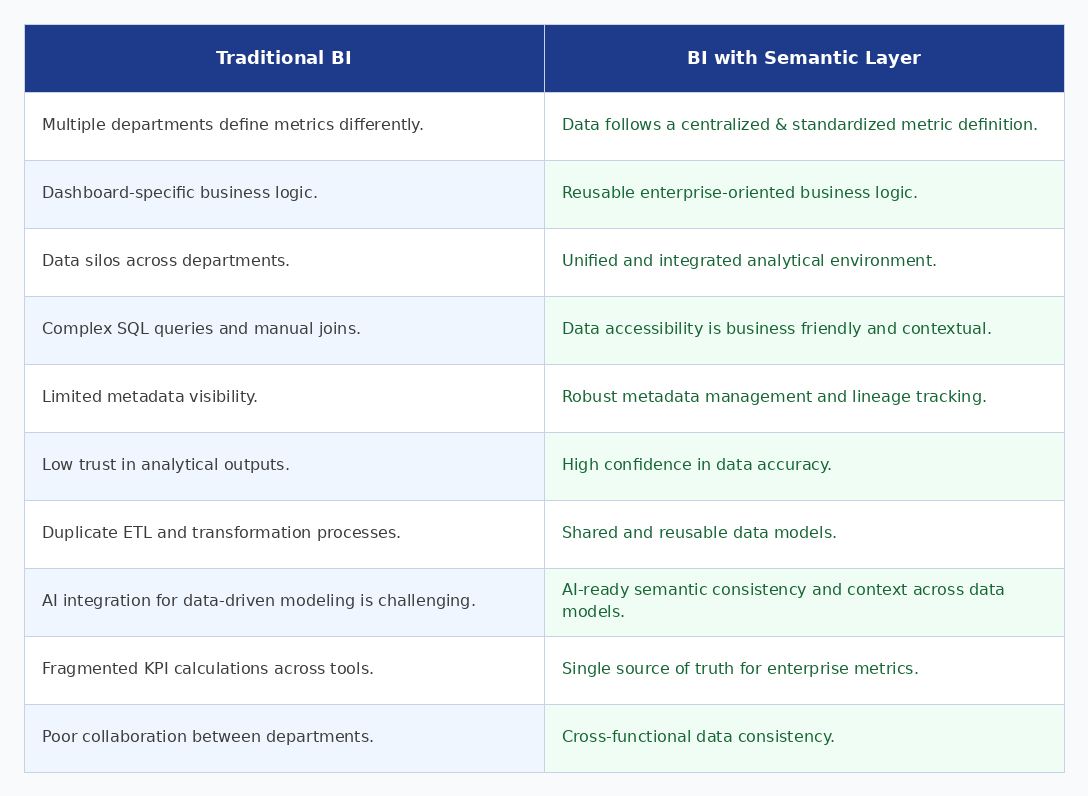
Traditional BI vs. Semantic-Layer-Driven BI
An enterprise-driven semantic layer can solve myriad root problems that traditional business intelligence systems fail to address. By understanding the semantics of data for analytics, enterprises can create a unified analytical environment that lacks in traditional BI.
Benefits of Implementing an Enterprise Semantic Layer
With an enterprise semantic layer, we can provide a 360-degree understanding of enterprise data by standardizing metrics, dimensions, and business logic across analytics systems. It improves data consistency, governance, scalability, and trust while enabling faster decision-making, self-service business analytics, and AI-driven intelligence throughout the enterprise. Let us now explore the benefits of the enterprise semantic layer.
- Improved Data Consistency: The semantic layer standardizes KPI definitions and business metrics across departments. It ensures all dashboards and reports use the same calculations & context-oriented data. It eliminates conflicting numbers, reduces business analytical confusion, and creates a reliable single source of truth.
- AI and Machine Learning Readiness: With the semantic layer, we can extract structured business context data meaningfully from diverse enterprise ecosystems that AI systems require. It can provide consistent, high-quality, and governed data for accurate BI analytics-based predictions and automation. It makes intelligence analytics easy.
- Reduced Operational Costs: With centralized business logic, data engineers can minimize duplicate SQL queries, dashboard calculations, and data transformations. Semantic layers can fetch context-sensitive data, reducing engineering workload, lowering maintenance complexity, decreasing infrastructure overhead, and boosting enterprise analytics environments.
- Increased Data Trust: When all departments use standardized metrics and semantic-based data fetching, along with validated data definitions, analytics confidence improves significantly. Executives, BI analysts, and business teams can trust reports and dashboards, leading to more accurate and confident decision-making processes.
- Better Scalability for Analytics: As enterprises grow, the semantic layer enables scalable analytics by supporting reusable metrics, centralized governance, and standardized models. Organizations can expand data operations without continuously rebuilding reporting logic or increasing engineering complexity.
- Improved Collaboration across Departments: Shared business definitions and consistent KPIs improve collaboration between teams such as finance, sales, marketing, operations, and IT. Everyone works from the same analytical framework, reducing disputes and improving organizational alignment.
Challenges in Building an Enterprise Semantic Layer
Although an enterprise semantic layer provides significant benefits for analytics consistency and governance, implementing it across large organizations can be complex. Here are some challenges enterprises might face while preparing a fully-functional enterprise semantic layer.
- Organizational Resistance: Departments may resist adopting centralized metric definitions because teams usually follow their own reporting methods and business logic. Such alignment often requires strong leadership, collaboration, and change management strategies.
- Data Quality Issues: Incomplete, duplicated, or inaccurate enterprise data reduces the reliability of semantic models. Enterprises must address data cleansing, validation, and quality management before establishing trusted and standardized analytical foundations.
- Fragmented Data Sources: We all know that enterprise data remains distributed across multiple systems, cloud platforms, and applications with inconsistent schemas and formats. Integrating these disconnected environments into a unified semantic framework needs permissions and technical know-how. Also, upgrading from the legacy data fetching system is time-consuming.
- Integration problem with Existing BI Tools: Many enterprises already use multiple BI platforms and reporting systems. It ensures compatibility and seamless integration between the semantic layer and existing analytics tools. The friction comes because it requires extensive customization and engineering effort.
Best Practices for Implementing an Enterprise Semantic Layer
- We can focus on critical metrics first that deliver faster business value and improve organizational adoption. Standardizing high-impact KPIs such as revenue, customer retention, and operational performance can be the key to success.
- Enterprises should create governance frameworks involving business leaders, analysts, engineers, and compliance teams. Clear ownership, policies, and accountability help maintain consistency, security, and long-term semantic integrity across the enterprise.
- We can ensure that the semantic layer works seamlessly with current data warehouses, cloud platforms, and BI tools. Smooth integration minimizes disruption and improves enterprise-wide adoption of semantic-driven analytics.
- We should apply role-based security policies across all BI platforms to prevent the leakage of sensitive enterprise information. Controlled access ensures authorized datasets while supporting compliance, privacy, and enterprise governance requirements.
Wrapping Up
We hope this article provided a concrete idea of how the semantic layer can enhance enterprise BI and fix what's missing so far. Enterprise BI remains broken, not because enterprises lack dashboards, data warehouses, or analytics tools, but because they lack semantic consistency. The enterprise semantic layer solves this foundational problem by creating a unified business understanding of enterprise data. It collects data from all possible enterprise ecosystems and standardizes metrics, dimensions, relationships, governance policies, and business terminology across the company.
The article highlighted the benefits of the enterprise semantic layer and what challenges businesses might face while implementing it for effective business intelligence analytics. Lastly, we have gathered insights into the best practices and solutions enterprises should adopt.

.png)
.png)


