.png)


One dataset, every view: the case for tagging your financial data once
Most reporting pain in large finance functions traces back to a single root cause: the same transaction has to be re-described every time someone wants to look at it differently. A cost lands in the general ledger, and then it gets manually mapped into a segment report, a business-unit P&L, a cost-centre view and a project report — four times, four chances to disagree.
There is a better model, and a leading energy group we worked with built their entire ERP target architecture around it.
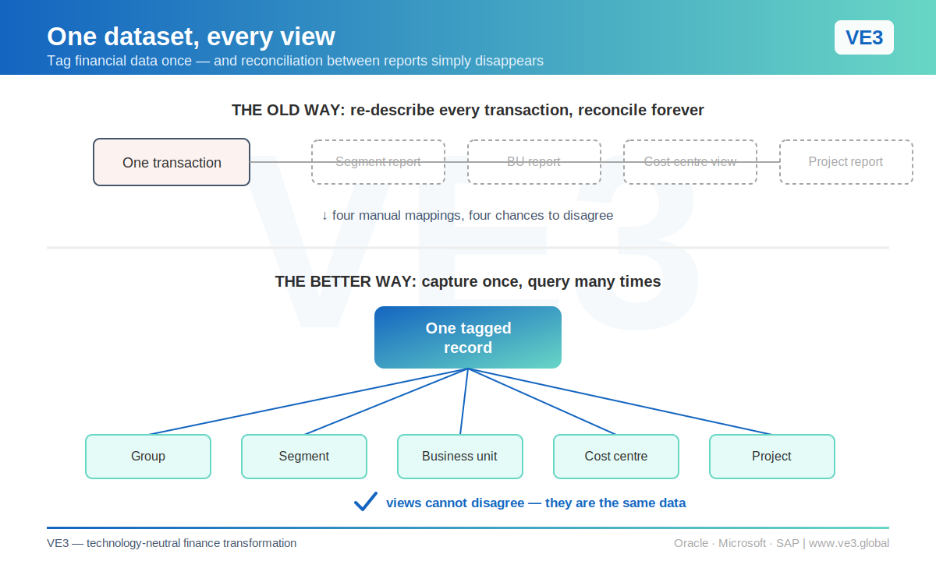
Figure 1: Capture once, query many times — tagging removes reconciliation.
The idea
Capture every transaction once, at the most granular level, with all of its attributes attached as tags or dimensions: region, company, segment, sub-segment, business unit, profit centre, cost centre, project. Store that in a single unified record — every major ERP platform now offers a version of this single-ledger concept.
Then every report becomes a query against that one record rather than a separate dataset that has to be reconciled back to it. Want the group consolidation? Filter and roll up. Want one business unit's standalone P&L? Filter differently. Want segment reporting with no eliminations? Filter again. Nothing is re-keyed, because there is only ever one set of numbers.
Why finance leaders should care
Reconciliation collapses. If the business-unit view and the group view are two cuts of the same record, they cannot disagree. The reconciliation step that eats your team's time simply isn't there to do.
New views are cheap. This group could consolidate at full-group level today and at segment level tomorrow without rebuilding anything, because "segment" was already a tag on every transaction. The cost of a new reporting dimension is close to zero when the data was tagged correctly from the start.
Drill-down is free. From any consolidated number, you can drill straight back to the entity-level transactions behind it — because they are literally the same data, not a summary that points at a different system.
Granularity serves more than reporting. The same tagging let this group run business units inside a single company as fully separate reporting entities — each with its own P&L, balance sheet and cashflow — and still aggregate them to the parent, with no forced consolidation between them. That kind of flexibility is impossible if your structure only understands legal entities.
The trap to avoid
The seductive alternative is to solve each reporting need as it arises — a new report here, a mapping table there. Each fix is quick. Collectively they build the exact reconciliation burden you were trying to escape. Tagging once is more work up front and far less work forever after.
When you evaluate ERP, the test is simple: ask to see one transaction appear, correctly and without re-entry, in several different reports at once. That single demonstration tells you whether you're buying one source of truth or a tidier version of the problem you already have.
About VE3
VE3 is a technology-neutral consultancy and a partner to Oracle, Microsoft and SAP. The single-record, tag-once principle in this article isn't specific to any one platform — it's a data-architecture decision, and getting it right early is one of the highest-leverage choices a finance function can make. VE3 helps enterprises design that architecture independently of vendor, so the technology serves the reporting model rather than the other way around. Talk to the VE3 team about building one source of truth for your finance data.

.png)
.png)


