.png)


Most AI programmes in regulated organisations are not won or lost on the model. They are decided much earlier, by a choice that rarely gets the scrutiny it deserves: how the system will be deployed. Two options dominate enterprise shortlists - a managed SaaS platform that commits to storing your data in a chosen region, and an on-premise or in-tenancy deployment that runs inside your own infrastructure. On a procurement slide they can look almost interchangeable. In practice they diverge sharply at exactly the points that determine whether your programme reaches production or quietly stalls in assurance. This is a buyer’s framework for telling them apart and choosing well.
Two models that are easy to confuse
SaaS with data residency is a managed service. The vendor runs the model on their platform, and you are given a contractual commitment that your data will be stored in a particular jurisdiction - the UK, say. You consume it through an API. Residency is a statement about where data sits.
On-premise or in-tenancy deployment means the system runs inside your own environment - your data centre, or your own cloud account and security boundary. Inference happens on compute you control, with no external API calls and no data leaving the perimeter. This is a statement about who processes your data and who controls the processing.
That difference - storage location versus processing control - is the whole game. Treating residency as a proxy for control is the most expensive assumption a buyer can make, and it is the one that surfaces too late, in a security review or a regulator’s question.
The six dimensions that actually decide it
Rather than argue in the abstract, weigh the two models against the criteria that genuinely move a procurement decision.
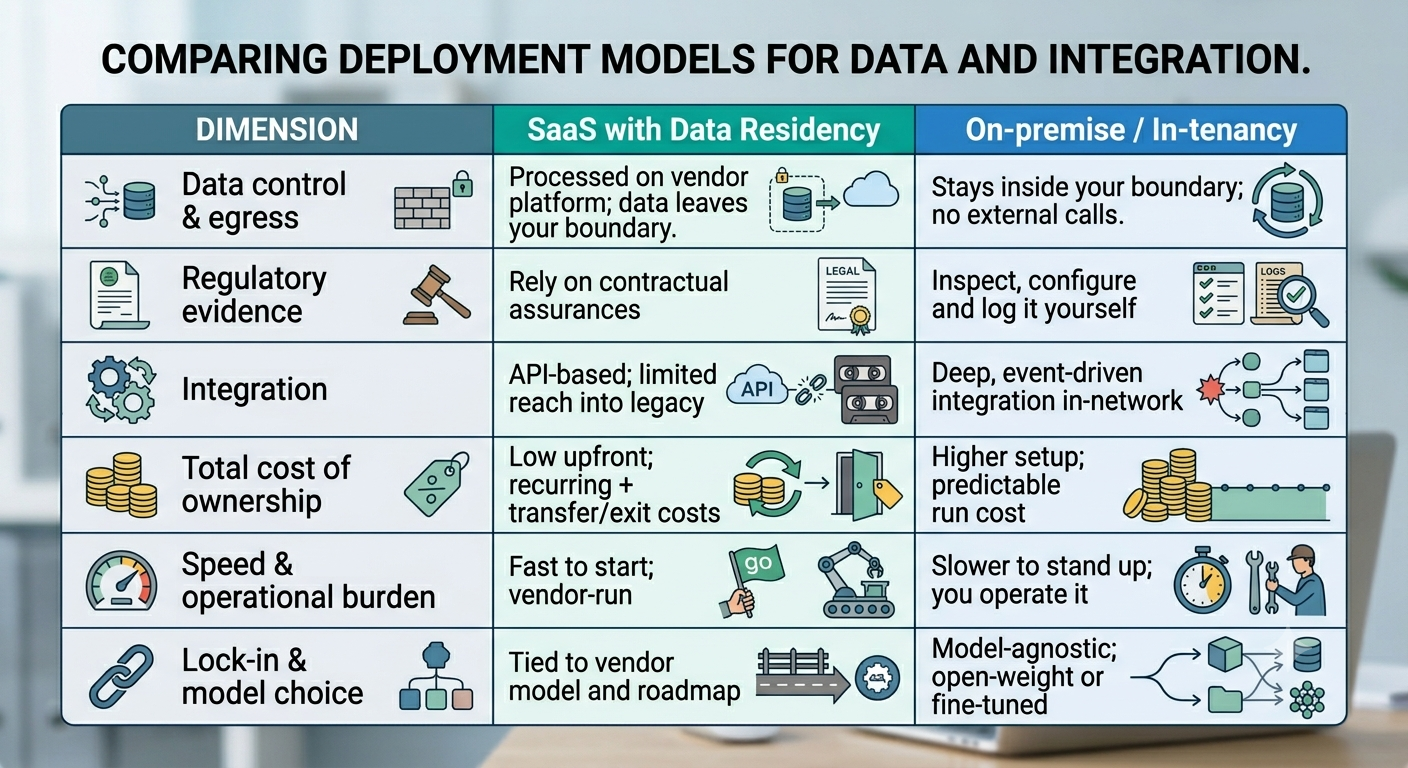
- Data control and egress. With SaaS, your data is processed on the vendor’s platform; even with residency, it leaves your boundary and is handled under their architecture and access model. With on-premise or in-tenancy deployment, nothing of consequence egresses - the data and the inference stay inside your control.
- Regulatory evidence. Regulated work demands that you prove your controls, not merely assert them. SaaS leaves you relying on the vendor’s contractual assurances and certifications. On-premise lets you inspect, configure and log the arrangement yourself - the difference between satisfying a data protection impact assessment and hoping a third party’s paperwork will.
- Integration with existing systems. Most regulated organisations carry significant legacy estates. SaaS typically reaches them through APIs, which can be constrained by what the vendor exposes and by what you are willing to send outbound. On-premise deployment sits inside your network, enabling deeper, event-driven integration with the repositories and case systems where the work actually happens.
- Total cost of ownership. SaaS is cheaper to start - low upfront cost, recurring fees - but the headline price rarely tells the whole story once data-transfer charges, scaling tiers and exit costs are counted. On-premise carries higher setup cost and needs infrastructure and skills, but the running cost is more predictable and the data never incurs egress fees. Compare lifetime cost, not month one.
- Speed to deploy and operational burden. This is SaaS’s genuine strength: it is fast to stand up and the vendor carries the operational load. On-premise takes longer to deploy and you own the running of it. For a low-risk pilot under time pressure, that speed matters; for a sensitive production service, the trade is usually worth making.
- Lock-in and model choice. A SaaS platform ties you to its model and its roadmap; if the provider changes terms, pricing or model behaviour, you absorb it. A model-agnostic on-premise approach keeps your options open - open-weight models, models within your own cloud tenancy, or fine-tuned domain models - chosen to fit the workload rather than the vendor’s commercial interests.
At a glance:
Which model fits which workload?
The honest answer is that both have a place - the error is using one where the other is required. SaaS with data residency can be entirely appropriate for lower-sensitivity workloads: non-personal or already-public data, internal productivity tools, or fast proofs of concept where the priority is learning quickly and the consequences of an output are low. For that profile, the speed and low operational burden are real advantages.
On-premise or in-tenancy deployment becomes the right answer the moment the workload involves the most sensitive categories of personal data, informs consequential decisions about people, carries no-egress mandates, or sits under transparency and audit obligations you must evidence. In those settings, control is not a preference - it is a requirement, and residency alone will not satisfy it. The deciding question is rarely “which is better?” but “what does this specific workload oblige us to be able to prove?”
A worked example makes the line clear. An internal tool that drafts non-sensitive policy summaries from published material is a comfortable fit for SaaS with residency - the data is not personal and the output is low-stakes. A system that reads and triages claimant or patient evidence to support a decision about someone’s entitlement sits firmly on the other side: the data cannot leave the perimeter, every output must be traceable, and the controls must be demonstrable to a regulator. Same organisation, same vendor shortlist - two different deployment answers, driven entirely by the workload.
A short decision checklist
Route the choice with five questions before you shortlist:
• Does this workload involve sensitive personal data or decisions that affect individuals?
- Are we under an explicit no-egress or data-sovereignty requirement?
- Will we need to evidence our controls to a regulator or governance board - not just point to a certificate?
- How deeply must this integrate with internal or legacy systems?
- What is the lifetime cost and exit position, not just the month-one price?
If the first three answers lean towards sensitivity, sovereignty and evidence, the deployment decision is effectively already made - and it is not SaaS with a residency clause.
Weighing the deployment decision for a regulated AI workload? Talk to our team about a sovereign, human-in-the-loop approach - or read our overview of sovereign, on-premise AI.

.png)
.png)


