.png)


Multi-entity finance consolidation is one of the most technically demanding aspects of running a UK housing group. When a group operates across eight, ten, or more legal entities, the monthly task of producing accurate consolidated financial statements involves intercompany reconciliation, elimination entries, entity-level statutory reporting, and group-level management accounts, all of which must agree with each other and meet strict regulatory deadlines.
For many housing associations, this process is still largely manual. Finance teams extract data from legacy systems, reconcile intercompany balances in spreadsheets, and assemble consolidated figures by hand. It is time-consuming, error-prone, and increasingly difficult to sustain as regulatory scrutiny intensifies and entity structures evolve through merger activity.
Oracle Fusion Cloud Finance is designed to handle this complexity natively. This article explains how the platform manages multi-entity group structures, how consolidation works in practice, and what housing finance directors need to understand before designing their deployment.
Why Multi-Entity Complexity is Growing in Housing?
The UK housing sector has been consolidating steadily for several years. According to New Street Consulting Group, 14 housing association mergers were completed in a single recent year, and the pace has continued with several significant combinations completed in 2025 and 2026. Bromford Flagship LiveWest, formed in January 2026, serves approaching 300,000 customers across England. Sovereign Network Group, Optivo-Southern Housing, and Peabody-Catalyst are among the other major combinations that have created large, multi-entity group structures requiring sophisticated consolidated financial management.
At the same time, many housing groups that have not yet merged are nonetheless operating across multiple legal entities for historic, regulatory, or operational reasons. A group of ten entities is common for a mid-sized housing association that has grown through acquisition or internal restructuring. The Regulator of Social Housing's strengthened oversight framework, including the requirement to demonstrate financial viability at group level through annual financial statements and the Financial Reporting Standard 102 (FRS 102) requirements updated for accounting periods from January 2026, makes the quality and timeliness of consolidated reporting a board-level concern, not just a finance team task.
14
Housing association mergers completed in a single year, with the pace continuing into 2025 and 2026 as the sector consolidates for financial resilience
The Foundation: Oracle Fusion's Enterprise Structure
Before Oracle Fusion can consolidate anything, the group's legal structure must be mapped correctly into the platform's enterprise architecture. This design phase is the most consequential work in any multi-entity Oracle Fusion implementation, and it cannot be undone once the system is live.
Oracle Fusion models a group structure through three interdependent layers: the enterprise, legal entities, and ledgers. Understanding how these relate to each other determines whether consolidated reporting works cleanly or requires manual workarounds.
Legal Entities
Each company within the housing group is configured as a separate legal entity in Oracle Fusion. Legal entities are the units that hold legal obligations, enter into contracts, and file statutory accounts. For a group of ten housing companies, this means ten legal entity records, each linked to the appropriate company registration number, VAT registration, and filing obligations.
Ledger Design: Single Ledger vs Multiple Ledgers
The ledger is where Oracle Fusion records and reports financial transactions. For a UK housing group where all entities operate in sterling, share the same accounting calendar, and use a common chart of accounts, the recommended approach is a single primary ledger covering all legal entities. Each entity is distinguished within the ledger by a balancing segment value, which Oracle uses to track entity-level balances, ensure intercompany transactions are correctly recorded, and produce entity-level statutory reporting without running separate ledger close processes.
A single-ledger design for a UK-only, single-currency housing group simplifies the architecture significantly. There is one close process, one chart of accounts to maintain, and one reporting environment. Consolidated and entity-level reporting are both available from the same data source, without balance transfers between ledgers.
Chart of Accounts: Designed for Both Entity and Group Reporting
The chart of accounts must serve two purposes simultaneously: satisfying the statutory reporting requirements of each individual legal entity, and supporting group-level consolidated reporting. Oracle Fusion's General Ledger supports up to three balancing segments. For a housing group, best practice assigns one balancing segment to the legal entity, enabling Oracle to produce a balanced trial balance for each entity automatically. Additional segments capture cost centre, fund type, or programme, depending on the group's management reporting requirements.
A critical design constraint
Oracle strongly advises against changing the chart of accounts structure after the system goes live. For a housing group planning to reduce its entity count from ten to six over two years, the chart of accounts must be designed to accommodate the planned end-state as well as the current structure. Segments and value sets should be sized to handle the full lifecycle of the group, not just the day-one configuration. Organisations that do not plan for structural change in their chart of accounts design end up facing costly remediation work when consolidation or restructuring occurs.
Intercompany Transactions: From Manual Reconciliation to Automatic Balancing
Intercompany transactions are the most common source of consolidation complexity in housing groups. When Entity A provides a shared service to Entity B, when a parent charges a management fee to a subsidiary, or when cash is transferred between entities, both sides of the transaction must be recorded accurately and then eliminated at group level when consolidated accounts are prepared.
In a manual consolidation environment, this means reconciling intercompany balances between entities before month-end close, identifying and correcting mismatches where one entity has recorded a transaction differently from its counterpart, and then posting elimination journals to remove the internal flows from the consolidated statements. Under FRS 102, intercompany transactions and balances must be fully eliminated in consolidated accounts, and failure to do this correctly produces overstated revenue, inflated balance sheet positions, and a consolidated trial balance that will not agree with the underlying entity figures.
How Oracle Fusion Handles Intercompany Balancing
Oracle Fusion's intercompany module generates the counterpart entry automatically whenever a transaction crosses a legal entity boundary. When Entity A posts a management fee invoice to Entity B, Oracle creates the corresponding receivable in Entity A and payable in Entity B without requiring a separate manual journal. The intercompany accounts used for these automatic entries are configured as part of the chart of accounts setup, with specific account codes designated for intercompany receivables, payables, revenue, and expense flows.
This automatic balancing means that intercompany positions are always in agreement from the moment a transaction is posted. There is no period-end scramble to reconcile intercompany balances, because they have never been out of balance. The reconciliation that previously took senior finance team members several days each month is eliminated entirely.
Intercompany Elimination at Consolidation
At group reporting stage, Oracle Fusion uses Calculation Manager to generate elimination entries that remove intercompany balances from the consolidated view. Elimination rules are defined once during implementation and applied automatically at each period close. The elimination entries post to a designated elimination ledger or segment, keeping them separate from entity-level trading entries and preserving a clear audit trail of what has been eliminated and why.
For housing groups with a large number of trading pairs, the volume of intercompany transactions can be substantial. Oracle Fusion's automated elimination framework handles this at scale, processing all intercompany flows across the group in a single close run rather than requiring manual elimination journals for each trading relationship.
The Period Close Process for a Ten-Entity Group
One of the clearest benefits Oracle Fusion delivers for multi-entity housing groups is the compression of the period close timeline. On legacy systems, closing ten entities sequentially and then assembling consolidated figures is a process that typically takes the finance team a significant portion of the working month. Oracle Fusion's integrated architecture and automated close tools change this fundamentally.
Subledger Close
Oracle Fusion's subledgers, covering Accounts Payable, Accounts Receivable, Fixed Assets, and Expenses, feed directly into the General Ledger. When a subledger period is closed, all transactions are automatically transferred to the GL without manual journal posting. For a ten-entity group, each entity's subledgers close independently, and the GL receives the postings in real time. Finance managers can see the running GL position for each entity throughout the month, not just after month-end processing is complete.
Entity-Level Close
Oracle Fusion's Account Monitor and Close Monitor provide finance teams with a real-time view of close progress across all entities simultaneously. Open items, unposted journals, and unreconciled accounts are visible at a glance, allowing the team to prioritise resolution without manually chasing status updates from each entity's accountant. Approval workflows ensure that manual journal entries are authorised before posting, reducing the risk of late adjustments disrupting the close timetable.
Consolidated Close
Once entity-level periods are closed, the group consolidation runs automatically. Oracle applies the intercompany elimination rules, runs any required revaluations, and produces consolidated financial statements directly from the platform. The consolidated trial balance, income statement, and balance sheet are available without extracting data to a separate consolidation tool or spreadsheet model.
Organisations migrating to Oracle Fusion from legacy multi-entity environments typically achieve 20 to 30 percent reduction in period close duration within the first year of operation. For housing groups where the finance director is presenting consolidated management accounts to the board within days of month-end, this compression has direct governance value.
Managing Entity Restructuring Within Oracle Fusion
Housing groups that are consolidating their entity structure over a defined timescale, reducing from ten legal companies to six for example, need their finance platform to accommodate that change without requiring a new implementation. Oracle Fusion supports this through its configurable enterprise structure.
Merging Entities
When two legal entities within the group merge, Oracle Fusion handles the combination by transferring balances and open transactions from the absorbed entity to the surviving entity. Historical records under the old entity remain accessible for audit and reporting purposes. The absorbed entity's balancing segment can be retained in the chart of accounts as an inactive value, preserving historical reporting continuity without cluttering active reporting views.
Decommissioning Subsidiaries
When a subsidiary is wound down or transferred, its legal entity record is end-dated in Oracle Fusion. Transactions already posted under that entity remain in the system and are reportable. No new transactions can be posted after the end date. This creates a clean break in the operational records while maintaining the historical audit trail that regulatory compliance requires.
Restructuring Without a System Change
For housing groups where the entity consolidation programme is planned in advance and the target structure is known, Oracle Fusion can be configured from day one to reflect both the current and the planned end-state. This means that as entities are merged or wound down, the system change is a configuration update rather than a structural redesign. This is only possible if the enterprise structure was designed with the future in mind during the initial implementation.
Consolidated Reporting and RSH Financial Viability
The Regulator of Social Housing requires registered providers to submit annual accounts demonstrating financial viability at group level. The Housing Association Outlook Report 2026 identifies financial discipline under stress as one of the defining challenges for the sector, noting that viability conversations now blend multiple pressures including repairs costs, insurance, interest, and decarbonisation commitments that must be reported coherently across group structures.
Oracle Fusion's Financial Reporting Studio and Oracle Transactional Business Intelligence (OTBI) provide configurable reporting frameworks that can produce both entity-level statutory accounts and group-level management and regulatory reports from the same underlying data. Once report templates are designed and validated, they run automatically at each period close, eliminating the manual assembly process that legacy environments require.
For group finance directors preparing quarterly viability assessments or responding to RSH information requests, real-time access to consolidated financial data across all entities is the difference between a one-day reporting exercise and a week-long data-gathering effort. Oracle Fusion makes the former the default.
Legacy vs Oracle Fusion: Multi-Entity Consolidation at a Glance
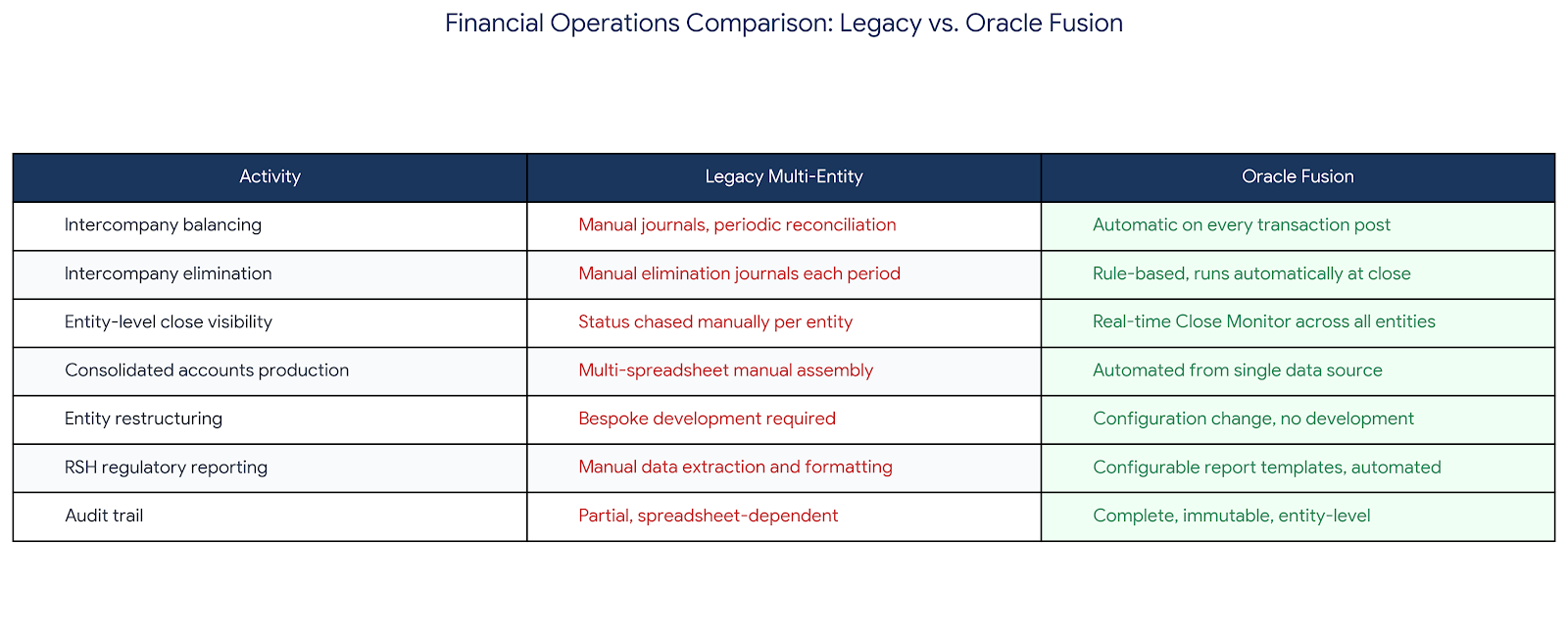
The FRS 102 Update: What Multi-Entity Housing Groups Need to Know
The updated FRS 102 applies to accounting periods beginning on or after 1 January 2026. For UK housing associations preparing consolidated financial statements, the most relevant changes include updated lease accounting requirements aligned more closely to IFRS 16, revised revenue recognition guidance, and changes to the treatment of certain financial instruments.
For housing groups using Oracle Fusion, the platform's configurable accounting rules and chart of accounts structure can accommodate the updated standards without requiring system changes in most cases. The lease accounting updates in particular affect how operating leases appear in the balance sheet, and Oracle Fusion's Fixed Assets and Lease Management modules handle this natively. Housing groups on legacy systems that have not been updated to reflect FRS 102 changes face a more challenging compliance path, often requiring manual adjustments outside the system that introduce reconciliation risk.
Implementation Priorities for Multi-Entity Deployments
Housing groups deploying Oracle Fusion across multiple entities should prioritise the following design and planning decisions before any configuration work begins.
- Design the enterprise structure for the end-state, not just today. If the group will have six entities in two years rather than ten, the chart of accounts and ledger design should accommodate both structures from day one
- Define intercompany trading relationships early. Map every significant intercompany flow, including management fees, shared service charges, intra-group loans, and cash transfers, before intercompany account codes are configured
- Agree the consolidation method before ledger design. For a UK-only, single-currency group, the reporting-only consolidation method using a single ledger and a ledger set is the simplest and most maintainable approach
- Plan the entity-level close sequence. Define which entities close first and which consolidation steps follow, so that the Close Monitor reflects the actual process the team will follow
- Establish elimination rule ownership. Decide which team owns the elimination rule configuration and how changes to the intercompany trading pattern are managed as the group's internal structure evolves
- Test consolidation thoroughly before go-live. Run a full consolidation cycle against historical data in the test environment, comparing the Oracle Fusion output to the manually produced consolidated accounts from the legacy system. Differences must be investigated and resolved before go-live is confirmed
One Platform, Ten Entities, One Close
Managing ten legal entities under one finance platform is not a compromise. It is what Oracle Fusion is designed for. The platform's single-ledger architecture, automatic intercompany balancing, rule-based elimination framework, and real-time Close Monitor combine to make multi-entity consolidation a structured, automated process rather than a manual exercise that consumes the finance team's time every month.
For UK housing groups navigating merger activity, entity consolidation programmes, and intensifying regulatory reporting requirements, the ability to produce accurate consolidated financial statements quickly and with confidence is not a luxury. It is a governance requirement. Oracle Fusion delivers it, provided the enterprise structure is designed correctly from the start.
VE3: Oracle Fusion Multi-Entity Finance for Housing Groups
VE3 is an enterprise AI, data, and digital transformation consultancy and Oracle partner with Oracle Fusion Finance implementation experience across complex, multi-entity UK social housing groups. We design enterprise structures, configure intercompany frameworks, and deliver consolidated reporting environments that work from day one. To discuss your multi-entity finance transformation, visit ve3.global.

.png)
.png)


