.png)


Loyalty programmes are one of the most widely adopted tools in marketing - and one of the least interrogated. Most brands know how many members they have. Far fewer know how much incremental revenue those members actually generate, or how much programme cost sits against zero measurable return.
The numbers tell an uncomfortable story.
26% of all loyalty points issued go unspent every year (Antavo Loyalty Report, 2026)
7.5 programmes the average consumer belongs to, but actively engages with fewer than three (EY, 2025)
16% of brands have achieved genuine individual-level personalisation, despite most holding the data to do it (EY Loyalty Report, 2025)
The problem is rarely the concept. It is almost always the architecture.
Why Most Loyalty Programmes Underperform
The structural issue facing most loyalty programmes today is a data disconnect. Loyalty data sits in one platform. CRM data sits in another. Service interactions live somewhere else entirely. Nobody has a single, live view of the customer and because they don't, the personalisation that members expect simply cannot happen at scale.
Instead of individual-level offers driven by real behaviour, teams send tier-based promotions to every Gold member regardless of what they have bought, how recently, or how likely they are to churn. Campaigns are built manually by analysts processing yesterday's data and hoping the offers are still relevant by the time they land.
It is not a failure of effort. It is a failure of architecture. And architecture is something that can be changed.
"Only 16% of brands have achieved genuine hyper-personalisation in their loyalty programmes - despite most already holding the customer data required to do it." - EY Loyalty Report, 2025
What Salesforce Loyalty Management Actually Changes
Salesforce Loyalty Management is not a standalone rewards tool bolted onto the side of your CRM. It is a native Salesforce Cloud, which means your loyalty programme logic, tiers, points, promotions, and partner rules all live inside the same platform as your customer profiles, service cases, marketing journeys, and Agentforce AI agents.
That integration is what makes the real difference. Here is what it looks like in practice:
- When a member reaches a new tier, a personalised Marketing Cloud journey fires the same day - not in the next batch cycle
- When a service agent opens a case, the member's loyalty status and reward history are visible in the same screen without switching tools
- When Agentforce detects a churn signal - declining engagement, reduced spend, lapsing points - it triggers a personalised retention offer autonomously, without a campaign being built and approved manually
- Real-time Data 360 profiles replace overnight batch segments, meaning the person who browsed your site at 9am can receive a relevant reward offer by noon
The result is a programme that responds to individuals rather than categories. That is what loyalty members have always expected - and what the technology has only recently made practical at enterprise scale.
72% of consumers say loyalty programmes make them more likely to spend with their preferred brand (Capillary Tech / EY, 2026)
The Self-Funded Model: Rewards That Pay for Themselves
One of the persistent tensions in loyalty management is the CFO conversation. Rewards are a cost. Retention is measurably cheaper than acquisition. But the ROI calculation between those two facts is rarely clean enough to satisfy a budget committee looking for hard numbers.
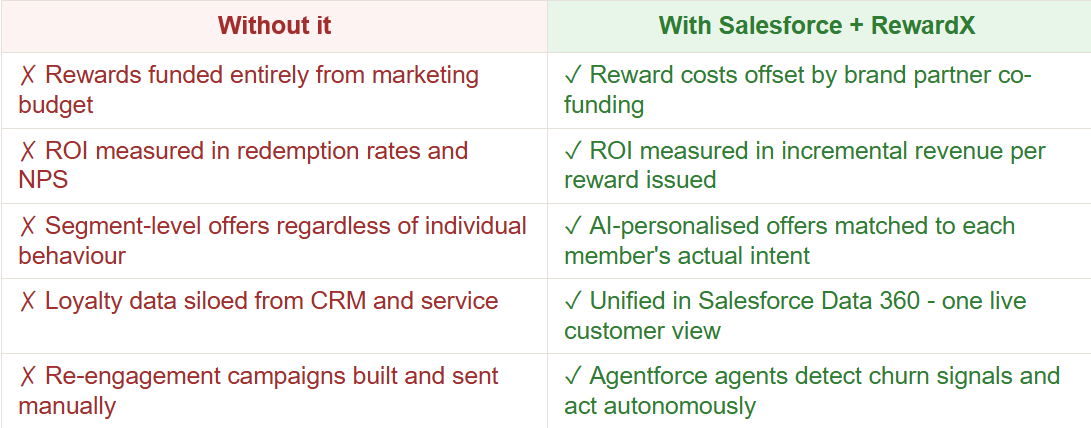
The self-funded loyalty model changes this by restructuring the economics. Rather than treating every reward as a line item in the marketing budget, the programme is built so that brand partner contributions and the incremental spend the programme generates together offset the cost of rewards issued.
The conversation shifts from 'how much are we spending on loyalty' to 'how much incremental revenue did the programme generate this quarter.' That is a fundamentally more defensible position - and a more honest measure of whether the programme is working.
Here is what that looks like in practice, compared to the traditional model:
RewardX: The Commercial Layer That Closes the Loop
Salesforce Loyalty Management handles the programme logic. What it does not include out of the box is the reward catalogue and brand partner infrastructure needed to run the self-funded model in practice. That is where RewardX comes in.
RewardX is VE3's loyalty platform, built specifically to sit alongside Salesforce Loyalty Management and provide the commercial layer the platform needs to move from cost centre to revenue contributor.
- 300+ reward brands: across retail, travel, dining, and lifestyle - available immediately, no individual partner negotiations required
- Self-Funded Incentive Framework: structures partner co-funding so that reward costs are offset by commercial contributions rather than absorbed by marketing budgets
- Native Salesforce integration: connects directly to Salesforce Loyalty Management, Data 360, and Marketing Cloud - no middleware, no manual exports, no overnight sync
- AI-driven reward matching: surfaces the most motivating reward option for each individual member based on their actual behaviour and preference history, not their tier
Because RewardX integrates natively with Salesforce, member behaviour, reward history, and engagement signals flow through a single governed data environment. Loyalty teams work in Salesforce. Analysts see the same data. Finance gets attribution reports from the platform they already use.
Five Signs Your Current Programme Needs This Architecture
Not every loyalty programme needs a rebuild. But these five patterns consistently signal that the current setup is capping programme value - and that a Salesforce-native approach would unlock meaningful returns.
- Your personalisation is tier-based - every Gold member receives the same offer regardless of their individual purchase history or recent engagement
- Your loyalty and CRM data live in separate systems - there is no single live view of the customer across marketing, service, and loyalty teams
- Reward costs are a fixed budget line with no mechanism for partner co-funding or incremental spend attribution to offset them
- Re-engagement campaigns are manually triggered - a human decides when to run a win-back rather than the platform detecting the signal and acting on it
- Your redemption rate has plateaued - members accumulate points but do not spend them, which means the reward catalogue is not motivating individuals to act
If three or more of these apply, the constraint is architecture - not effort, not creative, and not the points multiplier.
Want to see it in action?
RewardX integrates natively with Salesforce Loyalty Management and gives you 300+ reward brands, self-funded programme economics, and AI-driven personalisation - without a separate platform to manage.

.png)
.png)


