.png)


A practical guide to the operating model that turns enthusiastic adoption into scalable, secure, well-governed Power Platform - for IT leaders, Power Platform leads and governance teams.
Power Platform adoption almost always outruns the governance needed to sustain it. The barrier to building is low by design, so apps and flows multiply quickly - and without a structure to manage them, that momentum curdles into shadow IT, duplicated data flows, security gaps and unpredictable cost.
A Centre of Excellence (CoE) is the answer to that problem: the operating model that turns enthusiastic, ungoverned adoption into something scalable, secure and sustainable. Done well, it makes cost predictable, keeps security and compliance teams comfortable, and lets makers move faster because the guardrails are clear rather than improvised. This guide explains what a CoE actually is, the building blocks that make one work, and how to stand one up without over-engineering it on day one.
What a Centre of Excellence actually is
A Centre of Excellence is not a central team that builds everything - that simply recreates the bottleneck low-code was meant to remove. Nor is it a committee whose main output is saying no. A working CoE is an operating model with three jobs: to govern the platform, to enable the people using it, and to operate it day to day. Get the balance wrong - all control and no enablement - and makers route around you; all enablement and no control, and you are back to sprawl. The craft of a good CoE is holding both at once.
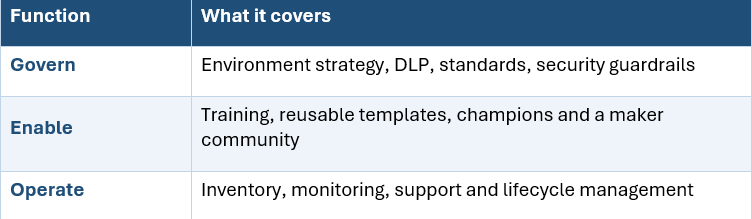
1. Start with executive ownership and a clear operating model
Every successful CoE has a named owner with executive backing and a defined remit. Decide who owns the platform operationally, who sits on the governance board, and how decisions get made - before you touch a single setting. Without clear ownership a CoE has no authority, and the platform drifts. This is also a readiness question: if you cannot name the owner today, that is the first gap to close, because everything that follows depends on someone being accountable for it.
2. Define your environment strategy
Environments are the containers that separate work, control access and apply policy, and they are the foundation of governance. At a minimum, separate development, test and production; give makers managed environments to build in rather than letting them loose in the default; and lock down the default environment, which is where most ungoverned sprawl quietly accumulates. In practice that means new ideas start in a personal-productivity or development environment, prove their value, and only then graduate - through a controlled process - into a managed production environment with the right policies attached. A deliberate environment strategy is the single highest-leverage governance decision you will make, and the hardest to unpick once apps are scattered everywhere.
3. Set your data loss prevention (DLP) policy
DLP policies decide which connectors can be used together, and they are how you stop sensitive data leaking through low-code apps. Classify connectors into business, non-business and blocked groups, and apply tighter policies to production than to experimentation. The principle is simple: a connector that reaches corporate data should never sit in the same app as one that can post to the public internet, unless that combination has been explicitly approved. This is also where Information Security becomes a partner rather than a blocker: agree the connector-approval process early, so a new premium connector does not stall every use case waiting on it. DLP designed in from the start is far cheaper than DLP retrofitted after an incident.
4. Establish standards, ALM and a change process
Consistency is what makes a platform supportable at scale. Define naming conventions, solution and environment standards, and an application lifecycle management (ALM) approach - using Power Platform Pipelines or Azure DevOps - so changes move from development to production safely and repeatably. Proper ALM is what ends the most dangerous habit in low-code: editing live apps directly in production, where a single mistake breaks something hundreds of people rely on. A lightweight architecture or change-review step keeps quality high without becoming a bottleneck. None of this is glamorous, but standards are cheap to set now and genuinely painful to retrofit once hundreds of apps already exist.
5. Enable and grow your makers
A CoE that only governs will be resented; one that also enables will be invited in. Invest in training pathways for different skill levels, publish reusable templates and components so makers do not start from scratch, and build a community where they share and learn from one another. Identify and support champions - the enthusiastic makers who become your multipliers across the business. Track adoption as deliberately as you track risk: active makers, apps reaching production, and problems solved are the numbers that prove the platform is paying back. Enablement is what converts governance from a tax that people resent into a service they actively want to use.
6. Monitor, administer and tame sprawl
You cannot govern what you cannot see. Build an inventory of apps, flows and makers - Microsoft’s CoE Starter Kit is a common starting point - and monitor usage, ownership and orphaned resources. Establish a clear process for archiving or reassigning abandoned apps, especially when their maker leaves, and review the estate on a regular cadence. Visibility is what turns governance from reactive firefighting into proactive management, and it is usually the capability organisations wish they had built sooner.
7. Extend governance to AI and agents
This is the newest and fastest-moving frontier. Copilot Studio and agentic AI add real capability - and a consumption-based cost model that can run up charges before anyone notices, with no single dashboard showing all usage across the tenant. Bring agents into the same operating model from the start: who can build them, in which environments, against what data, and within what spend limits. Treat an agent as you would any other production asset - owned, reviewed and monitored - rather than a novelty that lives outside the rules. Retrofitting governance onto AI agents after they have proliferated is far harder than designing it in while the numbers are still small.
Common mistakes that derail a CoE
Three patterns cause more failures than any others. The first is building a central team that becomes the bottleneck, recreating the very constraint low-code was meant to remove. The second is leading with control and no enablement, so makers quietly route around the CoE entirely. The third is launching everything at once - a heavyweight governance regime imposed overnight that no one adopts. The mindset that avoids all three is simple: a CoE is a product, not a project. It is built, used and improved continuously.
Start light, then mature deliberately
You do not need a fully featured CoE on day one, and trying to build one is itself a common failure. Start with the essentials - ownership, environment strategy and DLP - then layer on standards, enablement, monitoring and AI governance as adoption grows. Match the weight of governance to the scale of usage. A small, well-run CoE that people actually use will always beat an ambitious one that stalls under its own complexity.
How to tell your CoE is working
A healthy Centre of Excellence shows a few consistent signals. Makers come to it for help rather than working around it. New apps land in the right environments by default, not by exception. Security and compliance teams are comfortable because they can see what exists and trust the guardrails. Licensing cost is understood and forecastable rather than a quarterly surprise. And abandoned or orphaned apps are caught and dealt with, not left to accumulate. If most of those are true, the operating model is doing its job; if several are not, that points directly to which building block needs attention next.
The bottom line
A Centre of Excellence is what separates organisations that scale Power Platform safely from those that are eventually overwhelmed by it. It is less a technology project than an operating model - governance, enablement and administration, held in balance and grown over time. The organisations that get the most from Power Platform are not the ones that adopted it fastest. They are the ones that governed it best.
VE3 helps organisations design and stand up governed, sustainable Centres of Excellence - from environment strategy and DLP to maker enablement and operating model. If you want to know where you stand before you build, our free Power Platform Readiness Framework assesses governance maturity across eleven domains, so your CoE starts from evidence rather than assumption. Connect with us to know how we can help.

.png)
.png)


