.png)


How Retrieval-Augmented Generation Removes Hallucination Risk in Regulated Summaries
“Show me where it says that.” It is the question every regulated decision rests on, and the one that makes organisations nervous about AI summaries. If a model can confidently invent a fact, how can anyone trust it to summarise a claimant’s evidence or a patient’s history? Retrieval-augmented generation is the architecture that answers that fear directly. It is the difference between an AI that guesses and an AI that cites. Here is how it works, why it matters most in regulated work, and where its limits lie.
Key takeaways
- RAG makes an AI model answer only from retrieved source documents, not from its own training memory.
- This grounds every statement in real evidence, drastically reducing hallucination.
- In regulated summaries, RAG pairs with source attribution so each claim links back to its origin.
- RAG reduces hallucination sharply but does not abolish it - retrieval quality and human review still matter.
What is retrieval-augmented generation (RAG)?
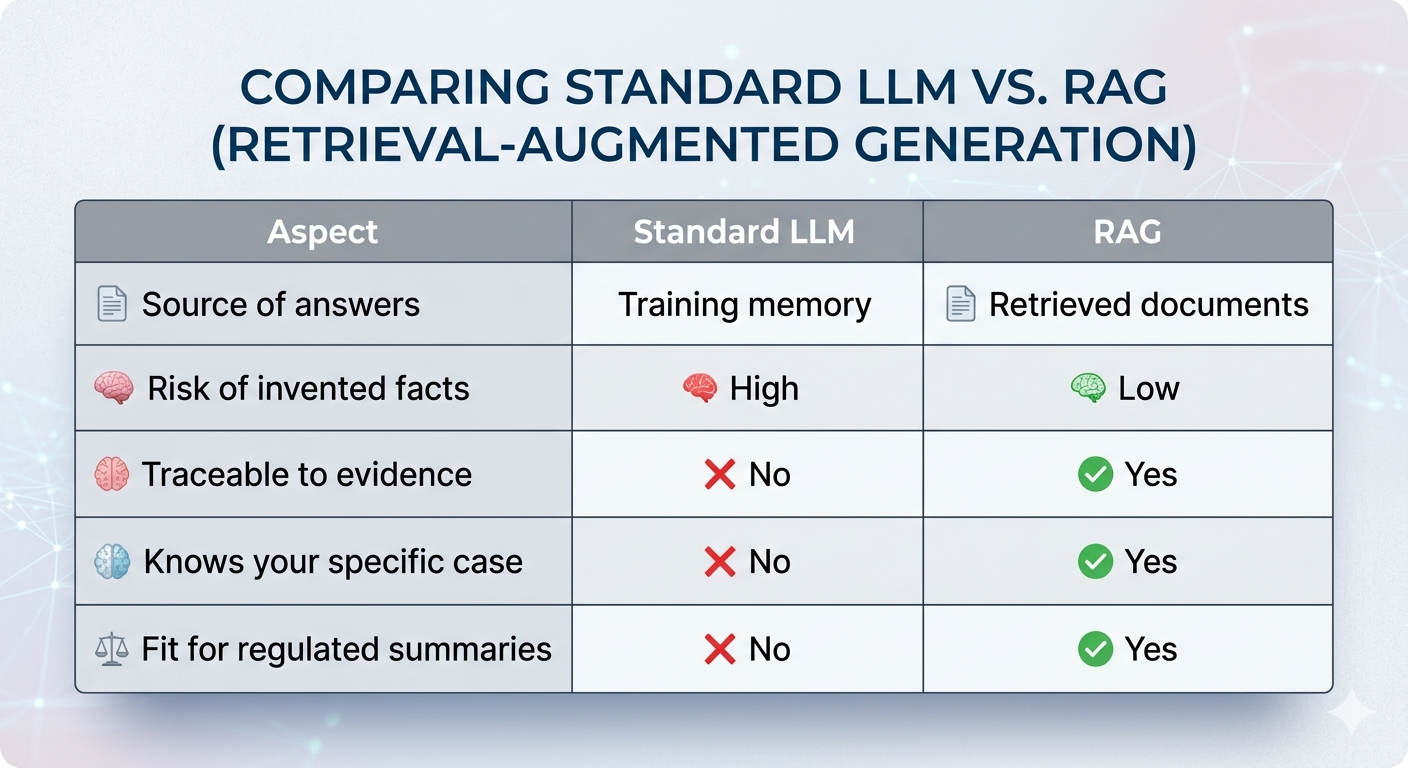
Retrieval-augmented generation (RAG) is an AI technique that retrieves relevant documents first, then instructs the model to generate its answer only from that retrieved material, rather than from its internal training data.
In a regulated summary, that means the system pulls the actual pages of an evidence bundle, and the model writes strictly from those pages. The model is no longer reaching into a vast, opaque memory of everything it once read. It is reading a specific, controlled set of documents and reporting what they say.
Why do AI models hallucinate in the first place?
A standard large language model generates text by predicting the most plausible next word, based on patterns learned during training. It has no built-in concept of “true” or “this specific document.” When it lacks a fact, it does not stop — it produces the most likely-sounding continuation, which can be wholly invented. That tendency is harmless when drafting a birthday message. It is unacceptable when summarising the evidence behind a decision about someone’s health or entitlement.
How does RAG stop hallucination?
RAG changes the model’s job from “recall” to “read.” It works in four steps:
Retrieve. The system searches the relevant document set and pulls the passages that match the question.
Ground. Those passages are handed to the model as the only permitted source material.
Generate. The model writes its summary from that material, not from its training memory.
Attribute. Each statement is tagged with the source passage it came from.
Because the model can only draw on supplied evidence, it has nothing to invent from. If the documents do not contain an answer, a well-built RAG system says so rather than guessing.
A worked example
Take a GP letter that mentions a mobility limitation, a medication and an anxiety diagnosis. Asked to summarise it, a standard model might confidently add a plausible-but-absent detail - a date, a dosage, a related condition it has “seen” in training. A RAG system pulls only that letter, summarises the three facts it actually contains, and tags each to the sentence it came from. Ask it about something the letter never mentions, and it returns nothing rather than a guess. The summary is shorter, duller and correct — which is exactly what a reviewer needs.
Why RAG matters most in regulated work
In low-stakes settings, an occasional made-up detail is an annoyance. In regulated decisions it is a liability - a wrong fact in a summary can drive a wrong outcome, and the organisation is accountable for it. RAG matters here for three reasons: it keeps summaries faithful to the actual evidence; it makes every claim checkable; and it produces the audit trail regulators expect. It turns “trust the AI” into “verify the AI,” which is the only basis on which AI belongs anywhere near a consequential decision.
Does RAG eliminate hallucination completely?
Honestly, no and any vendor who claims otherwise should be treated with caution. RAG dramatically reduces hallucination by removing the model’s licence to invent, but two things still matter. First, retrieval quality: if the system pulls the wrong passages, the summary will faithfully reflect the wrong evidence. Second, interpretation: a model can still misread or over-generalise from a correct source. This is exactly why grounded AI is paired with human-in-the-loop review. RAG makes the AI’s work checkable; a human does the checking. Together they are trustworthy; neither is sufficient alone.
Is RAG the same as fine-tuning a model?
No, they solve different problems. Fine-tuning adjusts a model’s internal weights by training it further on examples, changing how it behaves in general. It does not give the model access to your specific, current documents, and it does not make its answers traceable. RAG leaves the model unchanged and instead feeds it the relevant evidence at the moment of the question. For regulated summaries, RAG is usually the safer choice: it works with live documents, it can be updated instantly by changing the source set, and every answer stays tied to a citable source. The two can be combined, but it is RAG, not fine-tuning, that controls hallucination.
What makes RAG trustworthy in practice?
Three design choices turn RAG from a technique into something an auditor will accept:
Source attribution - every summarised point links to its origin, so any claim can be verified in one click.
Sovereign deployment - retrieval and generation run inside your own environment, so sensitive evidence never leaves the perimeter.
Human authority - the AI recommends; a professional confirms or overrides.
Get those three right and RAG stops being a clever feature and becomes a defensible part of a regulated decision process - fast for the reviewer, and fully accountable to anyone who later asks how a conclusion was reached.
Building AI summarisation, you can put in front of an auditor? Talk to our team about grounded, source-attributed, human-in-the-loop document AI, or read our guides to intelligent document processing and sovereign AI.

.png)
.png)


