.png)


Unplanned downtime is one of the most expensive problems an asset-intensive organisation can face. When critical equipment fails without warning, the consequences reach far beyond the repair bill. Production stops. Revenue is lost. Penalties may be incurred. Safety risks emerge. And the engineering team shifts from planned, productive work into emergency response.
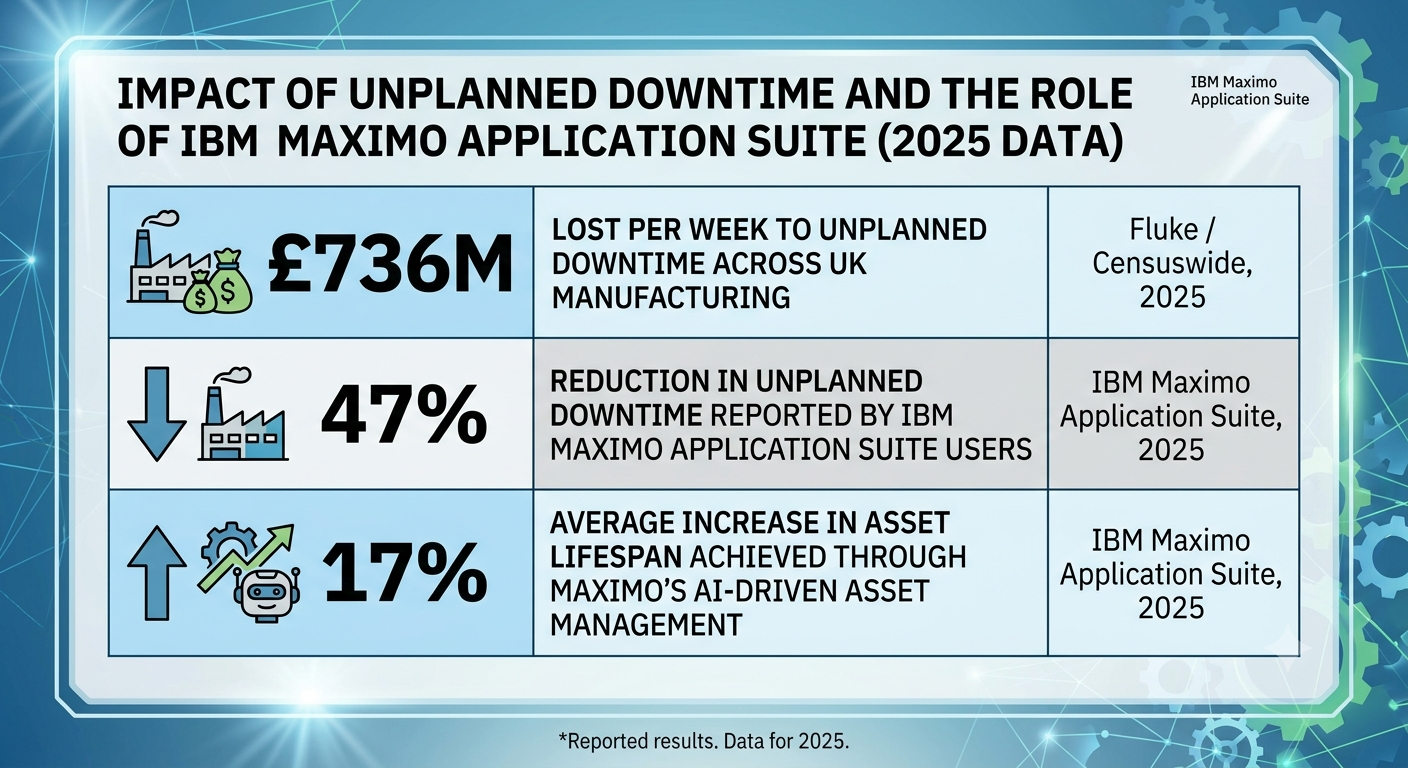
For UK manufacturers, utilities, transport operators, and facilities managers, this is not a theoretical risk. It is a weekly reality. Research published in 2025 found that 68% of UK manufacturers experienced unplanned downtime in the past year, at an estimated cost to the sector of up to £736 million every week.
IBM Maximo Application Suite addresses this problem directly. It is not a monitoring tool or a maintenance scheduling system in isolation. It is a unified platform that connects asset condition data, AI-powered analytics, and maintenance workflows to help organisations prevent failures before they happen, respond faster when issues do arise, and make smarter decisions about asset investment over time.
This article explains specifically how Maximo delivers those outcomes, what the platform's key capabilities are, and what organisations across different sectors are using it to achieve.
Why Unplanned Downtime Happens
Most unplanned downtime is not the result of catastrophic, unpredictable failure. It is the product of gradual asset degradation that goes undetected, maintenance schedules that are disconnected from actual asset condition, and fragmented data that prevents teams from seeing problems forming.
The common root causes across asset-intensive industries are consistent:
- Reactive maintenance cultures where equipment is only addressed after it fails, making breakdowns the default mode of operation
- Scheduled maintenance that replaces or services components based on time intervals rather than actual condition, missing deterioration between inspection points
- Siloed asset data spread across disconnected systems, making it impossible to build a complete picture of asset health across a fleet or facility
- Lack of real-time visibility into equipment performance, meaning developing faults go undetected until they cause disruption
- Poor spare parts planning, leading to extended downtime once a failure does occur because the right components are not available
IBM Maximo addresses each of these root causes through a connected set of capabilities that bring asset data, analytics, and maintenance workflows into a single operational environment.
How IBM Maximo Reduces Unplanned Downtime: The Core Mechanisms
01. Maximo Monitor
Connects IoT sensors and operational data streams to provide real-time visibility into asset performance. Anomalies are detected automatically using AI, and alerts are triggered before conditions develop into failures.
02. Maximo Health and Predict
Calculates a health score for each asset based on sensor readings, maintenance history, inspection records, and usage patterns. Uses AI and machine learning to forecast failure probability and recommend intervention before the failure window arrives.
03. Maximo Condition Insight
An agentic AI capability released in late 2025, powered by IBM watsonx. It interprets asset data in seconds, explains asset condition in plain language, identifies emerging trends, and recommends specific corrective actions without requiring data science expertise from the maintenance team.
Maximo Manage: Centralised Work Order and Asset Registry
Brings all asset records, work orders, and maintenance histories into one system. Maintenance teams have a complete, accurate picture of each asset's history, enabling better planning and faster response when condition data triggers an alert.
Maximo Work Order Intelligence
Uses IBM watsonx generative AI to improve work order quality. It analyses work order descriptions, recommends the most likely failure codes, and improves data accuracy, reducing delays caused by incomplete information and enabling better root cause analysis over time.
MRO Inventory Integration
Links asset condition data with spare parts inventory to ensure that when a maintenance alert is triggered, the required parts are available. Poor parts availability is one of the most common causes of extended downtime once a failure occurs.
Asset Investment Planning
Connects asset condition, failure risk, and financial data to support capital decisions. When teams know which assets are approaching end of useful life, they can plan replacement proactively rather than being forced into emergency procurement after an unplanned failure.
The AI Layer: What Makes Maximo Different in 2025
What separates IBM Maximo from conventional CMMS or EAM platforms is the depth of AI integration across the suite. Condition monitoring alone identifies when an asset is behaving abnormally. But AI adds the layer of interpretation: why is it behaving that way, what is likely to happen next, and what should the maintenance team do about it.
Asset Health Scoring
Maximo Health generates a single health score for each asset, combining data from multiple sources: IoT sensor readings, historical maintenance records, failure mode libraries, inspection results, and usage patterns. The score changes in real time as new data arrives, giving operations teams a continuously updated view of asset risk across their entire portfolio.
This matters for downtime prevention because it shifts the conversation from individual fault alerts to portfolio-level risk management. Teams can see which assets are most at risk across an entire site or fleet and prioritise maintenance resources accordingly.
Predictive Failure Modelling
Maximo Predict uses machine learning to model failure probability for individual assets based on their specific operating history and condition profile. Unlike rule-based alerting that fires when a threshold is breached, predictive modelling identifies the trajectory an asset is on and estimates when it is likely to fail if no intervention occurs.
This gives maintenance planners a defined window in which to act, enabling them to schedule work during planned production breaks rather than responding to emergency failures at the worst possible moment.
Maximo Condition Insight: AI Without the Data Science Burden
One of the consistent barriers to predictive maintenance adoption has been the requirement for specialist data science skills to build, validate, and maintain predictive models. Maximo Condition Insight, released as part of MAS 9.2.0 in late 2025, addresses this directly.
Powered by IBM watsonx, it analyses work orders, sensor metrics, time-series data, meter readings, failure mode libraries, and alerts together and returns a clear, plain-language explanation of an asset's condition, the trends it is observing, and the corrective actions it recommends. The system maps condition findings to specific failure modes and prescribes appropriate maintenance activities, without requiring the maintenance team to interpret raw data or build models themselves.
The practical result is that condition-based maintenance becomes accessible to operations teams across the organisation, not just data engineering specialists.
Industry Applications: How Different Sectors Use Maximo to Prevent Downtime
Industry Applications: How Different Sectors Use Maximo to Prevent Downtime
Sector
Downtime Challenge
How Maximo Helps
Energy and Utilities
Grid and generation assets where a single failure can cause outages affecting thousands of customers and triggering regulatory consequences.
Condition monitoring on transformers, turbines, and pumping infrastructure with real-time alerts and predictive failure modelling. Outage management workflows integrated with maintenance scheduling.
Transport and Rail
Rolling stock and infrastructure failures that cause service disruption, safety incidents, and compliance breaches, often at high-profile, high-visibility moments.
Fleet-wide health scoring, condition-based maintenance triggers, and integrated inspection management. Work orders generated automatically when asset health drops below defined thresholds.
Manufacturing
Production line equipment failure that stops output, disrupts supply commitments, and triggers costly emergency maintenance at the worst possible time.
Real-time monitoring of production assets, AI-driven failure prediction, and MRO inventory integration to ensure parts availability before failures occur.
Water and Wastewater
Pumping stations, treatment assets, and pipeline infrastructure where failures carry both operational and regulatory risk in a complex, geographically distributed network.
IoT sensor integration across distributed assets, centralised health dashboards, and condition-based work order generation. Compliance records maintained automatically.
Facilities and Public Sector
Building services, HVAC, electrical infrastructure, and estates assets where deferred maintenance accumulates and emergency failures disrupt occupants and services.
Preventive schedule management, condition monitoring on critical building systems, and capital planning tools to prioritise maintenance investment across complex property portfolios.
Oil and Gas
Upstream, midstream, and downstream assets where a compressor or pump failure in a remote or hazardous environment can halt operations for extended periods with significant financial and safety consequences.
Hazardous work permit management, pipeline inspection workflows, real-time condition monitoring, and predictive analytics for high-consequence assets in remote and harsh environments.
What Organisations Achieve: The Outcomes
IBM's published data for Maximo Application Suite clients reports consistent improvements across the key metrics that matter most for downtime reduction:
47%
Reduction in unplanned downtime events, driven by condition-based and predictive maintenance replacing reactive approaches.
17%
Increase in asset lifespan, achieved through continuous condition monitoring and AI-driven maintenance timing that prevents premature degradation.
26%
Improvement in technician productivity, as maintenance teams shift from reactive firefighting to planned, data-informed work.
$243K
Annual asset management cost avoidance reported per organisation, from reduced emergency repairs, better parts planning, and optimised maintenance schedules.
What a Successful Maximo Implementation Looks Like
The organisations that achieve the strongest downtime reduction outcomes from Maximo share a common implementation approach. The technology alone is not sufficient. It needs to be deployed against a clear strategy, with the right data foundations in place.
1. Start with the highest-consequence assets. Deploy condition monitoring and predictive analytics on the assets where an unplanned failure carries the greatest operational or financial risk. This is where the business case is fastest to establish.
2. Build the asset data foundation first. Maximo's predictive capabilities depend on quality historical data. Organisations that invest in cleaning and centralising their asset records before activating AI features see significantly better results than those that skip this step.
3. Connect condition alerts to work order workflows. Condition monitoring only prevents downtime if alerts trigger planned maintenance responses. Integrating monitoring with Maximo Manage's work order system closes the loop between detection and action.
4. Use Condition Insight to democratise decision-making. Maximo Condition Insight removes the requirement for data science expertise. It should be deployed across the maintenance and operations team, not just within a specialist analytics function.
5. Measure reactive maintenance as the primary KPI. Track the percentage of maintenance work that is reactive versus planned. Reducing this ratio is the clearest indicator that Maximo is delivering on its downtime reduction promise.
The Sustainability Dimension
Reducing unplanned downtime is not only a financial and operational objective. It also has a direct sustainability impact that is increasingly relevant for UK enterprises operating under ESG reporting obligations.
When assets fail unexpectedly, emergency recovery operations are typically less efficient and more energy-intensive than planned maintenance. Asset degradation leads to sub-optimal performance that consumes more energy to achieve the same output. And premature asset replacement carries a significant embedded carbon cost.
IBM has identified that 79% of global greenhouse gas emissions come from the energy, industry, transport, and buildings sectors. These are precisely the industries where Maximo is most deployed. The platform now includes an emissions management module that allows organisations to monitor operational emissions in near-real time alongside asset performance data, supporting both compliance reporting and operational optimisation.
For UK enterprises with net zero commitments and carbon reporting obligations, connecting asset lifecycle management with emissions monitoring within a single platform is a practical step toward making sustainability measurable rather than aspirational.
The Bottom Line
Unplanned downtime is not an unavoidable cost of operating in asset-intensive industries. For most organisations, it is the result of operating without adequate visibility into asset condition, without the analytical tools to anticipate failures, and without a connected system that turns data into maintenance action.
IBM Maximo Application Suite addresses all three gaps. It connects real-time condition data, AI-powered predictive analytics, and maintenance workflow management in a unified platform that helps organisations shift from reactive firefighting to planned, evidence-based asset management.
The outcomes are measurable: fewer unplanned failures, longer asset lifespans, more productive maintenance teams, and lower total maintenance costs. VE3 implements Maximo across energy, transport, manufacturing, public sector, and facilities management, bringing both IBM platform expertise and sector-specific operational knowledge to every engagement.
Ready to reduce unplanned downtime across your operations?
VE3 partners with IBM to implement Maximo Application Suite for organisations that depend on physical assets to deliver their services. From strategy and architecture through deployment and ongoing support, we ensure your Maximo investment translates into measurable downtime reduction, lower maintenance costs, and stronger asset performance.

.png)
.png)


