.png)


Every technology leader eventually faces a version of the same question: when we need capability we don’t have, do we hire, borrow, or hand it off entirely? The answer used to be a relatively simple build-or-buy decision. Today, it’s far more layered — and the stakes of getting it wrong are considerably higher.
The global IT talent shortage is not abstract. The U.S. alone is projected to face a shortfall of 1.2 million software engineers by 2026, and IDC estimates that unresolved skills gaps could cost organisations worldwide $5.5 trillion in delayed products and lost competitiveness by the same year. Meanwhile, the managed services market has grown to $380 billion globally, driven by enterprises that have decided they can’t build everything in-house — and shouldn’t try.
Yet outsourcing everything isn’t the answer either. Control, institutional knowledge, and strategic differentiation still live inside your own four walls. The real question is: which parts of your IT operation should sit where?
This article maps each model clearly — what it is, when it works, when it doesn’t, and how leading organisations are blending all three.
The Three Models, Defined
1. Build In-House
Building in-house means recruiting, developing, and retaining your own permanent technology team. Engineers, architects, DevOps professionals, and security specialists sit on your payroll, embedded in your culture, reporting into your structure.
This is the highest-control option and the highest-cost one. Beyond salary, the true cost of an in-house engineer is typically 1.25 to 1.5 times their base pay when you account for benefits, equipment, licences, training, and recruitment time. For senior roles in AI, cloud, or cybersecurity, base salaries are climbing sharply: US AI engineering roles now average $180,000–$250,000 per year, with no sign of cooling.
Where it works: Core product development. Proprietary systems where institutional knowledge is a genuine competitive advantage. Strategic functions where vendor dependency would be a risk.
Where it breaks down: Specialist skills that take months to hire. Projects with variable demand. Any area where the skill set evolves faster than your training budget.
2. Staff Augmentation (Augment)
Staff augmentation sometimes called IT augmentation or team extension — means bringing in external engineers who work as part of your team, under your direction, on your tools and codebase. They are not a vendor delivering an outcome; they are talent filling a gap.
This model has grown significantly as near-shore and global talent platforms have matured. Global IT outsourcing spend hit $660 billion in 2025, with nearshore augmentation growing 21% year-on-year — largely because organisations want time-zone-compatible collaboration, not just cost arbitrage. The primary driver has also shifted: access to specialised talent now outranks cost savings as the leading reason companies augment.
Augmented engineers can typically onboard in two to four weeks, compared to the 66-day average it takes to fill a technical role through direct hiring. For project-based or cyclical demand, that speed is transformative.
Where it works: Filling specific skill gaps (AI/ML, cybersecurity, cloud-native) quickly. Scaling teams for defined projects without long-term headcount commitments. Accessing expertise that’s genuinely scarce in your local market.
Where it breaks down: Ongoing operational functions that require continuity. Work where the brief is fuzzy augmented talent delivers what’s scoped, not what’s implicit. High-security environments with strict data residency requirements.
3. Managed Services
Managed services transfers the ownership and accountability of a defined IT function to an external provider. You’re not buying talent you’re buying an outcome. The provider monitors your infrastructure, manages your cloud environment, runs your security operations centre, or handles your service desk. You pay a predictable monthly fee; they handle the complexity.
This model has matured far beyond basic helpdesk and server monitoring. In 2026, managed IT services span cloud infrastructure management, AIOps-powered monitoring, SOC-as-a-Service, DevOps pipeline management, and compliance management for regulated industries. The managed services market is forecast to grow from $405 billion in 2026 to $848 billion by 2033 at a 10% CAGR — a trajectory that reflects structural enterprise demand, not a trend.
Organisations using managed services report 20–30% reductions in overall IT costs and 15–25% productivity gains through improved uptime and reduced incident response times.
Where it works: Operational IT functions: infrastructure, networking, security monitoring, backups, compliance. Functions where specialist depth matters more than internal control. Any area where your team is currently in reactive mode.
Where it breaks down: Core business logic that’s proprietary. Functions requiring deep knowledge of your commercial context. Situations where vendor lock-in or data sovereignty constraints are a genuine concern.
Side-by-Side: How the Models Compare
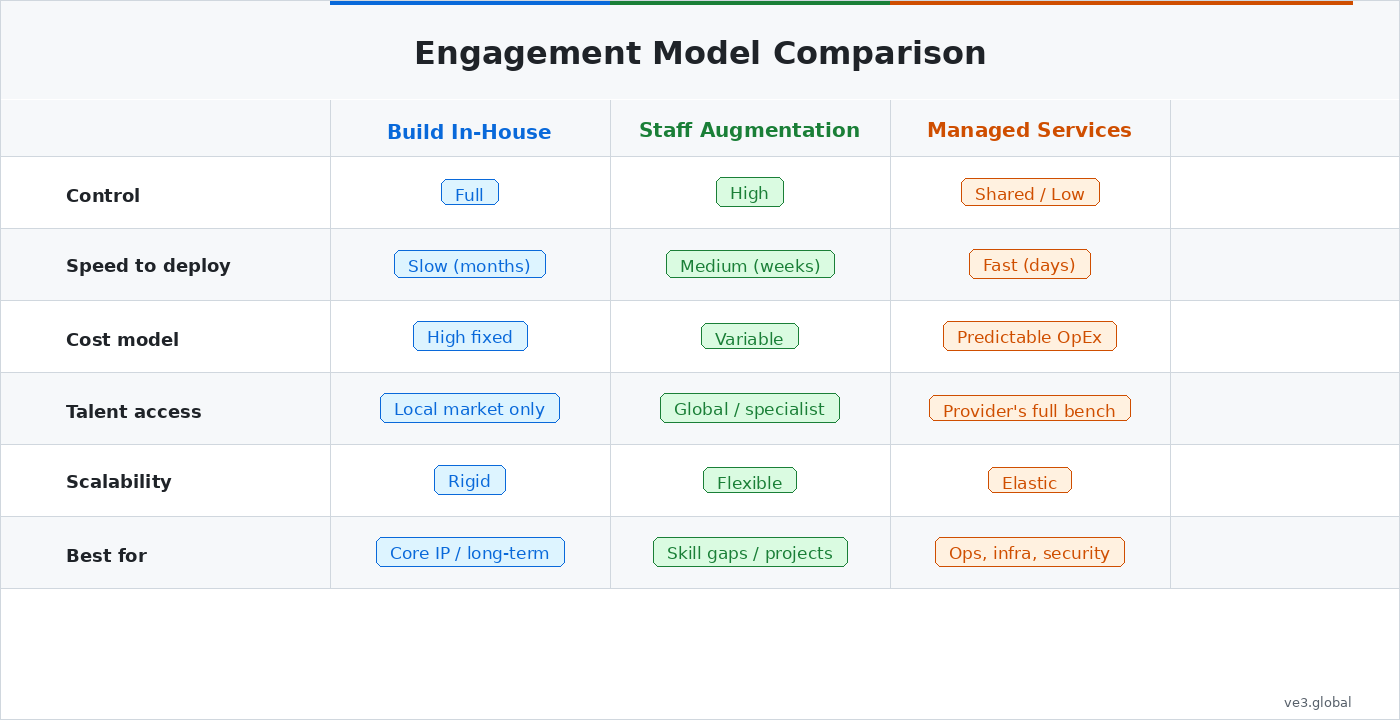
What’s Driving the Decision in 2026
The Talent Shortage Is Structural, Not Cyclical
Many IT leaders still treat the skills gap as a hiring problem they can solve with enough patience or salary inflation. The data does not support this view. Demand for software engineering roles is growing at twice the rate of the average US occupation. The cybersecurity industry alone faces a global gap of four million professionals. AI and cloud roles are inflating at 15–20% annually in salary terms — and still go unfilled for months.
This is not a temporary tightness. It is a structural imbalance between the pace of technology adoption and the pipeline of people trained to support it. Organisations that plan their IT resourcing model around this reality rather than hoping it resolves will consistently outperform those that don’t.
AI Is Reshaping What ‘In-House’ Means
The shift from AI experimentation to AI in production has created a new tier of demand: engineers who can operate AI systems at scale, maintain model performance, manage data pipelines, and ensure governance. These professionals are scarce and expensive. By 2026, demand for AI specialists exceeds supply by 3.2 to 1 globally.
At the same time, AI is changing what managed services providers can deliver. AIOps platforms that ingest metrics, logs, and traces from every infrastructure layer — then correlate and resolve issues automatically — now reduce mean time to recovery by 60–75% for common incident types. The ceiling for managed services quality has risen significantly, making it a more credible option for functions that previously required specialist in-house teams.
Cost Predictability Has Become a Board-Level Priority
In volatile economic conditions, the capital expenditure model of building large in-house teams creates a rigid cost structure that is difficult to adjust quickly. Managed services convert unpredictable emergency IT spend into predictable operational expense. Staff augmentation allows teams to scale with project demand without committing to permanent headcount. Both models appeal to finance leadership precisely because they decouple capability from fixed cost.
The shift is visible in procurement: 35% of organisations now use internal talent marketplaces focused on project-based work, up from 25% in 2024. Outcome-based contracts where providers are paid for results rather than hours have gone from niche to mainstream.
📊 Market Perspective
The global outsourcing market is on track to reach $450 billion by end of 2026. More significant than the size is the shift in motivation: access to specialised skills has overtaken cost savings as the primary driver for outsourcing decisions, according to Auxis and Deloitte research.
How to Choose: A Practical Framework
The most effective IT organisations in 2026 don’t choose one model — they apply each one deliberately, based on function type and strategic importance. Here is a framework for making that call.
Ask Three Questions About Each Function
1. Is this a source of competitive differentiation?
If the answer is yes — if this capability is part of what makes your products or services distinctive in the market — build it in-house. Keep the institutional knowledge. Invest in the people. This is where permanent headcount earns its cost.
If the answer is no, or if the function is operational rather than strategic, you have no strong reason to bear the full cost and management burden of internal ownership.
2. Is the need continuous or periodic?
Ongoing operational functions — infrastructure management, security monitoring, end-user support — suit managed services. The provider builds the process, the tooling, and the team. You benefit without carrying the overhead.
Periodic or project-based needs suit augmentation. You bring in specialists for a defined scope, then scale back. No redundancy, no long recruitment cycles.
3. Does the skill exist in your local market at a viable cost?
If you need a cloud security architect and there are three candidates in your city, all at salaries that strain your budget, augmentation or managed services is almost certainly the faster and more cost-effective path. The best organisations do not limit their talent search to commuting distance — they design their operating model around where the talent actually exists.
✔ Decision Principle
Build what differentiates you. Augment what requires specialist depth for defined periods. Manage what is operational, continuous, and provider-agnostic. Most IT teams need all three, applied to different functions.
Common Mistakes to Avoid
Defaulting to ‘Build’ Out of Habit
Many technology organisations have a cultural bias toward hiring. It feels like control. It feels like commitment. But building in-house for functions that would be better managed or augmented creates bloated headcount, slow response times, and capability gaps in the areas that actually matter — because the budget is absorbed by the wrong places.
Outsourcing Without Governance
Managed services contracts that lack clear SLAs, escalation paths, and regular performance reviews quickly become the worst of both worlds: you’ve lost internal knowledge, but you haven’t gained the accountability you expected. The model only works when the relationship is actively managed. Designating an internal owner for every managed service engagement is non-negotiable.
Treating Augmentation as a Permanent Workaround
Staff augmentation is a tool for specific gaps and defined timelines. Organisations that use it to indefinitely defer strategic hiring decisions end up with high contractor costs, inconsistent quality, and no internal capability development. If an augmented role has been running for 18 months with no plan to change the model, it is probably a strategic hire that hasn’t been made.
Ignoring the Hidden Cost of Vendor Dependence
Managed services create switching costs. Over time, institutional knowledge migrates to the provider. This is manageable — but it requires deliberate planning. Effective governance includes regular documentation requirements, knowledge transfer processes, and contract structures that give you viable exit options.
What the Best IT Operating Models Look Like Now
Across sectors, the organisations managing IT most effectively in 2026 share a common architecture:
- A lean but senior in-house team that owns architecture decisions, vendor relationships, and the functions closest to their core product or data.
- Augmented specialists brought in for defined projects or to fill skill gaps in areas like AI engineering, cloud-native development, and advanced security integrated into internal workflows rather than treated as separate workstreams.
- Managed services covering infrastructure, networking, endpoint management, and security operations with SLA-driven accountability and AIOps-powered monitoring that delivers proactive resolution rather than reactive firefighting.
- Outcome-based contracts that align provider incentives with business results, not billable hours.
This is not a radical restructuring it is a deliberate allocation of resource and responsibility based on what each part of the IT estate actually requires. The shift from reactive cost centre to strategic orchestrator, which analysts describe as the defining change in enterprise IT in this period, comes from getting those allocations right.
The Bottom Line
The question is no longer ‘build or buy.’ It is: which model fits this function, at this stage, in this market?
Build where it counts. Augment where speed and specialisation matter. Manage what is operational and continuous. Done deliberately, this isn’t outsourcing it’s architecture.
The organisations that will win on technology in the years ahead are not the ones that tried to own everything. They are the ones that were honest about where their competitive advantage actually lives — and structured everything else around making that advantage as effective as possible.
About VE3
VE3 is a global technology and enterprise AI consultancy helping organisations navigate complex IT decisions across cloud, data, and AI. Our advisory and managed delivery capabilities span strategy through execution so clients can build what matters, augment where they need depth, and trust us to manage what keeps them running.

.png)
.png)


